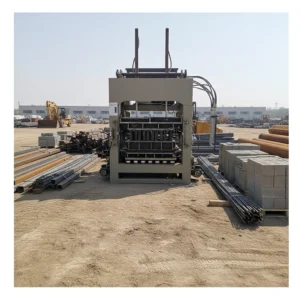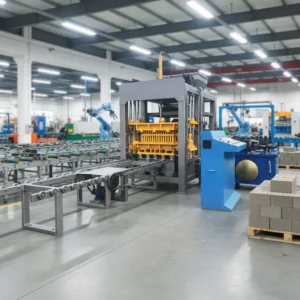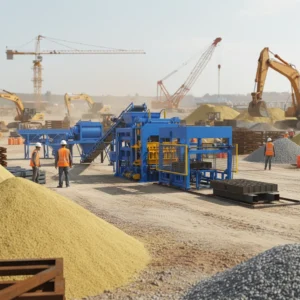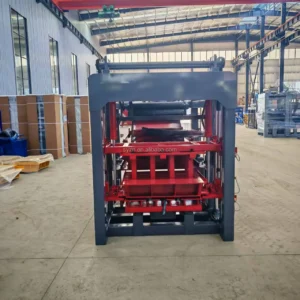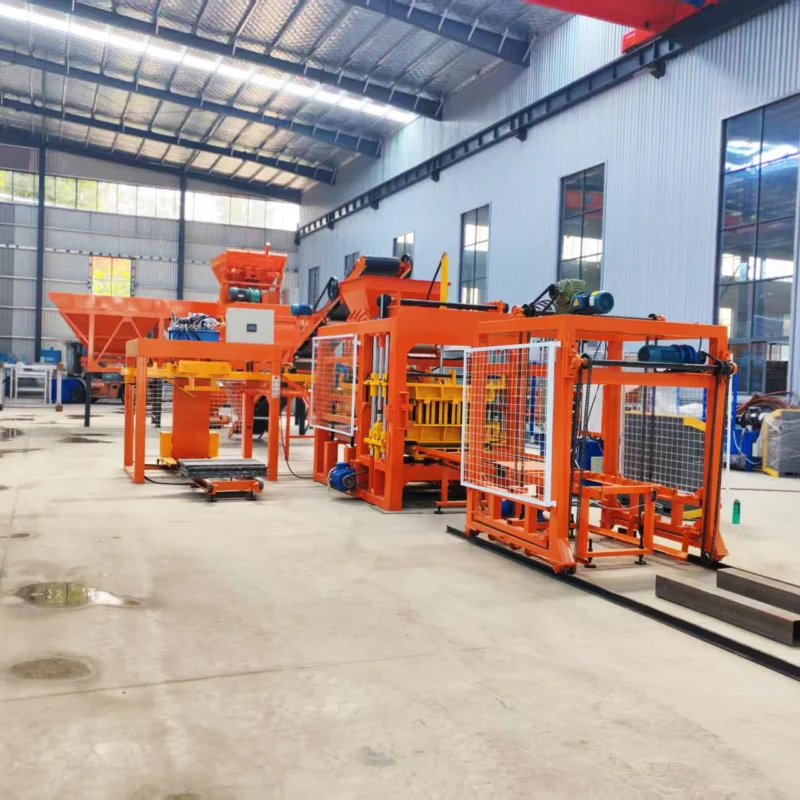
Integrated Line Synchronization — Every station in this QT6-15 block production line is timed to the press cycle, preventing material bottlenecks that silently erode daily output.
Technical Specifications
| Parameter | Value |
|---|---|
| Model | QT6-15 |
| Product Type | Hydraulic Concrete Block Making Machine |
| Overall Dimensions (L×W×H) | 8200×1700×2950 mm |
| Vibration Frequency | 0-60 Hz |
| Vibration Form | Platform Vibration |
| Vibration Force | 45 kN |
| Moulding Mode | Automatic loading, vibration moulding |
| Pallet Size | 880×850 mm |
| Molding Cycle | 15-20 s (standard blocks); 20-25 s (pavers) |
| Overall Power | 37 kW |
| Total Mass | 7 T |
| Demolding Method | Hydraulic |
| Control System | PLC with touch screen interface and fault diagnosis |
| Hydraulic System | Independent integrated hydraulic station |
| Output (Hollow block 400×200×200 mm) | 1080-1440 pcs/hour (basis: 6 pcs/mould, 15-20 s cycle) |
| Output (Hollow block 400×150×200 mm) | 1440-1920 pcs/hour (basis: 8 pcs/mould, 15-20 s cycle) |
| Output (Solid brick 240×115×53 mm) | 5760-7680 pcs/hour (basis: 32 pcs/mould, 15-20 s cycle) |
| Output (Rectangular paving brick 200×100×60 mm) | 2160-2880 pcs/hour (basis: 21 pcs/mould, 20-25 s cycle) |
| Output (Zigzag paving brick 225×112.5×60 mm) | 2160-2880 pcs/hour (basis: 15 pcs/mould, 20-25 s cycle) |
| Compressive Strength of Blocks | >15 MPa |
| Recommended Factory Area | 1200 m² |
Application Suitability
| Application | Material or Output |
|---|---|
| Hollow block production | Crushed stone, sand, cement, and waste ash aggregates |
| Solid brick manufacturing | Fly ash, slag, and local aggregate blends with adjustable cement dosage |
| Rectangular paving brick production | High-density aggregate mixes requiring 20-25 s cycle times |
| Zigzag interlocking paver production | Interlocking format moulds with platform vibration compaction |
| On-site contractor block plants | Mobile plant setups feeding directly into local housing projects |
What "1,440 Blocks per Hour" Leaves Out of Your Line Calculation
The press never sets the daily output alone — the slowest upstream or downstream station does.
When I first started walking customers through line layouts, I noticed a pattern: buyers would fixate on the QT6-15 cycle time and multiply it across an eight-hour shift, arriving at numbers the finished product yard could never confirm. The Hydraulic Block Machine production line only reaches its rated capacity when the mixer discharge, pallet feeder, and stacker all complete their routines within the same 15-20 second window. If the mixer takes 25 seconds per batch while the press finishes a cycle in 18, the press sits idle for seven seconds every cycle. Over a shift, those gaps compound into thousands of missing blocks [NEED_CITE: cycle synchronization impact on daily block output].
Matching Every Station to the Press Cadence
The QT6-15 completes a standard hollow block cycle in 15 to 20 seconds and a paving brick cycle in 20 to 25 seconds. A Hydraulic Block Machine production line built around this press must ensure the raw material batch mixer discharges a full hopper load within that same window. The pallet feeder must advance, position, and retract without forcing the press to wait, and the wet-side stacker must clear cured pallets before the next round arrives from the press.
Where Line Bottlenecks Typically Hide
Most bottlenecks in a block plant do not occur at the press itself. They surface at the transition points: the mixer-to-hopper transfer, the pallet return conveyor, and the green-product stacking station. If the pallet return loop is undersized, finished blocks pile up on the press table and the operator must intervene manually. I have seen plants where the entire Hydraulic Block Machine production line ran at roughly two-thirds of press capacity simply because the curing rack handler could not keep pace [NEED_CITE: common bottleneck stations in block production lines].
Reading the Specs Against Your Local Conditions
The 45 kN vibration force and 0-60 Hz adjustable frequency on the QT6-15 are designed to compact a range of aggregate blends, from coarse crushed stone to finer ash-based mixes. Platform vibration distributes force across the full 880×850 mm pallet area, which matters when you switch between hollow blocks and denser paving formats. The independent hydraulic station sits isolated from the main vibration frame, keeping hydraulic seals and valves away from the dust and shock that degrade shared systems. Compressive strength above 15 MPa is achievable when the vibration profile and hydraulic pressure are matched to your specific mix design and cement dosage.
The Cost of Ignoring Pallet and Curing Alignment
Choosing a pallet size without checking your curing yard dimensions and forklift fork width leads to problems that show up weeks after commissioning. The 880×850 mm pallet on the QT6-15 must fit your existing rack spacing and handling equipment. When pallets are too large for the curing racks, workers restack blocks by hand — a step that adds labour, damages green products, and defeats the purpose of an automatic stacking station. Buyers who skip this cross-check often discover the mismatch only after the first container arrives [NEED_CITE: pallet sizing and curing yard compatibility in block plants].
Why Sourcing the Full Line from One Supplier Matters
Block machinery is our single focus, so the QT6-15 press, its moulds, pallets, and handling equipment are specified as one matched system rather than assembled from separate vendors. The line configuration is set against your actual mix design and local aggregate, not pulled from a catalogue default. Mould design covers the formats your market actually sells, with custom drawings available when standard formats do not fit. Automation level is selectable — you can start with semi-automatic pallet handling and add stacking or cubing later without replacing the press. Installation includes operator training so your crew understands cycle timing from day one.
Documentation & Verification
- Line layout drawing with capacity calculation stated per block format and assumed cycle time
- Machine specification sheet covering vibration force, hydraulic ratings, and PLC configuration
- Mould drawing and format list matching your target block dimensions
- Pallet specification cross-referenced to your curing rack and forklift dimensions
- Voltage, frequency, and PLC display language confirmation document before production
- Factory test record on your specified block format before dispatch
Installation, Commissioning & Support
- Foundation plan aligned to the 8200×1700 mm machine footprint and 7 T operating mass
- Dedicated power circuit sized for the 37 kW total load at your confirmed voltage and frequency
- Dismantling and container loading plan with reassembly sequence for on-site crews
- PLC touch screen configured in your operator language before commissioning begins
- Hands-on operator training covering mould change, cycle adjustment, and fault diagnosis routines
- Wear parts and mould list provided with recommended replacement intervals
Before You Send an Inquiry
To size a Hydraulic Block Machine production line around the QT6-15, we need to know which block formats you plan to produce and the daily volume you are targeting. Share your local aggregate type and cement availability so the mix design can be factored into the cycle calculation. Confirm your site voltage, frequency, and preferred PLC language, along with the curing yard layout and forklift specifications you already have on site.
Frequently Asked Questions
Q: How is daily output calculated per block format, and what cycle time does each figure assume?
A: Every output figure we quote is tied to a specific block format and its corresponding mould cavity count. For hollow blocks at 400×200×200 mm, the calculation assumes 6 pieces per mould and a 15-20 second cycle. Paving bricks use a longer 20-25 second cycle. Daily output is then derived from the hourly rate multiplied by your planned shift hours, minus allowance for pallet changes and routine stops.
Q: What supporting equipment is included to match the press cycle?
A: The line configuration covers raw material feeding, the batch mixer, pallet feeder, automatic stacker, and curing rack handling. Each station is timed so its operating cycle completes within the QT6-15 press cycle of 15-25 seconds. This prevents the press from idling while waiting for material, pallets, or stacker clearance.
Q: How does the 880×850 mm pallet size align with my existing curing racks and forklift?
A: Before production begins, we cross-reference the 880×850 mm pallet against your curing rack spacing, rack load capacity, and forklift fork width. If your existing racks are narrower, we adjust the pallet specification or recommend rack modifications so that pallets move from the press to the curing yard without manual restacking.
Q: What voltage, frequency, and PLC language options are available?
A: The QT6-15 electrical system is configurable for your local grid voltage and frequency. The PLC touch screen interface can be set to your preferred operator language before the machine leaves our factory. We confirm these details in writing during the order stage to avoid commissioning delays on site.
Q: How does the independent hydraulic station reduce downtime?
A: The hydraulic station on the QT6-15 is mounted separately from the main vibration frame, keeping valves and seals away from dust ingress and mechanical shock. This isolation extends service intervals for hydraulic components and means a seal replacement does not require dismantling the press structure, keeping maintenance downtime shorter during routine servicing.