
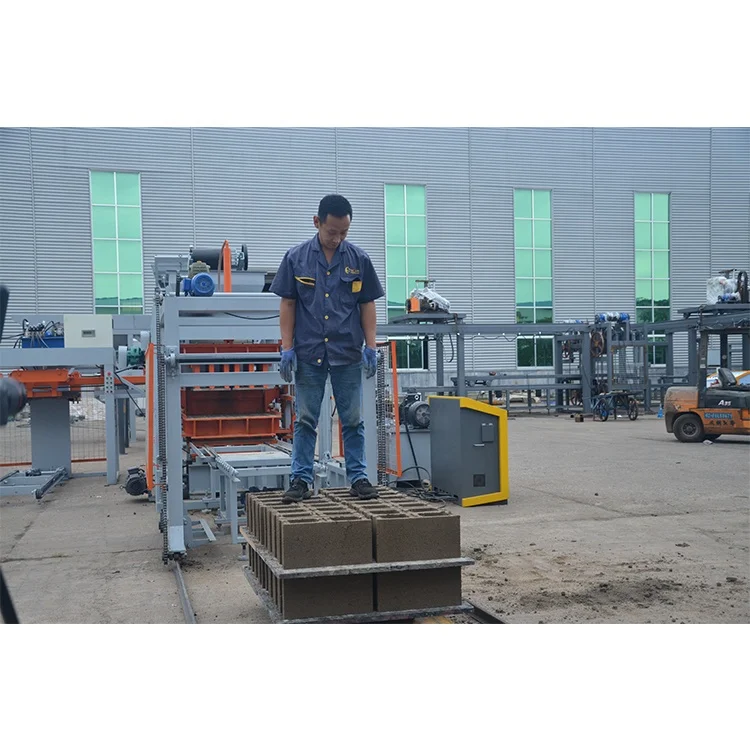
Line-Synchronized Press Integration — The QT6-15 block production line is configured so raw material feeding, mixing, pallet circulation, and stacking stations match the press cycle, preventing the bottleneck effect where downstream stations leave the press idle.
Technical Specifications
| Parameter | Value |
|---|---|
| Product Type | Hollow Block Making Machine |
| Model | QT6-15 |
| Overall Dimensions (L×W×H) | 8200×1700×2950 mm |
| Vibration Frequency | 0-60 Hz (adjustable) |
| Vibration Form | Platform Vibration |
| Moulding Mode | Automatic loading with vibration moulding |
| Pallet Size | 880×850 mm |
| Molding Cycle | 15-20 s (standard block formats) |
| Overall Power | 37 kW |
| Vibration Force | 45 kN |
| Total Mass | 7 T |
| Demolding Method | Hydraulic |
| Recommended Factory Area | 1200 m² |
| Control System | PLC with touch screen and fault diagnosis |
| Hydraulic System | Independent integrated hydraulic station |
| Output Capacity (Hollow block 400×200×200 mm) | 6 pcs/mould, 1080-1440 pcs/h, 8640-11520 pcs/8 hr |
| Output Capacity (Hollow block 400×150×200 mm) | 8 pcs/mould, 1440-1920 pcs/h, 11520-15360 pcs/8 hr |
| Output Capacity (Solid brick 240×115×53 mm) | 32 pcs/mould, 5760-7680 pcs/h, 46080-61440 pcs/8 hr |
| Output Capacity (Rectangular brick 200×100×60 mm) | 21 pcs/mould, cycle 20-25 s, 2160-2880 pcs/h, 17280-23040 pcs/8 hr |
| Output Capacity (Zigzag brick 225×112.5×60 mm) | 15 pcs/mould, cycle 20-25 s, 2160-2880 pcs/h, 17280-23040 pcs/8 hr |
| Compressive Strength of Blocks | >15 MPa |
| Raw Material Adaptability | Various waste ash, slag, and aggregates with reduced cement dosage |
Application Suitability
| Application | Material or Output |
|---|---|
| Hollow Block Production Plants | Crushed stone, fly ash, slag, and cement blends for 400×200×200 mm and 400×150×200 mm hollow blocks |
| Paving and Interlocking Brick Lines | Fine aggregates and pigments for 200×100×60 mm rectangular pavers and 225×112.5×60 mm zigzag bricks |
| Solid Brick Manufacturing | Dense aggregate mixes for 240×115×53 mm solid bricks exceeding 15 MPa compressive strength |
| On-Site Contractor Production | Local waste materials and reduced-cement mixes for project-specific block formats |
Why the "Pieces Per Hour" Quotation Often Fails the Plant Owner
Quoted capacity means nothing if pallet handling and stacking are excluded from the line design.
I have seen block plants where the press was rated for high output, but the pallet feeder could not keep up and the stacking station relied on manual labor. The result was that the turnkey block making plant sat idle for seconds between cycles, and real daily output fell far short of the brochure figure. The press is only as fast as the slowest station feeding or clearing it [NEED_CITE: synchronization requirements in automated production lines]. When a buyer focuses only on the press cycle without auditing upstream and downstream stations, the entire block production line operates below its designed rhythm.
Upstream Feeding and Mixing Must Match the Press Rhythm
The QT6-15 completes a molding cycle in 15-20 seconds for standard hollow block formats. That means the mixer must discharge a fresh batch to the hopper and the feeder must deliver raw material within that same window. If the mixer is undersized or the conveyor belt runs too slowly, the press waits. In a block production line, every second of press idle time compounds across an eight-hour shift. Specifying the mixer capacity and conveyor speed against the press cycle is not optional — it is the foundation of a synchronized turnkey block making plant.
Downstream Pallet Circulation and Curing Rack Alignment
The 880×850 mm pallet size on the QT6-15 is the reference dimension that every downstream station must match. Pallet feeders, return conveyors, curing rack slots, and the forklifts used to move stacked cubes all need to accommodate this footprint. A mismatch here means pallets jam on the return line, curing racks cannot accept the loaded pallets, or forklifts cannot lift the stacked output. I have watched plants lose hours each shift to pallet jams that trace back to a curing rack specified without checking the pallet dimension [NEED_CITE: pallet handling standards in block manufacturing].
Independent Hydraulic Station for Line Reliability
The QT6-15 uses an independent integrated hydraulic station that sits apart from the main machine vibration and dust. In a block production line running continuously, hydraulic oil temperature and contamination are the leading causes of cycle drift. Isolating the hydraulic station means the press maintains consistent pressure across every cycle, so downstream stacking and curing stations receive uniform blocks at predictable intervals. The PLC touch screen with fault diagnosis sends synchronization signals to upstream batching and downstream stacking, enabling the entire turnkey block making plant to operate as one coordinated system.
How Vibration Frequency and Hydraulic Pressure Shape Block Density
The 0-60 Hz adjustable vibration frequency and 45 kN vibration force work together with the hydraulic demolding system to compact the mix into the mould cavity. Higher frequency is not always better — a fly ash mix with fine particles responds to a different vibration profile than a coarse crushed stone mix. The platform vibration form distributes force evenly across the 880×850 mm pallet area, so blocks at the edges of the mould receive the same compaction as those in the center. This consistency is what allows the stacking station to handle uniform block dimensions without jamming or misalignment. The 37 kW overall power rating supports sustained vibration and hydraulic pressure throughout a full shift without thermal derating.
The Cost of Ignoring Line Integration
When a buyer purchases a press without specifying the surrounding stations, the gaps appear quickly. A pallet feeder that runs slower than the press cycle creates micro-stoppages that add up to thousands of lost blocks per shift. A stacking station that requires manual intervention turns an automated block production line into a semi-manual operation, increasing labor costs and introducing breakage from handling. Curing racks that do not match the pallet size force the plant to re-stack blocks before curing, doubling the handling effort. These are not equipment failures — they are specification failures that originate in the quotation stage [NEED_CITE: common causes of block plant underperformance].
Why This Configuration Approach Works
Block machinery is the single focus here, so the QT6-15 is specified as part of a matched system where the machine, mould, pallet, and handling equipment are designed together rather than assembled from separate suppliers. The configuration is set against the buyer’s actual mix design, local aggregate, and target block format. Mould design covers the formats the buyer’s market actually sells, with custom drawings available. Automation level is selectable, so a plant can start semi-automatic and add stacking and cubing later. Installation includes on-site commissioning with operator training so the entire line runs to cycle from day one.
Documentation & Verification
- Line layout drawing with capacity calculation stated per block format and matched cycle times
- Machine specification sheet covering QT6-15 press, hydraulic station, and PLC control configuration
- Pallet specification confirming 880×850 mm size and material against your curing area and forklift fleet
- Voltage, frequency, and PLC display language confirmation sheet signed before production
- Hydraulic and electrical schematics for integration with existing plant utilities
- Factory test record on your target block format before dispatch
Installation, Commissioning & Support
- Foundation plan based on 8200×1700×2950 mm overall dimensions and 7 T total mass
- Power supply confirmation for 37 kW overall power with dedicated circuit and correct voltage
- Machine dismantling for container loading and reassembly sequence at your site
- PLC touch screen commissioning with fault diagnosis calibration and cycle time tuning
- Operator training on mould change procedure and platform vibration frequency adjustment
- Wear parts list covering hydraulic seals, vibration motor brushes, and mould liners
What to Include in Your Inquiry
To configure the QT6-15 within a complete block production line, share your target block format and the daily output you need for that specific format. Include the local raw materials available — aggregate type, fly ash or slag source, and cement grade — so the mix can be matched to the press. Specify your existing curing area dimensions and forklift fleet so the 880×850 mm pallet system is confirmed compatible. State your local voltage, frequency, and the language you need on the PLC display to avoid delays during commissioning.
Frequently Asked Questions
Q: How do I verify the real daily output of the QT6-15 when the full line is included?
A: Real daily output depends on every station in the block production line keeping pace with the press. Request a line layout that states the capacity per block format — for example, 8640-11520 pieces per 8-hour shift for 400×200×200 mm hollow blocks — and shows the cycle time at each station from feeding through stacking and curing. The press cycle alone does not determine output.
Q: What pallet size and material should I choose for the QT6-15?
A: The standard pallet size is 880×850 mm, and this dimension must match your curing rack slots, pallet return conveyors, and forklift fork spacing. Material choice depends on your curing environment — bamboo, PVC, and steel pallets each have different lifespans under steam or ambient curing conditions. Confirm these details before the line ships.
Q: Which upstream and downstream stations must match the press cycle time?
A: The raw material feeder, mixer discharge, pallet feeder, and stacking station must all complete their actions within the QT6-15 molding cycle of 15-20 seconds for standard formats. Any station that takes longer becomes the bottleneck, and the press sits idle. The turnkey block making plant quotation should list cycle times for every station.
Q: What voltage, frequency, and PLC language confirmations are needed before shipment?
A: Provide your site voltage and frequency so the 37 kW power system is configured correctly. Specify the PLC touch screen display language for your operators. These confirmations must be signed off before production begins — changing them after the electrical panel is built causes commissioning delays and additional rewiring costs on site.
Q: How is the independent hydraulic station maintained in a dusty block plant?
A: The independent integrated hydraulic station is positioned away from the main press vibration and dust zone. Regular maintenance involves checking oil temperature, replacing filters at scheduled intervals, and inspecting seals. The hydraulic and electrical schematics provided with the QT6-15 show all service points and recommended intervals for your block production line environment.



