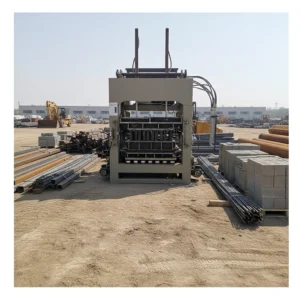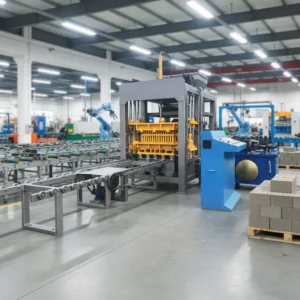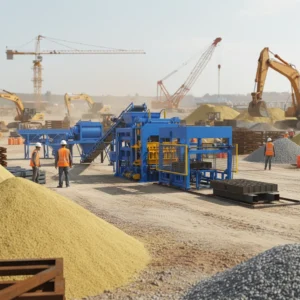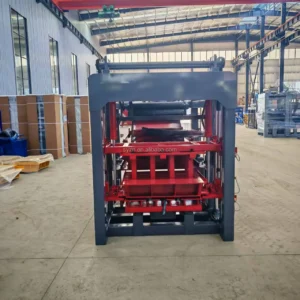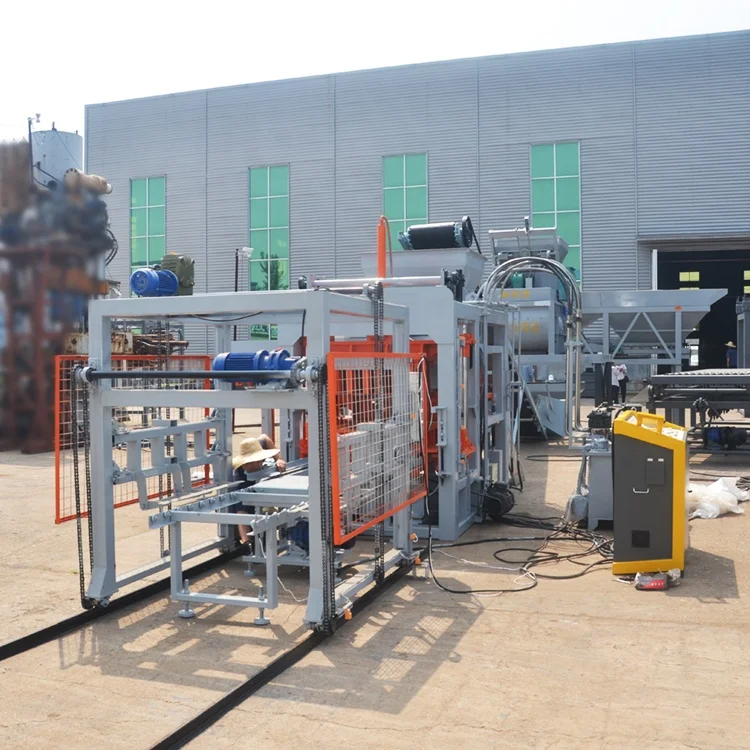
Integrated Hydraulic Isolation — The independent hydraulic station sits away from platform vibration and dust, maintaining consistent pressure through continuous shifts on the QT6-15 automatic block making machine turnkey line.
Technical Specifications
| Parameter | Value |
|---|---|
| Model | QT6-15 |
| Product Type | Automatic Hydraulic Concrete Block Making Machine |
| Overall Dimensions | 8200 × 1700 × 2950 mm |
| Total Mass | 7 T |
| Overall Power | 37 kW |
| Vibration Force | 45 kN |
| Vibration Frequency | 0–60 Hz (adjustable) |
| Vibration Form | Platform Vibration |
| Moulding Mode | Automatic loading, vibration moulding |
| Demolding Method | Hydraulic |
| Pallet Size | 880 × 850 mm |
| Molding Cycle | 15–20 s (basis not stated in source — confirm block format, material, thickness) |
| Control System | PLC controlled with touch screen interface |
| Hydraulic System | Independent integrated hydraulic station |
| Block Compressive Strength | More than 15 MPa |
| Output: Hollow Block 400×200×200 mm | 1,080–1,440 pcs/hour; 8,640–11,520 pcs/8 hr |
| Output: Hollow Block 400×150×200 mm | 1,440–1,920 pcs/hour; 11,520–15,360 pcs/8 hr |
| Output: Solid Brick 240×115×53 mm | 5,760–7,680 pcs/hour; 46,080–61,440 pcs/8 hr |
| Output: Rectangular Paver 200×100×60 mm | 2,160–2,880 pcs/hour (cycle 20–25 s); 17,280–23,040 pcs/8 hr |
| Output: Zigzag Paver 225×112.5×60 mm | 2,160–2,880 pcs/hour (cycle 20–25 s); 17,280–23,040 pcs/8 hr |
| Raw Material Adaptability | Waste ash, slag, various aggregates; adjustable cement dosage |
| Factory Area (line layout reference) | 1,200 m² |
Application Suitability
| Application | Material or Output |
|---|---|
| Hollow block production for load-bearing walls | Crushed stone, sand, cement, and industrial ash blends |
| Solid brick manufacturing for masonry infill | Fine aggregate with higher cement dosage for 15+ MPa strength |
| Rectangular and zigzag paving brick runs | Coarse aggregate base mix with pigmented face layer |
| Kerbstone and interlocking brick formats | Graduated aggregate with adjusted vibration frequency |
| Waste-material brick production | Fly ash, slag, and construction debris with cement binder |
Why the Press Is Only Half the QT6-15 Block Machine Production Line
A block press that outpaces its mixer or waits on pallets will never reach the cycle rate printed on the nameplate.
Most quotations I have reviewed list the press output without mentioning the batching station, pallet feeder, stacker, or curing rack handler. The buyer discovers after commissioning that a mixer feeding the press every 18 seconds cannot keep up with a 15-second cycle, so the line idles every third or fourth mould. Pallet return conveyors sized for a slower machine create a bottleneck at the stacker. [NEED_CITE: line station cycle matching principles in concrete block production] The QT6-15 block machine production line is specified as a system: raw material feeding, mixing, pallet feeding, automatic stacking, and curing rack handling are all matched to the 15–20 second press cycle so no station waits on another.
Every Station Must Match the Press Cycle
When configuring the QT6-15 block machine production line, the first calculation is the press cycle for each target block format. A hollow block at 15 seconds per mould demands a mixer that delivers a batch every 45–60 seconds and a pallet feeder that inserts a board in under 3 seconds. If the pallet return conveyor runs slower than the stacker release, wet blocks queue on the conveyor and get damaged. The automatic block making machine turnkey configuration specifies each station’s cycle time against the press so upstream and downstream never become the limiting factor.
From Raw Feed to Cured and Stacked Product
The supporting equipment is where daily throughput is won or lost. A raw material feeder with adjustable gate openings controls aggregate ratios before the mixer, reducing batch variation. The pallet feeder must accept 880 × 850 mm boards and present them within the press cycle window. After demolding, the stacking station lifts wet blocks onto curing racks, and the rack handler indexes full racks into the curing area. [NEED_CITE: pallet handling and curing rack logistics in block plants] When any of these stations is omitted from the quotation, the operator handles pallets and stacking manually — and the "automatic" press runs at manual speed.
Reading the Numbers Behind the Moulding Cycle
The 45 kN vibration force and adjustable 0–60 Hz frequency determine how well the mix compacts around the aggregate. Heavier, coarser aggregate needs higher force and lower frequency to consolidate without segregation; fine sand mixes need the opposite. The independent hydraulic station keeps demolding pressure stable regardless of vibration transfer from the platform — a shared hydraulic unit would see pressure fluctuation every time the vibrator engages. Block compressive strength above 15 MPa is achievable only when vibration force, hydraulic pressure, and mix design are all set for the buyer’s actual material. The 37 kW overall power rating must be matched with correct voltage and frequency for the destination market before the electrical panel is built.
When the Supporting Equipment Is Missing from the Quote
I once visited a plant where the press was running perfectly but the line was producing less than half its rated output. The buyer had been quoted the press alone; pallets were carried back by hand, and wet blocks were stacked on the floor to cure. The 7-tonne machine sat idle for seconds between each cycle waiting for a pallet to be placed. [NEED_CITE: real-world throughput gap between quoted and actual block line output] That plant owner paid for an automatic press and received a semi-automatic workflow. Specifying the QT6-15 block machine production line with every supporting station itemized prevents this gap between quoted cycle rate and actual daily throughput.
What Sets This Line Configuration Apart
Block machinery is our single focus, so the press, mould, pallet, and handling equipment are specified as one matched system rather than assembled from separate suppliers. Each line layout starts with the buyer’s target block format and local aggregate — not a catalogue default. Mould design covers the formats the buyer’s market actually sells, including custom drawings for special shapes. The automation level is selectable, so a plant can begin with semi-automatic pallet handling and add the full stacking and cubing system later. Pallet size and material are confirmed against the buyer’s existing curing area and forklift capacity before the line design is finalized. Installation support includes operator training on every station, not just the press.
Documentation & Verification
- Line layout and capacity calculation stating the block format assumed for each output figure
- Machine specification sheet with confirmed voltage, frequency, and PLC display language
- Mould drawing and format list for every block type in the production plan
- Pallet specification covering size, material, and thickness matched to curing rack and forklift
- Factory test record using the buyer’s sample raw material before dispatch
- Hydraulic and electrical schematic for local maintenance reference
Installation, Commissioning & Support
- Foundation plan based on 8200 × 1700 mm footprint and 7-tonne total mass for stable press operation
- Dedicated power circuit sized for 37 kW overall power with confirmed local voltage and frequency
- Independent hydraulic station positioned clear of the curing area for dust-free maintenance access
- PLC touch screen configured in the operator’s language before first production run
- Vibration frequency and hydraulic pressure tuned on-site using the buyer’s actual mix design
- Pallet return and stacking station commissioning verified against full press cycle speed
Before You Request a Quote
To configure the QT6-15 block machine production line correctly, share your target block formats with dimensions, required daily output, and the local raw materials you can source. Confirm your workshop area, ceiling height, existing forklift capacity, and local voltage and frequency. Let us know whether you need the full automatic block making machine turnkey package or are upgrading the press within an existing line.
Frequently Asked Questions
Q: How is line capacity calculated, and which block format does each output figure assume?
A: Each output figure is tied to a specific block dimension. For example, 1,080–1,440 pieces per hour applies only to 400×200×200 mm hollow blocks, while 2,160–2,880 pieces per hour applies to 200×100×60 mm rectangular pavers at a 20–25 second cycle. The line layout document states the assumed format for every capacity number so there is no ambiguity between quoted and real throughput.
Q: Which supporting stations are included in the quotation, and where do cycle times need to match?
A: The quotation itemizes raw material feeder, mixer, pallet feeder, stacker, and curing rack handler alongside the QT6-15 press. Each station’s cycle time is listed and cross-checked against the press moulding cycle of 15–20 seconds. Where a station runs slower, the line capacity document flags it as the limiting factor so you can decide whether to upgrade that station or accept the reduced throughput.
Q: How do I confirm pallet size and material against my existing curing area and forklift?
A: The standard pallet is 880 × 850 mm. Before the line is finalized, we review your curing rack slot dimensions, forklift tine width, and stacking height. If your existing racks accept a different size, the pallet feeder and return conveyor are adjusted accordingly. Pallet material — bamboo, PVC, or steel — is chosen based on block weight and expected service life in your climate.
Q: What voltage, frequency, and PLC language options are available for my market?
A: Voltage and frequency are confirmed during the inquiry stage to match your local grid. The PLC touch screen interface is available in multiple display languages, selected before production begins. The electrical schematic provided with the line documentation reflects the exact voltage, frequency, and language configuration shipped, so local electricians can service the system without ambiguity.
Q: What is the factory footprint, and how should the line be laid out for material flow?
A: The stated factory area reference is 1,200 m², which covers the press, supporting stations, pallet storage, and curing rack zone. The line layout drawing shows material flow from raw feed through mixing, pressing, stacking, and curing — arranged so that forklifts and personnel paths do not cross. This layout is adapted to your building dimensions and door positions before equipment is shipped.