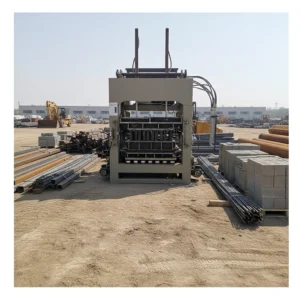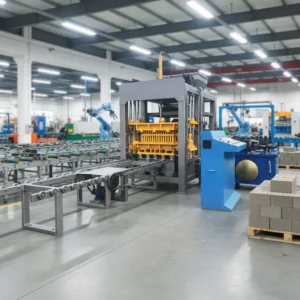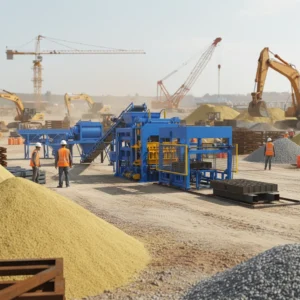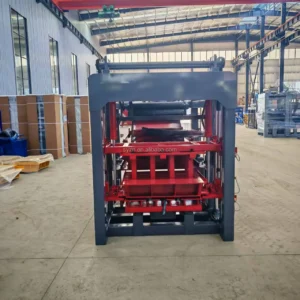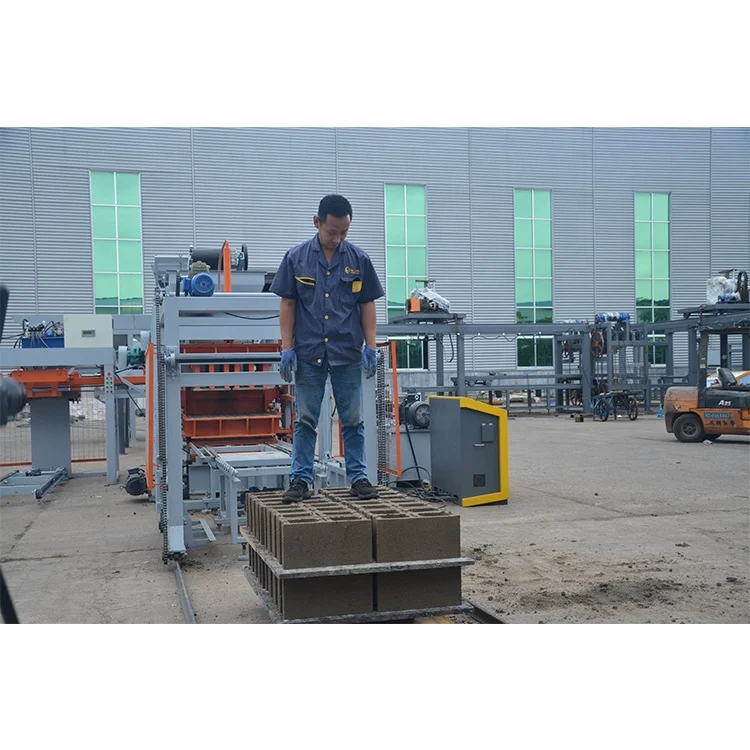
Matched Line Integration — every station from raw material feeding to stacking is timed against the QT6-15 press cycle so no single point holds back the entire output.
Technical Specifications
| Parameter | Value |
|---|---|
| Model | QT6-15 |
| Product Type | Automatic Hydraulic Press Block Making Machine |
| Overall Dimensions (L×W×H) | 8200×1700×2950 mm |
| Overall Power | 37 kW |
| Vibration Frequency | 0-60 Hz |
| Vibration Form | Platform Vibration |
| Vibration Force | 45 kN |
| Pallet Size | 880×850 mm |
| Moulding Mode | Automatic loading, vibration moulding |
| Demolding Method | Hydraulic |
| Molding Cycle | 15-20 s (basis to be confirmed) |
| Total Mass | 7 T |
| Control System | PLC with touch screen interface |
| Block Compressive Strength | > 15 MPa |
| Capacity – Hollow Block (400×200×200 mm) | 1080-1440 pcs/h (based on 6 pcs/mould, 15-20s cycle) |
| Capacity – Hollow Block (400×150×200 mm) | 1440-1920 pcs/h (based on 8 pcs/mould, 15-20s cycle) |
| Capacity – Solid Brick (240×115×53 mm) | 5760-7680 pcs/h (based on 32 pcs/mould, 15-20s cycle) |
| Capacity – Rectangular Paver (200×100×60 mm) | 2160-2880 pcs/h (based on 21 pcs/mould, 20-25s cycle) |
| Capacity – Zigzag Paver (225×112.5×60 mm) | 2160-2880 pcs/h (based on 15 pcs/mould, 20-25s cycle) |
| Raw Material Adaptability | Waste ash, slag, and various aggregates |
| Recommended Factory Area | 1200 m² |
| Warranty | 1 year for whole machine (excluding spare parts) |
Application Suitability
| Application | Material or Output |
|---|---|
| Hollow Block Production | Crushed stone, cement, and sand mixes for bearing and non-bearing walls |
| Solid Brick Manufacturing | Dense aggregate blends for structural masonry units |
| Rectangular Paver Production | Fine aggregate and cement for pedestrian and light-traffic paving |
| Zigzag/Interlocking Paver Output | Graded aggregate mixes for interlocking driveway and roadway surfaces |
| Industrial Waste Block Making | Fly ash, slag, and recycled aggregate blended with reduced cement dosage |
What a "Complete Line" Actually Means Around the QT6-15 Block Making Machine Production Line
The press is only as fast as the slowest station feeding it or clearing its output.
When I first started debugging block plants in the Pearl River Delta, I kept seeing the same pattern: the host machine ran fine on its own, but a pallet return conveyor lagging by a couple of seconds meant the press sat idle every few cycles. Buyers had paid for a certain output tier and wondered why the daily tally fell short. A QT6-15 block making machine production line only delivers its stated capacity when the mixer discharge rate, pallet feeder indexing speed, and stacking arm sweep are all calculated against the press cycle time — not quoted as isolated numbers [NEED_CITE: typical cycle time loss from upstream mismatch in block plants].
Upstream Stations That Keep the Press Fed
The raw material batching and mixing station must discharge a consistent batch volume within the window the QT6-15 press needs to complete one moulding cycle. If the mixer takes longer than the press cycle plus a small buffer, the press waits. We calculate mixer drum capacity and discharge gate speed against the 15-20 second moulding window so material arrives before the press signals for it, maintaining continuous operation throughout the shift.
Downstream Handling That Clears Output Without Delay
Once the QT6-15 block making machine production line press demoulds, the wet blocks on their pallets must move to the curing area before the next cycle begins. The pallet return conveyor, block stacker, and curing rack handler are each sized so their individual cycle times sit slightly below the press cycle. This prevents any downstream queue from propagating back to the press and forcing it into a hold state [NEED_CITE: pallet handling bottleneck impact on block line throughput].
Reading the Specifications Beyond the Press
Vibration force and hydraulic pressure together determine the green density of every block leaving the mould. The 45 kN platform vibration at frequencies up to 60 Hz compacts the aggregate matrix, while the hydraulic demolding system extracts the formed block without disturbing that compaction. If either force is mismatched to the buyer’s specific aggregate grading and cement content, compressive strength varies from batch to batch even though the machine settings remain constant.
The 880×850 mm pallet dimension is not an arbitrary choice — it dictates the curing rack slot width, the forklift tine spacing for moving stacked racks, and the floor area required per thousand blocks in the curing zone. Specifying pallet size independently of the existing curing infrastructure means buying new racks or re-pouring curing pads after the line arrives.
When Supporting Equipment Is Left Out of the Quote
A quotation listing only the press and moulds, without pallet feeders, stackers, or curing rack systems, shifts all downstream handling to manual labour. Buyers then discover that the cycle time they paid for cannot be sustained because workers cannot clear and return pallets fast enough to keep the press running continuously [NEED_CITE: labour dependency in block plants without automated handling].
Why Line Integration Matters at This Scale
Every supporting station around the QT6-15 block making machine production line is specified against the same block format assumptions used for the press capacity calculation. This means the capacity figures for hollow blocks, solid bricks, and pavers reflect the full line running in balance — not the press operating in isolation while workers scramble to keep up.
The control architecture extends beyond the press PLC. Pallet feeder indexing, mixer discharge timing, and stacker sweep sequences are coordinated through the same touch screen interface, so a single operator monitors the entire line from one station rather than running between separate control panels.
Shiyue configures each supporting station against the buyer’s actual site conditions — existing forklift capacity determines pallet material and weight limits, available curing area determines rack height and spacing, and local aggregate characteristics drive mixer selection and batching configuration.
The hydraulic station on the QT6-15 is mounted independently from the main frame, isolated from platform vibration and dust ingress. This separation protects valve blocks and pump seals during continuous operation and simplifies access during routine maintenance intervals.
Mould changeover procedures are factored into the line layout. Format switches require the pallet feeder guide rails and stacker gripper width to adjust alongside the mould itself, and the time required for a full format change across all stations is stated upfront rather than discovered during commissioning.
Documentation & Verification
- Line layout drawing with throughput matched per block format across all stations
- Pallet specification sheet cross-referenced to curing rack and forklift dimensions
- Hydraulic and electrical schematics showing integration points with site utilities
- Voltage, frequency, and PLC display language confirmation before production begins
- Factory test record documenting cycle times with the specified mould installed
Installation, Commissioning & Support
- Foundation plan accounts for 8200×1700 mm footprint and 7 T operating mass of the press
- Dedicated 37 kW power circuit specified with confirmed voltage and frequency for site
- Press and supporting stations arrive dismantled for container loading, reassembled on site
- Commissioning includes cycle timing verification across all line stations with buyer’s mould
- Operator training covers PLC fault diagnostics on the touch screen for press and line stations
- Wear parts list covers hydraulic seals, vibration motor bearings, and mould liner plates
Before You Send an Inquiry
To size the full line around the QT6-15 block making machine production line correctly, share the block format you plan to produce, the local aggregate and cement sources available, and the curing area dimensions on your site. Include the voltage and frequency at your facility, the forklift capacity you already have, and whether any upstream or downstream equipment from an existing plant will remain in service.
Frequently Asked Questions
Q: How is the cycle time of each upstream and downstream station matched to the QT6-15 press to avoid bottlenecks?
A: Each station — mixer discharge, pallet feeder, stacker, and curing rack handler — is calculated against the press moulding cycle for the specific block format you plan to produce. We state the assumed format in the line layout so you can verify throughput before the equipment is built.
Q: What supporting equipment is included in the quotation versus supplied separately?
A: The quotation lists every station from raw material feeding through stacking and curing rack handling. Any item that falls outside our supply scope is clearly marked, so you know exactly which components you need to source locally before the line arrives.
Q: How do we confirm pallet size and material against our curing area and forklift before the line is built?
A: We request your existing forklift capacity and curing rack dimensions early in the inquiry. The 880×850 mm pallet is then confirmed or adjusted so that pallet weight, rack slot spacing, and forklift tine width all align without requiring site modifications after delivery.
Q: What voltage, frequency, and PLC language options are available for our target market?
A: Voltage and frequency are confirmed before production begins to match your local supply. The PLC touch screen interface can be set to the operator language you specify, and this is documented in the electrical schematic provided with the machine.
Q: What is the recommended factory area and utility layout for a complete line around this press?
A: The press itself requires space within a recommended 1200 m² factory area that also covers raw material storage, mixing, curing racks, and finished block staging. We provide a line layout drawing showing utility connection points for water, power, and compressed air relative to the press position.