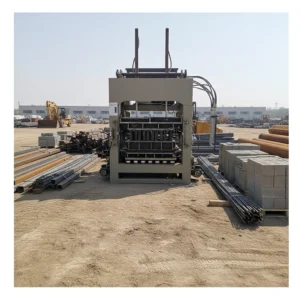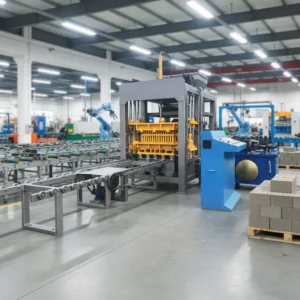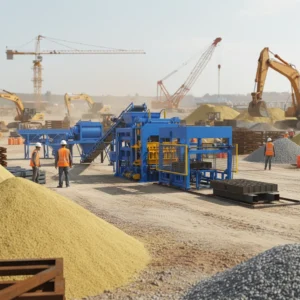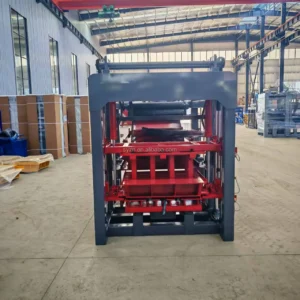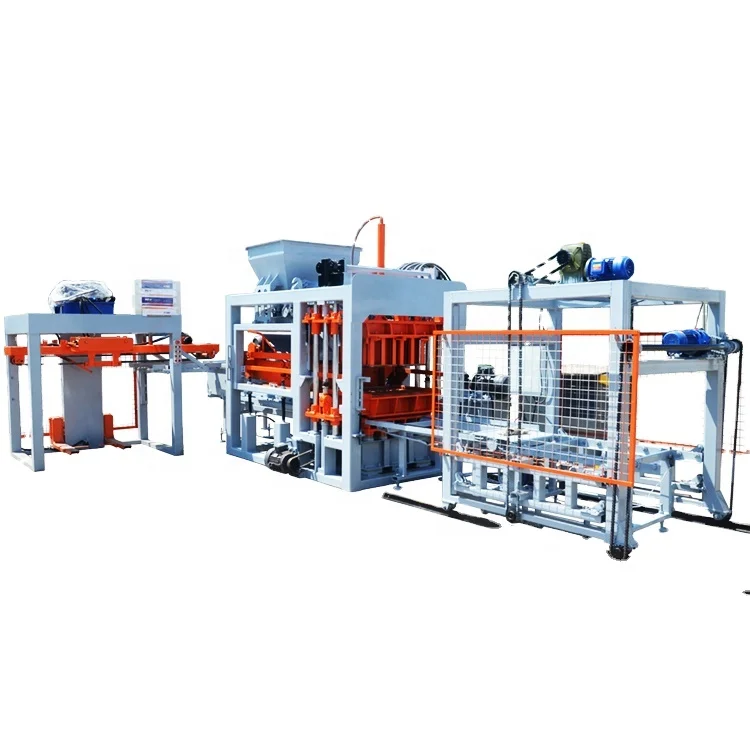
Matched system configuration — the QT6-15 press cycle dictates mixer capacity, pallet feeder speed and stacker timing so no upstream or downstream station becomes the bottleneck.
Technical Specifications
| Parameter | Value |
|---|---|
| Model | QT6-15 |
| Product Type | Hydraulic Block Making Machine |
| Overall Dimensions (L×W×H) | 8200×1700×2950 mm |
| Total Mass | 7 T |
| Overall Power | 37 kW |
| Vibration Frequency | 0-60 Hz |
| Vibration Form | Platform Vibration |
| Vibration Force | 45 kN |
| Moulding Mode | Automatic load, vibration moulding |
| Demolding Method | Hydraulic |
| Pallet Size | 880×850 mm |
| Molding Cycle | 15-20 s |
| Control System | PLC (Programmable Controller) with touch screen |
| Factory Area Required | 1200 m² |
| Block Compressive Strength | >15 MPa |
| Output Capacity (Hollow Block 400×200×200 mm) | 1080-1440 pcs/h, 8640-11520 pcs/8hr (basis: 6 pcs/mould, 15-20s cycle) |
| Output Capacity (Hollow Block 400×150×200 mm) | 1440-1920 pcs/h, 11520-15360 pcs/8hr (basis: 8 pcs/mould, 15-20s cycle) |
| Output Capacity (Solid Brick 240×115×53 mm) | 5760-7680 pcs/h, 46080-61440 pcs/8hr (basis: 32 pcs/mould, 15-20s cycle) |
| Output Capacity (Rectangular Paver 200×100×60 mm) | 2160-2880 pcs/h, 17280-23040 pcs/8hr (basis: 21 pcs/mould, 20-25s cycle) |
| Output Capacity (Zigzag Paver 225×112.5×60 mm) | 2160-2880 pcs/h, 17280-23040 pcs/8hr (basis: 15 pcs/mould, 20-25s cycle) |
| Voltage & Frequency | Configurable to buyer’s local supply (basis to be confirmed) |
| PLC Display Language | Configurable (basis to be confirmed) |
| Warranty | 1 year for whole machine (excluding spare parts) |
| Standards | CE (declared in company documentation) |
Application Suitability
| Application | Material or Output |
|---|---|
| Hollow block production for building walls | Crushed stone, cement, sand, fly ash blends |
| Solid brick manufacturing | Cement-aggregate mixes for load-bearing and non-load-bearing use |
| Rectangular paving brick for walkways and yards | High-density concrete mixes with fine aggregate |
| Zigzag interlocking paver for driveways | Interlocking profile concrete with standard cement ratios |
| Waste ash and slag block production | Industrial by-products blended with cement binder |
What a Standalone Press Cycle Hides About Real Throughput
The press only produces when every upstream and downstream station keeps pace.
A block production line QT6-15 supporting equipment setup must balance mixer discharge rate, pallet feeder indexing speed, and stacker cycle against the 15-20 second moulding window. When the mixer delivers a batch every forty seconds but the press completes a cycle every twenty, the press sits idle for half its shift. I configured a line for a Middle East project where this exact mismatch cost the plant thousands of blocks per day before we re-sized the mixer to match. That is why every block production line QT6-15 supporting equipment quotation I prepare starts with a station-by-station timing chart [NEED_CITE: block line cycle synchronization principles].
Raw Material Feeding and Mixing Sized to the Press
The QT6-15 demands a fresh batch of mixed material at every 15-20 second cycle. The raw material feeding system — belt conveyors, weigh hoppers, and the mixer — must deliver that volume without surge or starvation. Oversizing the mixer wastes energy on partial batches; undersizing it leaves the press waiting. Each block production line QT6-15 supporting equipment layout specifies mixer drum capacity, conveyor belt width, and hopper volume calculated against the target block format and its mould cavity count.
Pallet Circulation and the 880×850 mm Constraint
The pallet size on the QT6-15 is 880×850 mm, and that dimension governs the entire return loop. Pallet feeder spacing, the wet-side conveyor that carries freshly pressed blocks to the curing area, and the dry-side return conveyor all share this footprint. If the buyer’s existing forklift tines are too short for that pallet depth, or the curing racks were built for a different dimension, the block production line QT6-15 supporting equipment will not close the loop. I check forklift capacity and rack spacing before finalizing pallet specification [NEED_CITE: pallet handling system design for concrete block plants].
Reading the Specs That Matter on the Shop Floor
The 45 kN vibration force combined with hydraulic pressure determines how densely the concrete pack fills the mould cavity. Higher vibration frequency — adjustable from 0 to 60 Hz — suits finer aggregate mixes, while coarser stone blends respond better to lower frequency with sustained pressure. The 37 kW overall power rating reflects the combined draw of the hydraulic pump station, vibration motor, and conveyor drives running simultaneously. Because the hydraulic station is isolated from the main frame vibration and dust, seal and hose life improves compared to machines where the pump sits directly on the shaking table. Block compressive strength above 15 MPa is achievable when the vibration force and hydraulic pressure are matched to the buyer’s actual aggregate gradation, not a generic test mix.
The Cost of Skipping Line-Wide Timing
When a buyer purchases the press alone and sources pallets, conveyors, and stackers separately, station-to-station timing rarely aligns on first start-up. The pallet feeder may index slower than the mould cycle, forcing the PLC to insert wait states. The stacker may not clear cured pallets fast enough, backing up the return conveyor. These mismatches do not show up in the press specification sheet — they appear as lost hours on the production floor [NEED_CITE: common causes of throughput loss in block production lines]. I have seen plants run at half their quoted output for months before the owner traced the problem to an undersized pallet return belt.
Why Line Configuration Starts Here
The QT6-15 is treated as the centre point of a matched system rather than a catalogue item dropped into an empty floor plan. Machine, mould, pallet, and handling equipment are specified together against the buyer’s actual mix design and local aggregate, so vibration force and hydraulic pressure are set before the line ships. Mould design covers the formats the buyer’s market actually sells, with custom drawings available for non-standard profiles. The automation level is selectable — a buyer can begin with semi-automatic pallet handling and add automatic stacking and cubing later without replacing the press. Installation includes on-site commissioning where every station’s cycle time is verified against the timing chart, and operator training covers the full line, not just the press controls.
Documentation & Verification
- Line layout drawing with capacity calculation stated per block format and mould cavity count
- Machine specification sheet covering QT6-15 hydraulic, vibration, and electrical parameters
- Pallet specification matched to buyer’s curing rack spacing and forklift dimensions
- Hydraulic and electrical schematic for buyer maintenance team reference
- Voltage, frequency, and PLC display language confirmation recorded before production
- Factory test record documenting cycle timing across all connected stations
Installation, Commissioning & Support
- Foundation plan sized for the 8200×1700 mm machine footprint and 7 T operating mass
- Dedicated power circuit rated for 37 kW continuous draw at confirmed local voltage and frequency
- Machine arrives in dismantled shipping state; reassembly and station alignment verified on site
- PLC touch screen parameters set and tested against buyer’s mix during first production run
- Operator training covers mould change procedure, pallet feeder adjustment, and fault diagnosis
- Wear parts list with recommended first-order quantities for hydraulic seals and vibration mounts
Before You Request a Quotation
Send the target block format and daily volume so the line layout can be built around a realistic cycle calculation. Provide your local aggregate type and cement source so vibration force and hydraulic pressure are matched before the machine enters production. Confirm your site voltage, frequency, and preferred PLC display language to avoid commissioning delays. If you have existing conveyors, curing racks, or forklifts on site, share their dimensions so the pallet return loop is designed around what you already own.
Frequently Asked Questions
Q: How do the mixer output rate and pallet feeder speed need to align with the QT6-15’s 15-20s cycle so the press is never waiting?
A: The mixer must discharge one full batch into the press hopper within the moulding cycle window. The pallet feeder must index a fresh pallet and clear the pressed pallet before the next cycle starts. Each station’s timing is mapped on the line layout so no wait states are inserted by the PLC.
Q: The capacity table lists different outputs for hollow block, solid brick and pavers — which format should drive my line design?
A: The format that represents your highest daily volume should be the design basis. Supporting equipment — mixer size, conveyor speed, stacker capacity — is then scaled to that format’s cycle time and mould cavity count to avoid bottlenecks.
Q: What is included between semi-automatic pallet handling and fully automatic stacking and cubing?
A: Semi-automatic operation requires manual pallet placement and hand stacking of cured blocks. Adding automatic pallet feeding removes the first manual step. Full automation adds a stacker and cubing station that groups output into strapped cubes ready for the yard, reducing labour on the wet and dry sides.
Q: With 1200 m² factory area stated, how is that space divided?
A: The area covers raw material storage, the production line footprint, and the curing zone. The exact split depends on block format, daily output target, and curing duration. A line layout drawing allocates each zone based on the buyer’s site dimensions and pallet circulation path.
Q: How is the vibration force and hydraulic pressure adjusted when local aggregate differs from the factory test mix?
A: The PLC touch screen allows vibration frequency adjustment across 0-60 Hz, and the hydraulic pressure is tuned at the independent pump station. During commissioning, test blocks are pressed with the buyer’s actual aggregate, and settings are refined until compressive strength and surface finish meet target.