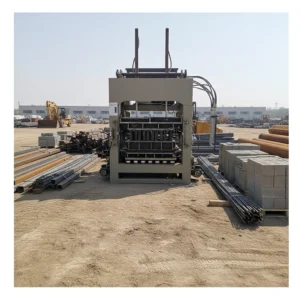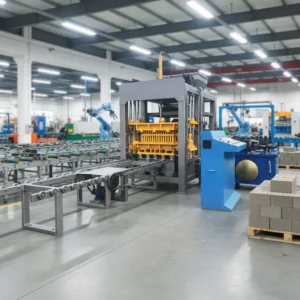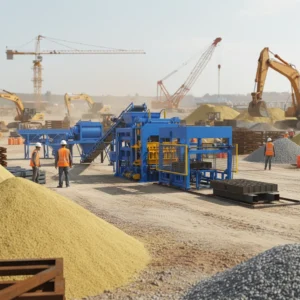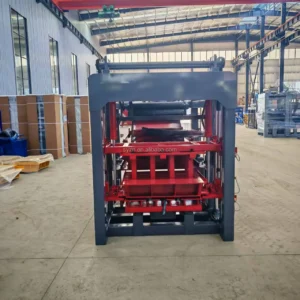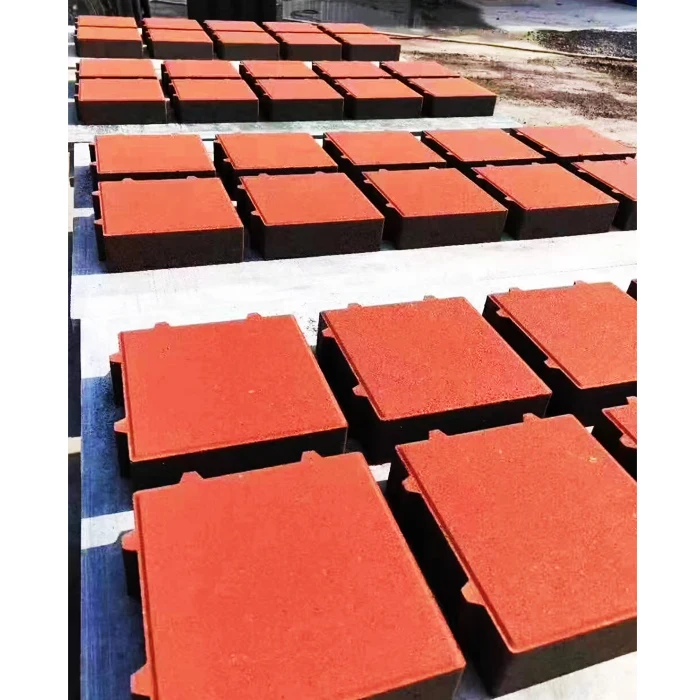
Complete line matching — The QT6-12 is specified not as an isolated press but as the center of a coordinated block production line, where raw material feeding, mixing, pallet circulation, stacking, and curing rack handling are each sized so the press is never left waiting between cycles.
Technical Specifications
| Parameter | Value |
|---|---|
| Model | QT6-12 |
| Product Type | Automatic Concrete Block Making Machine |
| Dimension | 7350 × 1780 × 2950 mm |
| Rated Pressure | 16 MPa |
| Main Vibration | Platform vibration |
| Vibration Frequency | 4600 r/min |
| Pallet Size | 880 × 700 mm |
| Molding Cycle | 15–20 s |
| Overall Power | 30.5 kW |
| Automation Level | Automatic |
| Control System | PLC (brand and display language to be confirmed with buyer) |
| Voltage & Frequency | Configurable (to be confirmed with buyer before production) |
| Raw Materials | Crushed stone, sand, cement, coal fly ash, cinder, slag, gangue, gravel, perlite, industrial wastes |
| Output Capacity — Hollow Brick | 1080 pcs/h based on 400 × 200 × 200 mm, 6 pcs/mould, 16–20 s cycle |
| Output Capacity — Porous Brick | 2800 pcs/h based on 240 × 115 × 90 mm, 14 pcs/mould, 15–18 s cycle |
| Output Capacity — Standard Brick | 6800 pcs/h based on 240 × 115 × 53 mm, 30 pcs/mould, 14–17 s cycle |
| Daily Output — Hollow Brick | 8,640 pcs/day based on 400 × 200 × 200 mm |
| Daily Output — Porous Brick | 22,400 pcs/day based on 240 × 115 × 90 mm |
| Daily Output — Standard Brick | 54,400 pcs/day based on 240 × 115 × 53 mm |
| Standards | CE, SGS, ISO 9001 |
| Warranty | One year |
Application Suitability
| Application | Material or Output |
|---|---|
| Hollow block production for wall construction | Crushed stone, sand, cement, fly ash blends |
| Porous brick manufacturing for infill and partition walls | Sand, cement, cinder, slag mixes |
| Standard solid brick for load-bearing masonry | Gravel, sand, cement with local aggregate |
| Paving stone and interlocking block for roads and walkways | Face-mix and base-mix concrete with pigment |
| Kerbstone and edger production for landscaping | High-density concrete with coarse aggregate |
| Grass block and slope block for erosion control | Permeable concrete mixes with reduced cement ratio |
What a Quoted Cycle Time Leaves Out of Your Block Production Line Turnkey
The press is only as fast as the slowest station feeding it or clearing its output.
I have walked onto sites where a block press sat idle for a third of the shift because the pallet return loop could not keep up, or the mixer batch size meant the hopper ran dry every nine minutes. The cycle time printed in a brochure assumes every upstream and downstream station is perfectly timed to the press. In reality, the raw material batching accuracy, the mixer discharge rate, the pallet magazine capacity, and the stacking speed all have to match the QT6-12 molding cycle of 15–20 seconds, or the quoted throughput never materializes. [NEED_CITE: block production line bottleneck analysis by station cycle matching]
Where the Stations Connect and Why Timing Matters
A block production line turnkey centered on the QT6-12 begins at the raw material silo or batching hopper. The aggregate and cement must be weighed and discharged into the mixer within the window that the press completes its current cycle. If the mixer takes longer than the press cycle to prepare a fresh batch, the press waits. Every second of idle time at 15–20 seconds per cycle accumulates into hundreds of missing blocks per shift.
Pallet Circulation as the Hidden Bottleneck
The QT6-12 uses 880 × 700 mm pallets, and each moulding cycle consumes one pallet from the magazine. After pressing, the wet block on its pallet must travel to the curing area and the empty pallet must return. If the curing rack layout forces the forklift to travel further than the cycle allows, pallets pile up at the press exit. [NEED_CITE: pallet return loop design for concrete block plants] The pallet magazine must hold enough stock to bridge the gap between the press exit and the return conveyor, otherwise the operator is forced to hand-feed pallets and the automatic cycle breaks down.
Reading the Pressure and Vibration Figures Together
The QT6-12 delivers 16 MPa rated hydraulic pressure alongside platform vibration at 4600 r/min. These two parameters work as a pair: vibration settles the mix into the mould cavity while hydraulic pressure compacts it to final density. A mix with high fines content — common when local sand carries clay — absorbs vibration differently than a clean washed sand. The pressure and vibration settings must be adjusted to the buyer’s actual aggregate, not left at a factory default, or block strength will vary from batch to batch. The 30.5 kW overall power budget covers both the hydraulic pump and the vibration motor, so the electrical supply must be stable at the confirmed voltage and frequency to prevent pressure drop mid-cycle.
The Cost of Ignoring Station Synchronization
When a block plant is assembled from separate suppliers without a unified cycle time calculation, the mixer is often undersized relative to the press throughput. The result is a line that runs at two-thirds of the nameplate capacity for the entire first year while the buyer blames the press. [NEED_CITE: consequences of mismatched block line station capacity] Pallet specification is another frequent gap: if the pallets ordered are a different thickness than what the curing racks accept, the buyer must either replace the racks or reorder pallets, both of which delay production by weeks.
Why Procuring the Full Line from One Source Matters
Shandong Shiyue Intelligent Machinery Co., Ltd has focused exclusively on block machinery and supporting equipment since 2019, which means the press, moulds, pallets, and handling systems are specified as one matched set. Each block production line turnkey proposal includes a capacity calculation that states the block format assumed for every throughput figure. The pallet size and material are confirmed against the buyer’s existing curing racks and forklift before production starts. Voltage, frequency, and PLC display language are locked in before the machine enters assembly, preventing commissioning delays on arrival. Mould design covers the formats the buyer’s market actually sells, and custom mould drawings are available when standard formats do not match local demand.
Documentation & Verification
- Line layout drawing with station-by-station cycle time matched to the QT6-12 molding cycle
- Capacity calculation sheet stating the exact block format for each throughput figure
- Pallet specification confirming material, thickness, and size against buyer’s curing infrastructure
- Voltage, frequency, and PLC display language confirmation record before production
- Factory test record on the buyer’s target block format before dispatch
- Hydraulic and electrical schematic with confirmed power ratings
Installation, Commissioning & Support
- Foundation plan sized for the QT6-12 footprint of 7350 × 1780 mm with vibration isolation requirements
- Dedicated power circuit matching confirmed voltage and the 30.5 kW overall load
- Pallet magazine and return conveyor aligned to the 880 × 700 mm pallet size on site
- PLC parameter setup for buyer’s confirmed mix design, molding cycle, and vibration frequency
- Operator training covering mould change procedure, daily maintenance, and block quality checks
- Wear parts list for hydraulic seals and vibration components with recommended replacement intervals
What We Need to Size Your Line Correctly
To prepare an accurate block production line turnkey proposal around the QT6-12, please provide the target block formats you intend to produce, your daily output requirement per format, and a sample of your local sand and aggregate so we can run a mix compatibility test. We also need your site’s voltage and frequency, the PLC display language your operators require, and details of any existing pallet handling or curing infrastructure that the new line must integrate with.
Frequently Asked Questions
Q: How is the daily output figure calculated and which block format is it based on?
A: Each daily output number is derived from the moulding cycle time, the number of cavities per mould, and an assumed shift length. For example, 8,640 hollow blocks per day is based on the 400 × 200 × 200 mm format with six cavities per mould. If your target format differs, the daily output must be recalculated using the cavity count and cycle time for that specific format.
Q: What upstream and downstream equipment must be included so the press does not sit idle?
A: The batching and mixing station must discharge a fresh batch within the QT6-12 cycle window of 15–20 seconds. Downstream, the pallet return conveyor and stacking system must clear wet blocks from the press exit at the same rate. Any gap in either direction creates idle time that reduces actual throughput below the quoted cycle rate.
Q: How does pallet size and material selection affect the curing area layout?
A: The QT6-12 uses 880 × 700 mm pallets. The curing rack spacing, forklift tine width, and rack bay depth must all accept this dimension. Choosing a pallet material — wood, PVC, or steel — also affects weight and stack height, which influences how many pallets a single forklift trip can move and therefore how fast the return loop operates.
Q: Can the line be configured for my local aggregate rather than a catalogue default?
A: Yes. The vibration frequency and hydraulic pressure settings are adjusted after reviewing a sample of your local sand and aggregate. This ensures the QT6-12 compacts your specific mix to target block strength. Batching ratios and moisture targets are documented so the operator can reproduce consistent results shift after shift.
Q: What documentation verifies that all line stations are correctly matched before shipment?
A: Before dispatch, you receive a line layout showing each station’s cycle time relative to the press, a capacity calculation per block format, pallet specifications confirmed against your curing infrastructure, and a factory test record run on your target format. Voltage and PLC language confirmation records are included to prevent commissioning delays.