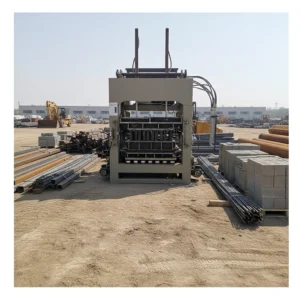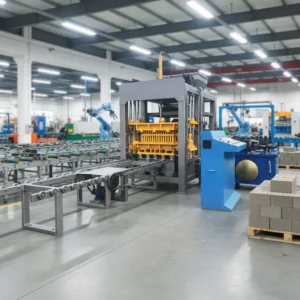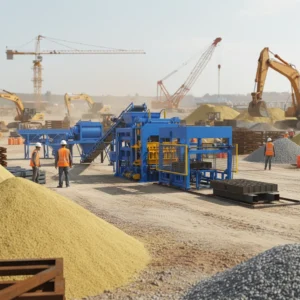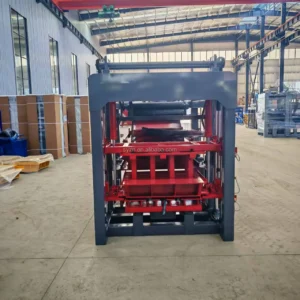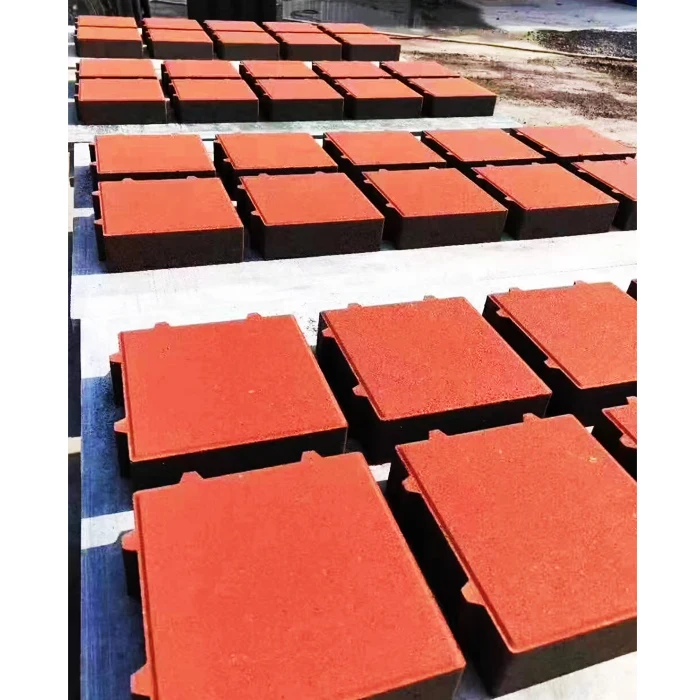
System-Matched Sizing — Every QT6-12 line leaves our factory with raw material feeding, mixing, pallet circulation and stacking stations calculated against the buyer’s actual block format, so the press never waits for material or pallets.
Technical Specifications
| Parameter | Value |
|---|---|
| Product Type | Automatic Hydraulic Block Making Machine |
| Model | QT6-12 |
| Overall Dimensions (L×W×H) | 7350×1780×2950 mm |
| Rated Hydraulic Pressure | 16 MPa |
| Main Vibration Type | Platform vibration |
| Vibration Frequency | 4600 r/min |
| Pallet Size | 880×700 mm |
| Molding Cycle | 15–20 s |
| Overall Power (Press Station) | 30.5 kW |
| Output — Hollow Block | 1080 pcs/h, 8640 pcs/day (based on 400×200×200 mm, 6 pcs/mould, 16–20 s cycle) |
| Output — Porous Brick | 2800 pcs/h, 22400 pcs/day (based on 240×115×90 mm, 14 pcs/mould, 15–18 s cycle) |
| Output — Standard Solid Brick | 6800 pcs/h, 54400 pcs/day (based on 240×115×53 mm, 30 pcs/mould, 14–17 s cycle) |
| Automation Level | Automatic |
| Mould Compatibility | Interchangeable — hollow block, porous brick, solid brick, paving stone, interlocking block, kerbstone, grass block, slope block |
| Raw Materials | Crushed stone, sand, cement, fly ash, cinder, slag, gangue, gravel, perlite, industrial wastes |
| Voltage & Frequency | Configurable to site requirement (confirm before manufacture) |
| Control System | PLC-based (brand and display language to confirm) |
| Standards | CE, SGS, ISO 9001 |
Application Suitability
| Application | Material or Output |
|---|---|
| Hollow block masonry for building construction | Crushed stone, sand, cement, fly ash blends on 400×200×200 mm format |
| Standard solid brick for load-bearing walls | Sand, cement, slag mixes on 240×115×53 mm format |
| Porous brick for infill and partition walls | Lightweight aggregate, cement, perlite on 240×115×90 mm format |
| Paving stone for sidewalks and road edges | High-density crushed stone and cement on interlocking moulds |
| Kerbstone and edger for infrastructure projects | Coarse aggregate and cement on kerbstone mould |
| Slope protection and landscaping blocks | Local aggregate and industrial waste blends on grass or slope block mould |
Why "Blocks per Hour" Means Nothing Without the Rest of the Line
A press is only as fast as the slowest station feeding it or clearing its output.
I spent weeks on a site in East Africa where an automatic block making machine sat idle for minutes every cycle — not because the press was slow, but because the mixer could not deliver a fresh batch in time and the pallet return conveyor had a bottleneck at the curve section. The rated output of the press was never reachable because the block production line equipment around it had been sourced separately, with no one responsible for matching cycle times across stations. When you evaluate the QT6-12, the question is not just what the press can do in 15–20 seconds, but whether your mixer, belt conveyor, pallet feeder and stacker can all keep that same rhythm for an entire shift [NEED_CITE: typical block plant bottleneck causes in sub-Saharan installations].
Matching Every Station to the 15–20 Second Press Cycle
The QT6-12 completes a moulding cycle every 15–20 seconds depending on block format. That means the mixer must deliver a homogenous batch to the hopper within that window, the pallet feeder must place a clean 880×700 mm pallet on the conveyor, and the wet-side stacker must clear the finished pallet before the next press stroke. When we lay out a block production line equipment package around this press, each station’s throughput is calculated against the target block format — because a hollow block cycle at 20 seconds gives a different rhythm than a solid brick cycle at 14 seconds, and the upstream and downstream equipment must track whichever format dominates your daily schedule.
Pallet Circulation as the Hidden Throughput Limit
Pallets are the carriers that link every station. The 880×700 mm pallet size on the QT6-12 determines how many pallets you need in circulation, how your curing racks are spaced, and which forklift can handle a loaded rack. If your existing curing yard was built for a different pallet dimension, pallets will not seat correctly on the racks, and workers will spend time re-stacking by hand — exactly the kind of manual intervention that erases the advantage of automatic block making machine supporting equipment. We confirm pallet dimensions against your curing layout before the line enters production, so the pallet loop closes without manual transfer points [NEED_CITE: pallet sizing and curing rack compatibility in block plants].
Reading the Specs That Actually Shape Your Daily Output
The 16 MPa rated hydraulic pressure and 4600 r/min platform vibration work together to compact the mix into a dense, consistent block. Hydraulic pressure provides the static clamping force while vibration rearranges aggregate particles into a tighter matrix — if either is too low for your mix design, blocks leave the press weak and crumble during curing. The 30.5 kW overall power rating covers the press station itself; total line draw including mixer, conveyor motors and stacker must be calculated during layout engineering so your transformer and switchgear are sized correctly. Mould interchangeability across eight block formats means the same press serves multiple market segments, but each format change requires the operator to adjust cycle time, vibration duration and feed volume — parameters stored in the PLC once your preferred formats are confirmed.
The Cost of Ignoring Line-Level Synchronization
When stations are bought individually and connected later, the typical result is a press that spends a large part of each shift waiting. The mixer runs too slow for the press cycle, or the stacker cannot keep up during solid brick runs where output volume is high. Workers end up pulling pallets off the line by hand, which introduces breakage and defeats the consistency that automatic operation was supposed to deliver. On one project I supported, the buyer added a second mixer after installation to close the gap — an expense and delay that a matched line calculation would have prevented [NEED_CITE: hidden costs of unmatched block line stations].
Why Sourcing the Full Line From One Supplier Matters Here
Block machinery is our single focus, which means the QT6-12 press, its moulds, pallets, and every piece of block production line equipment around it are specified as one system rather than assembled from unrelated vendors. Configuration starts from your actual mix design, local aggregate gradation and target block format — not a catalogue default that may not match your raw materials. Mould design covers the formats your market actually buys, with custom drawings available when standard formats do not fit. Automation level is selectable, so you can begin with semi-automatic pallet handling and add stacking or cubing later. Installation support includes operator training on your specific PLC language and control layout.
Documentation & Verification
- Line layout drawing with capacity calculated per block format you intend to produce
- Machine specification sheet covering hydraulic, vibration and electrical parameters
- Mould drawing and format list showing every interchangeable mould included
- Pallet specification matched to your curing rack spacing and forklift capacity
- Hydraulic and electrical schematic for local maintenance reference
- Factory test record running your specified mould and cycle time before dispatch
Installation, Commissioning & Support
- Foundation plan reflecting the 7350×1780 mm press footprint and vibration isolation requirements
- Dedicated power circuit sized for 30.5 kW press draw plus upstream and downstream equipment
- Container-shipped assembly with on-site reconnection of hydraulic and electrical systems
- First-run commissioning with cycle time and pressure adjusted to your local aggregate mix
- Operator training on PLC controls in your confirmed display language
- Wear parts and mould maintenance schedule based on your daily production volume
What We Need to Quote Your Line Accurately
To build a block production line equipment proposal around the QT6-12 that actually matches your site, share your target block formats with daily volume per format, the local aggregate and cement types available, your workshop floor area and ceiling height, and the voltage and frequency at your site. If you already have curing racks or forklifts, send their dimensions so we can align pallet size and handling equipment before the line goes into production.
Frequently Asked Questions
Q: How is line capacity calculated per block format, and what assumptions are included?
A: Each throughput figure is tied to a specific mould cavity count, block dimension and cycle time range. For example, hollow block output of 1080 pieces per hour assumes a 400×200×200 mm block on a 6-cavity mould with a 16–20 second cycle. We provide a written capacity table listing every format you plan to produce so you can verify against your actual market demand before ordering.
Q: How do the feeding and mixing stations match the press cycle to prevent bottlenecks?
A: The mixer batch size and discharge time, belt conveyor speed and hopper volume are all calculated against the shortest cycle time of your dominant block format. This ensures a fresh mix arrives at the press hopper within every 15–20 second window so the press never idles waiting for material between strokes.
Q: What voltage, frequency and control language options are available?
A: Voltage and frequency are configured to your site supply — common ranges include 380V/50Hz and 440V/60Hz, but we confirm your exact requirement before manufacture. PLC display language is set to your operator preference and documented in the control schematic, so commissioning proceeds without delay on arrival.
Q: How is pallet size chosen to match the buyer’s existing curing setup?
A: The standard 880×700 mm pallet is confirmed against your curing rack dimensions and forklift fork spacing before production begins. If your existing racks require a different size, we adjust the pallet specification and the entire pallet circulation loop — feeder, return conveyor and stacker — to match, avoiding manual re-handling.
Q: Does the quotation cover stacking and curing handling, or only the press?
A: A complete line quotation includes raw material feeding, mixing, pallet circulation, the QT6-12 press, wet-side stacking and curing rack handling equipment. Each station is listed individually with its specification so you can see exactly what is included and where optional automation upgrades can be added later.