
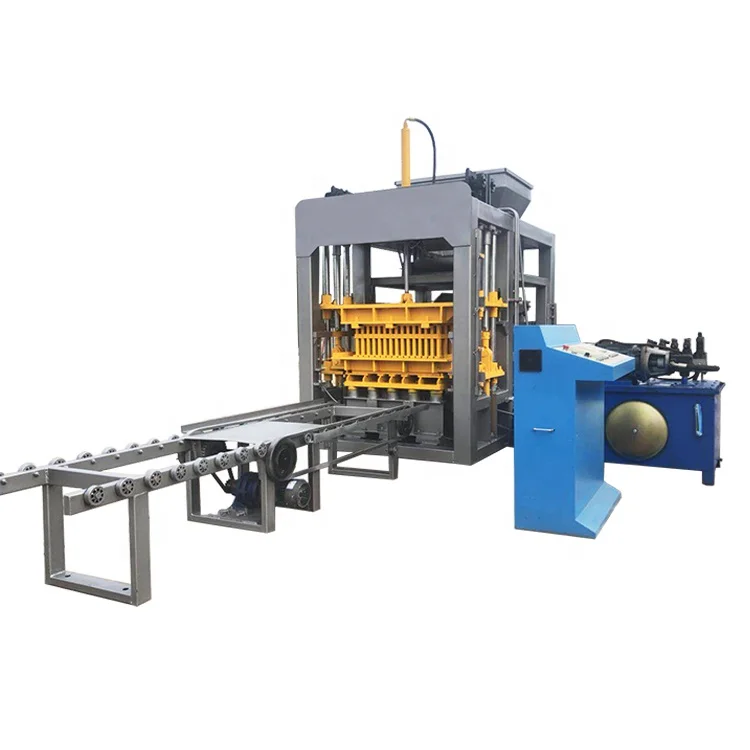
Matched Line Configuration — the QT5-15 is positioned as the centre of a complete block production line where feeding, mixing, pallet circulation, and stacking are sized to the press cycle, not supplied as standalone items.
Technical Specifications
| Parameter | Value |
|---|---|
| Model | QT5-15 |
| Product Type | Full Automatic Hollow Concrete Block Making Machine |
| Overall Dimensions (L×W×H) | 7400×1950×2800 mm |
| Rated Pressure | 21 MPa |
| Main Vibration Form | Platform Vibration |
| Vibration Frequency | 2800–4500 r/min |
| Pallet Size | 1100×550 mm |
| Molding Cycle | 15–25 s |
| Overall Power | 26.5 kW |
| Demolding Method | Hydraulic |
| Automation Level | Full Automatic |
| Output Capacity (Hollow brick 400×200×200 mm) | 1800 pcs/h (basis: 5 pcs/mold, 16–20 s cycle) |
| Output Capacity (Hollow block 400×150×200 mm) | 1300 pcs/h (basis: 6 pcs/mold, 15–20 s cycle) |
| Output Capacity (S paver 225×112.5×60 mm) | 3700 pcs/h (basis: 16 pcs/mold, 15–17 s cycle) |
| Raw Materials | Crushed stone, sand, cement, dust, fly ash, gravel, slag |
| Applied Products | Concrete blocks, hollow/solid blocks, pavers, interlocking blocks, curbstone, colored pavers |
| Standards | CE |
Application Suitability
| Application | Material or Output |
|---|---|
| Hollow block production for building walls | Crushed stone, sand, cement, fly ash blends |
| Solid block manufacturing for load-bearing structures | Gravel, cement, slag aggregates |
| S-shaped paver production for driveways and walkways | Fine sand, cement, pigment additives |
| Interlocking block output for retaining walls | Coarse aggregate, cement, dust |
| Curbstone and kerb forming for road projects | High-strength concrete mixes with gravel |
| Colored paver runs for landscaping contracts | Cement, sand, oxide pigments |
Why Quoted Capacity Misses the Daily Target
A capacity figure without a block format and cycle time is a number without meaning.
Catalogue outputs are frequently measured on a single mould cavity count and an ideal cycle that the rest of the line cannot sustain. I have watched a block plant in Peru lose thousands of blocks in a single shift because the mixer discharged slower than the press cycled, leaving the QT5-15 idle every forty seconds. The turnkey concrete block making line only reaches its stated daily output when every upstream and downstream station matches the press rhythm. [NEED_CITE: cycle-time synchronization in concrete block plants]
Matching Upstream Stations to the Press Rhythm
The QT5-15 completes a moulding cycle in 15–25 seconds depending on block height and mix consistency. Raw material feeding and mixing must discharge a fresh batch within that window, or the press waits. Sizing the batcher and mixer to the actual block format — not a catalogue average — is the first step in building a block production line equipment layout that runs without dead time.
Pallet Circulation as the Hidden Bottleneck
Pallet size 1100×550 mm defines how many blocks leave the press per cycle and how they travel through curing. If the pallet return loop is slower than the press, the machine stalls. If the curing rack spacing does not accept this pallet dimension, forklifts make extra trips and output piles up on the floor. Confirming pallet geometry against existing curing infrastructure prevents costly rework after the line is installed. [NEED_CITE: pallet handling standards in block production]
Reading the Numbers That Matter
Platform vibration at 2800–4500 r/min combined with 21 MPa hydraulic pressure determines block density and green strength. Higher vibration frequency compacts fine aggregates more effectively, while hydraulic pressure locks the shape before demolding. The 26.5 kW overall power covers the press itself; the full block production line equipment draw will be higher once the mixer, conveyor, and stacker are running. Mould change is hydraulic-assisted, but the time depends on how many formats are queued and whether the operator has pre-staged the next mould set.
The Cost of Ignoring Line Synchronization
When the batcher, mixer, or pallet feeder is undersized, the press idles and daily output drops well below the quoted figure. Buyers who focus only on the press specification often discover the bottleneck after installation, when adding a larger mixer or an extra pallet rack means unplanned downtime and additional freight. These mismatches are the most common reason a turnkey concrete block making line fails to meet its first-month production target. [NEED_CITE: common causes of block line underperformance]
Why the Line Configuration Matters Here
Block machinery is a single focus at Shiyue, so the QT5-15 is never shipped as a standalone press with unrelated add-ons. Every station from the batcher to the cubing unit is specified against the buyer’s mix design, local aggregate, and target format. Mould design covers the exact blocks the buyer’s market sells, including custom drawings. The automation level can start semi-automatic and progress to full stacking and cubing as the plant scales. Factory test records document the cycle time per format before dispatch, so no capacity claim is left unverified.
Documentation & Verification
- Line layout drawing showing every station and cycle time per block format
- Capacity calculation stating mould cavity count and assumed cycle per format
- Pallet specification matched to curing rack dimensions and forklift capacity
- Hydraulic and electrical schematic with confirmed voltage and frequency
- Factory test record on buyer’s block format before dispatch
- Operation and maintenance manual with wear parts and mould list
Installation, Commissioning & Support
- Foundation plan sized to the 7400×1950 mm footprint and dynamic vibration load
- Dedicated power circuit for the 26.5 kW press plus upstream equipment draw
- Machine dismantled for container loading and reassembled on-site with alignment checks
- First-run parameter setting for vibration frequency and hydraulic pressure per mix design
- Operator training on mould change sequence and PLC navigation in confirmed language
- Wear parts list with hydraulic seal and vibration motor replacement intervals
What to Include in Your Inquiry
Provide the block formats you sell most, the daily output target per format, and the raw materials available locally. Confirm the voltage and frequency at the plant, the PLC display language your operators need, and whether you already have curing racks or forklifts that the pallet size must fit. If you are expanding an existing line, list the upstream equipment you plan to keep so the block production line equipment proposal accounts for their cycle times.
Frequently Asked Questions
Q: How is daily output calculated for each block format?
A: Every output figure is tied to a specific mould, cavity count, and cycle time. The hollow brick 400×200×200 mm runs at 1800 pcs/h based on 5 pcs/mold and a 16–20 s cycle. We provide a written capacity calculation for your exact format so the daily plan matches the machine’s real rhythm.
Q: How do upstream stations stay synchronized with the press?
A: The batcher, mixer, and pallet feeder are sized so their discharge or return time falls within the 15–25 s molding window. If any station is slower, the press idles. The line layout drawing shows cycle time per station so no bottleneck is hidden before installation.
Q: What pallet size is used and how does it fit my curing area?
A: The standard pallet is 1100×550 mm. Before production starts, we confirm this dimension against your curing rack spacing and forklift capacity. If your existing racks use a different size, the pallet and mould layout are adjusted to prevent double-handling.
Q: Can the line start semi-automatic and upgrade later?
A: Yes. The QT5-15 supports a semi-automatic configuration with manual pallet handling and can add automatic stacking and cubing later. The base frame and hydraulic system remain the same, so the upgrade does not require a new press or foundation changes.
Q: What happens during a mould change?
A: The mould is hydraulically released and swapped for the next format. Only the press pauses; the mixer and pallet feeder continue preparing the next batch. Change time depends on the mould set and whether it is pre-staged, which we confirm during operator training.


