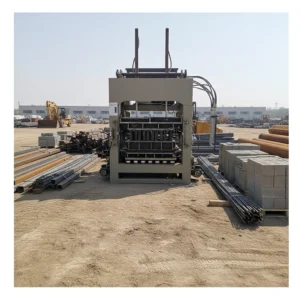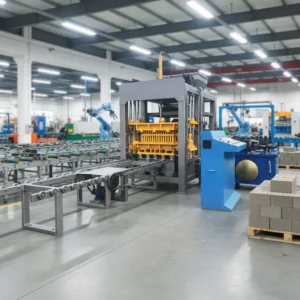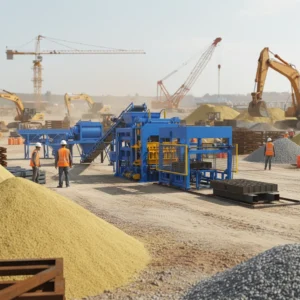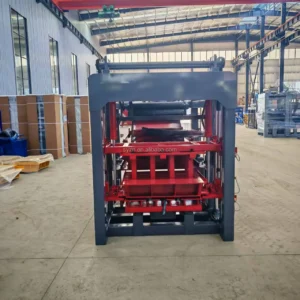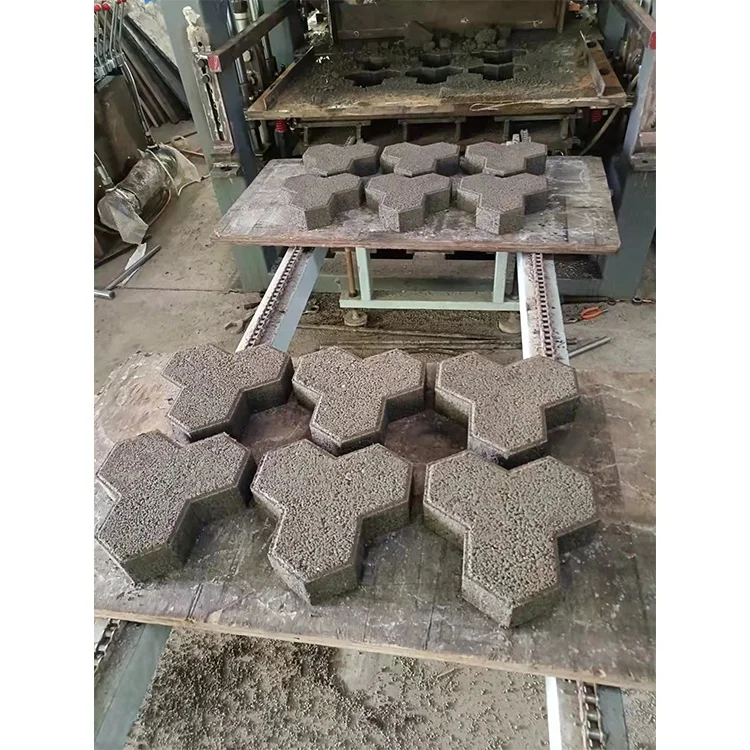
Matched System Configuration — the QT5-15 press, JS500 mixer, pallet feeder, brick conveyor, and block sweeper are specified together so cycle times align across every station rather than leaving the press waiting on upstream or downstream equipment.
Technical Specifications
| Parameter | Value |
|---|---|
| Product Type | Fully Automatic Concrete Block Making Machine |
| Model | QT5-15 |
| Overall Dimensions (L×W×H) | 7100×1600×2610 mm |
| Molding Cycle | 15 s |
| Vibration Frequency | 0-60 Hz |
| Vibration Force (Exciting Power) | 40 kN |
| Rated Power | 33.5 kW |
| Mixer Model | JS500 |
| Pallet Size | 1100×550 mm |
| Net Weight | 5 T |
| Control System | PLC control system |
| Hydraulic Station | Included (high-pressure hydraulic system) |
| Line Equipment Included | Pallet feeder, brick conveyor, block sweeper |
| Applied Products | Paver, solid block, hollow block, curbstone |
| Raw Materials | Crushed stones, sand, cement, dust, fly ash |
| Output — Hollow Block 400×200×200 mm | 5 pcs/mould, 450 pcs/hr, 3600 pcs/8hr |
| Output — Hollow Block 400×150×200 mm | 6 pcs/mould, 540 pcs/hr, 4320 pcs/8hr |
| Output — Solid Brick 400×100×200 mm | 8 pcs/mould, 720 pcs/hr, 5760 pcs/8hr |
| Voltage & Frequency | Configurable to buyer’s local grid (confirm before order) |
| Automation Level | Fully automatic |
Application Suitability
| Application | Material or Output |
|---|---|
| Hollow block production for wall construction | Crushed stone, sand, cement, fly ash — 400×200×200 mm and 400×150×200 mm formats |
| Solid brick manufacturing for structural and infill use | Cement, sand, crushed stone — 400×100×200 mm format |
| Paver production for walkways and yards | Cement, fine aggregate, dust — various paving formats via mould change |
| Curbstone fabrication for road and site edging | Cement, crushed stone mix — kerb formats via dedicated mould |
| On-site block production for housing projects | Locally sourced aggregate blended with cement at project location |
| First block plant setup for entrepreneurs | Full line from raw material feeding through to block output and conveying |
What Happens Between the Press and the Curing Yard
When a QT5-15 automatic block making machine production line quote lists only the press, buyers discover after arrival that pallets must be moved by hand and freshly pressed blocks sit stacked on the floor. The line only produces what the slowest station allows. I have watched a block plant in Southeast Asia where the mixer emptied its batch in ninety seconds but the press cycled every fifteen, so the hopper ran dry twice every hour. The owner had paid for capacity he could never reach because the stations upstream and downstream were never timed against each other [NEED_CITE: line synchronization standards for concrete block production]. That gap between quoted output and actual daily count is almost always a line-balance problem, not a press problem.
How Each Station Feeds the Next
The JS500 mixer is sized so its batch volume and discharge rate match the QT5-15 press demand within each molding cycle. When the mixer completes a batch, the material moves to the press hopper before the previous charge is fully consumed, keeping the press running without dry pauses. This is the reason the mixer model is specified alongside the press rather than selected independently.
The pallet feeder positions each pallet under the mould in time with the press cycle, and the brick conveyor carries pressed blocks away before the next pallet arrives. The block sweeper clears loose material from the pallet return path so the feeder can seat the next pallet flat. Every station operates on the same PLC-controlled timing, which is what makes the QT5-15 automatic block making machine production line function as a continuous loop rather than a series of isolated machines.
Where the Line Ends and the Buyer’s Scope Begins
The conveyor delivers blocks to the stacking point, but stacking method, curing rack handling, and cubing are not included in this configuration [NEED_CITE: scope of supply conventions for block production lines]. Buyers need to confirm whether their curing yard uses racks that match the 1100×550 mm pallet size and whether their forklift can handle loaded pallets at that dimension. Planning the curing area layout before the line arrives prevents a situation where blocks pile up at the end of the conveyor with nowhere to go.
Reading the Specs That Actually Matter
Vibration force and hydraulic pressure work together to compact the mix into the mould. The 40 kN vibration force at up to 60 Hz consolidates the aggregate, while hydraulic pressure holds the mould closed and applies the final compaction. If vibration is high but pressure is low, blocks emerge with loose edges; if pressure is high but vibration is insufficient, the mix does not fill the mould corners. Both values must be appropriate for the buyer’s specific aggregate gradation and cement ratio.
The 15-second molding cycle governs how many cycles the press completes per hour, and the output table above shows what that translates to for each block format. A buyer producing 400×200×200 mm hollow blocks will see 3600 pieces in an eight-hour shift, while the same press running 400×100×200 mm solid bricks reaches 5760 pieces in the same period. Comparing daily output across different block sizes without checking which format the number assumes leads to incorrect planning.
The 1100×550 mm pallet size determines how many blocks fit per cycle and must align with the curing rack dimensions and forklift capacity already on site or planned for purchase. Ordering a line without confirming pallet compatibility means blocks arrive at the curing area on pallets that do not fit the racks.
The Cost of Ignoring Station Timing
A mixer that is too small forces the press to idle between batches, cutting actual output well below the quoted figure. A pallet feeder that is too slow adds seconds to every cycle because the press waits for the pallet to seat. I have seen plants where the conveyor was positioned too far from the press, requiring an operator to bridge the gap by hand — turning a fully automatic QT5-15 automatic block making machine production line into a semi-automatic one with extra labour [NEED_CITE: common causes of block line downtime in emerging markets]. These mismatches do not show up in the press specification sheet; they appear only when the full line layout is reviewed as a system.
Why Buyers Source This Line Here
Block machinery is the single focus of the manufacturing operation behind this line, so the press, mould, pallet, and handling equipment are specified as one matched set rather than assembled from separate vendors.
Each configuration is set against the buyer’s actual mix design, local aggregate, and target block format instead of a catalogue default, which means the JS500 mixer and pallet feeder are confirmed for the materials the buyer will actually use.
Mould design and supply cover the formats the buyer’s market sells, including custom drawings when standard moulds do not match local block dimensions.
Automation level is selectable, so a buyer can start with the included automatic pallet feeding and conveying, then add automatic stacking later as the plant scales.
Installation and commissioning include operator training on the PLC controls, mould change procedure, and daily maintenance routines specific to this line configuration [NEED_CITE: commissioning support standards for exported block machinery].
Documentation & Verification
- Line layout drawing showing station positions and pallet flow path for the QT5-15 configuration
- Capacity calculation sheet stating the block format assumed for each output figure
- Machine specification sheet covering hydraulic pressure, vibration force, pallet size, and PLC language
- Voltage and frequency confirmation document matched to the buyer’s local grid before production
- Factory test record showing the press running on the buyer’s target block format before dispatch
- Packing photographs of each line station before container loading
Installation, Commissioning & Support
- Foundation must accommodate the 7100×1600 mm press footprint plus mixer and conveyor spacing
- Dedicated electrical circuit rated for 33.5 kW total line load with confirmed voltage and frequency
- Press and line stations ship partially assembled; on-site assembly aligns conveyor to press discharge
- First production run verifies molding cycle timing across mixer, feeder, press, and conveyor
- Operator training covers PLC interface, mould change, and pallet feeder adjustment for the 1100×550 mm pallet
- Wear parts list identifies hydraulic seals, vibration springs, and mould liners for initial spare stock
What to Prepare Before Requesting a Quote
To size this QT5-15 automatic block making machine production line correctly, share the block formats you plan to produce, your target daily output per format, and the aggregate materials available locally. Confirm your site voltage, frequency, and preferred PLC display language. Let us know the curing area dimensions and forklift capacity so the pallet size and conveyor discharge height can be matched.
Frequently Asked Questions
Q: How are the mixer, pallet feeder, and conveyor matched to the press cycle time?
A: The JS500 mixer batch volume and discharge rate are calculated so each batch reaches the press hopper before the previous charge runs out. The pallet feeder indexes a new pallet within the 15-second cycle, and the conveyor removes pressed blocks before the next pallet arrives. All stations run on the same PLC timing to prevent idle gaps.
Q: Which line stations are included and which remain the buyer’s responsibility?
A: The quotation covers the QT5-15 press, JS500 mixer, pallet feeder, brick conveyor, and block sweeper. Stacking after the conveyor, curing rack systems, and cubing equipment are not included. Buyers should confirm their curing yard layout and material handling plan before the line ships.
Q: How is the 1100×550 mm pallet size confirmed against my curing setup?
A: Pallet dimensions must match both the mould footprint and the curing rack slots. Before production, we confirm that the 1100×550 mm pallet fits the buyer’s existing or planned racks and that the site forklift can handle loaded pallets at that size without overhang or instability.
Q: What electrical details need confirming before shipment?
A: Voltage, frequency, and PLC display language must be confirmed against the buyer’s local grid and operator preference. A 33.5 kW line requires a dedicated circuit, and the motor wiring is configured at the factory to the confirmed supply so no rewiring is needed on arrival.
Q: How is daily output verified for different block formats?
A: Output figures are stated per format — 3600 hollow blocks (400×200×200 mm) or 5760 solid bricks (400×100×200 mm) per eight-hour shift. The capacity calculation sheet provided with the quotation shows the molding cycle count and pieces per mould for each format the buyer plans to run.