
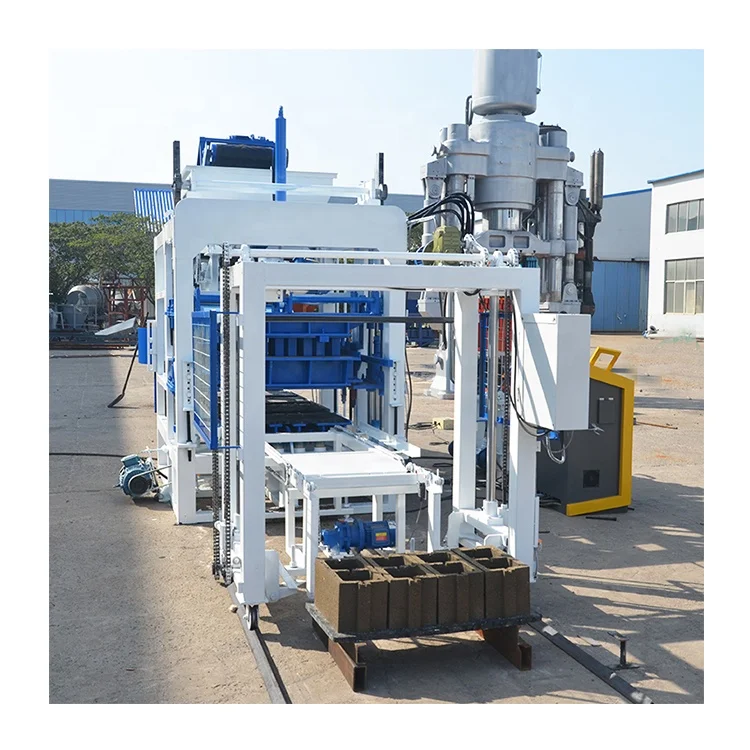
Line-Wide Cycle Matching — we configure the QT4-18 press together with its mixer, pallet return and stacking stations so the stated moulding cycle translates into actual daily output rather than a theoretical peak.
Technical Specifications
| Parameter | Value |
|---|---|
| Product Type | Stationary Block Making Machine |
| Host Machine Power | 27.5 kW |
| Moulding Cycle | 15 s (basis to be confirmed) |
| Host Machine Dimensions | 7100 × 1600 × 2610 mm |
| Pallet Size | 1020 × 570 mm |
| Weight of Host Machine | 5 T |
| Vibration Force | 40 kN |
| Mixer Model | JS500 |
| Voltage | 380 V |
| General Water Consumption | 4 T per day |
| Workers Required | 3–4 |
| Workshop Area | 150 m² |
Application Suitability
| Application | Material or Output |
|---|---|
| Hollow block production | Crushed stone, sand, cement, fly ash |
| Paver block production | Fine aggregate, cement, pigment |
| Solid block production | Coarse aggregate, cement, quarry dust |
Why the Mixer Must Match the Moulding Cycle
A complete block making machine production line succeeds or fails on timing between stations, not on the press alone.
Buyers often focus on the host machine cycle time without checking whether upstream and downstream equipment can sustain that pace. When the JS500 mixer discharge rate falls behind the QT4-18 cycle, the press sits idle while wet mix waits in the hopper. When the pallet return conveyor cannot deliver a clean, dry board in time, the press waits again. Each idle gap compounds across a shift and the daily count drops well below expectation [NEED_CITE: production line cycle time reconciliation principles]. The block making machine production line must therefore be calculated as a chain of matched intervals, not as a single press rating.
How the Pallet Loop Dictates Real Throughput
The 1020 × 570 mm pallet dimension governs not only what block formats the QT4-18 can produce but also how many boards circulate through the curing zone at any given moment. If the curing rack spacing or forklift tine width on site does not match this pallet, boards must be respaced by hand before stacking, adding labour and slowing the return loop. Specifying the pallet against the buyer’s existing curing layout is the first step in a turnkey block plant conversation.
Mixer, Batching and Continuous Feed Alignment
The JS500 mixer must discharge a full batch before the next moulding cycle begins, otherwise the press waits. We calculate mixer charge time, mixing duration and discharge time against the 15-second press interval to confirm whether continuous feed is realistic or whether a larger mixer or buffer hopper is needed. This is where a block making machine production line either flows or bottlenecks [NEED_CITE: JS500 mixer discharge timing versus block press cycle].
Reading the Specs Against Your Site Conditions
Vibration force at 40 kN combined with hydraulic pressure determines block density and demoulding strength. If local aggregate is rounded river gravel rather than crushed stone, the vibration setting may need adjustment to achieve the same compaction. The 380 V electrical supply must match site transformer capacity, including starting current for the 27.5 kW main motor. Workshop area of 150 m² must accommodate raw material storage, the press itself, curing racks and finished block staging; we verify this against the buyer’s plot plan before confirming the layout.
What Happens When Line Stations Are Specified in Isolation
When pallet handling, stacking and curing are not included in the initial quotation, fresh blocks end up stacked by hand at the end of the conveyor. The quoted cycle rate becomes unreachable because workers cannot clear boards fast enough. Pallets pile up, green blocks chip, and the press operator slows the machine to wait. Every station around the QT4-18 must be budgeted and timed from day one [NEED_CITE: block plant auxiliary equipment impact on daily output].
Why We Configure the Line as One System
Block machinery is our single focus, so the press, mould, pallet and handling equipment are specified as one matched set rather than assembled from separate suppliers. Configuration starts from the buyer’s actual mix design and target block format, not a catalogue default. Mould design covers the formats the buyer’s market sells, including custom drawings. Automation level is selectable so a buyer can begin with manual pallet handling and add stacking later. Installation support includes operator training on the full line, not just the host machine.
Documentation & Verification
- Line layout drawing showing each station and the block format assumed for cycle calculation
- Machine specification sheet covering host power, vibration force and pallet dimensions
- Mould drawing and format list matched to buyer’s target products
- Hydraulic and electrical schematic including 380 V wiring and control language
- Factory test record run on the buyer’s specified block format before dispatch
- Voltage, frequency and PLC display language confirmation sheet signed before production
Installation, Commissioning & Support
- Foundation plan based on 7100 × 1600 mm footprint and 5 T static load plus dynamic vibration
- Dedicated circuit sized for 27.5 kW host motor starting current and JS500 mixer draw
- Machine delivered in modular sections; reassembly supervised by our technician on site
- First-run cycle test across selected block formats to verify 15 s interval under load
- Operator training covering mould change procedure and daily pallet inspection routine
- Wear parts list with reorder lead times for hydraulic seals and mould liners
Tell Us About Your Line Before We Quote
We need to know the block formats you sell, the daily volume you target, the aggregate and cement available locally, and the curing space you can allocate. Share your existing forklift and curing rack dimensions so the 1020 × 570 mm pallet can be checked against them. Confirm local voltage and frequency plus your preferred PLC display language so the electrical package is built correctly before shipment.
Frequently Asked Questions
Q: How is the 15-second moulding cycle verified, and which block format does it assume?
A: The cycle time depends on block height, wall thickness and mix consistency. We confirm the figure against a specific format — for example a 400 × 200 × 200 mm hollow block — and document the assumption in the capacity calculation so both sides agree on what the number means before the order is placed.
Q: Which stations around the press are included in a standard turnkey block plant quote?
A: The base package covers the QT4-18 host, JS500 mixer and pallet feeder. Stacker, curing rack handling and cubing are listed as optional line items so buyers see exactly which stations are included and can add automation later without redesigning the whole layout.
Q: What happens if the JS500 mixer discharge cannot keep pace with the press?
A: The press idles between cycles and daily output falls below the calculated figure. We verify mixer batch volume and discharge time against the press cycle during proposal stage and recommend a larger mixer or buffer hopper if the timing gap exceeds an acceptable margin.
Q: Is the 150 m² workshop area enough for raw material, press, curing and staging?
A: That figure covers the press zone, mixer, pallet return and a basic curing rack bank. If you plan higher daily output or need larger raw material stockpiles, we revise the layout to show the extra metres required before you commit to a building envelope.
Q: How are pallet size, curing rack spacing and forklift compatibility confirmed before shipment?
A: We ask for photographs and dimensions of your existing curing racks and forklift. The 1020 × 570 mm pallet is then checked against those measurements; if spacing differs we adjust pallet dimensions or rack design before the line enters production.


