
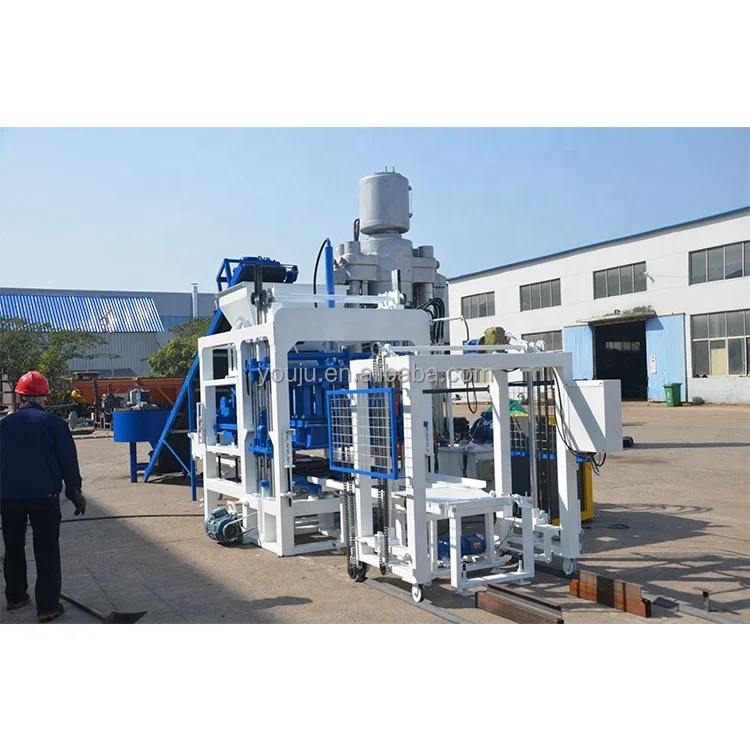
Line-Matched Throughput — The QT4-18 is specified as the centre of a complete block line where mixer batch time, conveyor speed and stacker rhythm are all set against the 18–25 s moulding cycle so the press never idles.
Technical Specifications
| Parameter | Value |
|---|---|
| Model | QT4-18 |
| Product Type | Semi-automatic Block Making Machine |
| Overall Dimensions (L×W×H) | 2500×1750×2200 mm |
| Rated Pressure | 16 MPa |
| Vibration Form | Platform Vibration |
| Pallet Size | 950×550 mm |
| Molding Cycle | 18–25 s |
| Overall Power | 27.5 kW |
| Control System | PLC with frequency converter |
| Mould Lifting Mechanism | Double-sided synchronous gears |
| Electrical Components | Schneider |
| Automation Level | Semi-automatic (manual pallet handling, automatic molding cycle) |
| Supporting Equipment | JQ500 pan mixer, 8 m belt conveyor (6 m optional), stacker, block clamper, cement silo, batching plant, trolley |
| Mould Change Method | Manual |
Application Suitability
| Application | Material or Output |
|---|---|
| Hollow block production for masonry walls | Cement, sand, crushed stone, fly ash |
| Solid block production for load-bearing structures | Cement, coarse aggregate, sand |
| Paving block production for walkways and yards | Cement, fine aggregate, pigment |
| On-site block production for housing projects | Locally sourced sand, gravel and cement |
What "Cycles per Hour" Leaves Out When the Line Is Not Matched
A press quoted at cycles per hour tells you nothing about daily output until every upstream and downstream station is timed to the same rhythm.
I have stood on project sites in the Gulf where a block press sat idle for six seconds every cycle because the belt conveyor could not deliver a fresh pallet fast enough. The press was rated for a certain number of cycles, but the line around it was assembled from separate suppliers who never compared notes. The daily tally fell far short of what the buyer expected, and the contractor blamed the machine [NEED_CITE: common causes of block line throughput shortfall]. With the QT4-18 semi-automatic block making machine production line, the mixer, conveyor and stacker are sized together before the order is locked, so the 18–25 s moulding window is fully used.
How Each Station Keeps Pace with the Press
The JQ500 pan mixer discharges a batch in time for the next moulding stroke, while the 8 m belt conveyor carries the mix into the hopper without overflow or starvation. The frequency converter inside the PLC cabinet lets the operator fine-tune conveyor speed against the actual batch weight, preventing the press from waiting on material or the hopper from flooding.
Where the Pallet Loop Breaks Down First
A 950×550 mm pallet leaves the press, rides the block receiver conveyor to the stacker, and then travels to the curing yard. If the curing racks are spaced for a different pallet length, or the forklift forks are too short for the 550 mm width, the pallet piles up at the stacker exit and the press operator runs out of empty pallets to feed back in. Confirming pallet dimensions against the curing yard and forklift before the line ships removes this bottleneck [NEED_CITE: pallet handling constraints in small block plants].
Reading the Numbers That Actually Matter
The 16 MPa rated hydraulic pressure works with platform vibration to compact the mix inside the mould. Higher pressure alone does not guarantee block density if the vibration frequency does not match the aggregate size; the two must be set together for the specific mix the buyer will run. The double-sided synchronous gear lift keeps the mould box level during extraction, reducing corner cracks on hollow blocks where wall thickness is already thin. A PLC with frequency converter gives the operator control over moulding cycle length, allowing a longer cycle for a drier mix or a shorter one for a wetter paver blend, always within the 18–25 s range. Electrical components from Schneider mean replacements can be sourced in most industrial markets without waiting for a proprietary part.
What Happens When Stations Are Sourced Separately
A contractor once added a third-party stacker that cycled two seconds slower than the press. Every third moulding stroke, the stacker was still in place, and the press operator had to pause or risk dropping a wet block on the conveyor. That two-second mismatch cost roughly one pallet of output per shift, and the contractor spent weeks rewiring signals between two PLCs that were never designed to talk to each other [NEED_CITE: PLC integration issues across mixed-brand block lines].
Why Buyers Specify the Whole Line Here
Block machinery is the single focus of this workshop, so the QT4-18 press, mould, pallet and handling equipment leave as one matched set. The line is configured against the buyer’s actual mix design and local aggregate, not a catalogue default. Mould design covers the formats the buyer’s market sells, with custom drawings available. The automation level starts semi-automatic, leaving room to add automatic pallet feeding later. Installation and commissioning include operator training on the full line, not just the press.
Documentation & Verification
- Line layout drawing stating capacity per block format and station timing
- Pallet specification sheet cross-referenced with curing yard dimensions
- Voltage, frequency and PLC language confirmation before production
- Factory test record running the buyer’s target block format on the full line
- Hydraulic and electrical schematic for local maintenance teams
Installation, Commissioning & Support
- Foundation plan sized to the 2500×1750 mm footprint and 27.5 kW total load
- Dedicated circuit with breaker rating matched to the 27.5 kW draw and local voltage
- Press shipped partially dismantled; reassembly includes vibration platform re-torque
- First production run supervised until block density and cycle rhythm stabilise
- Spare mould wear plates and hydraulic seals listed for first reorder
What to Include in Your First Inquiry
Send the block format you sell most, the daily output target, and the aggregate available near your site. Share the curing yard dimensions and the forklift model already on the floor so the pallet size can be confirmed. State the local voltage and frequency, and the language you need on the PLC display.
Frequently Asked Questions
Q: How is the line capacity calculated, and which block format is it based on?
A: Capacity is quoted per block format, not as a single cycles-per-hour figure. The calculation uses the 18–25 s moulding cycle, the number of cavities in the specific mould, and the mixer batch time. A 400×200×200 mm hollow block will show a different daily total than a paving block, so the layout document states the format assumed.
Q: Will the 950×550 mm pallet fit my existing curing racks and forklift?
A: That pallet size must be checked against your rack spacing and forklift fork length before the order is confirmed. If the racks are narrower or the forks shorter, a custom pallet spec is drafted so the stacker and block receiver conveyors are adjusted accordingly.
Q: How do mixer, conveyor and stacker cycles stay matched to the press?
A: The JQ500 mixer batch time and 8 m belt speed are set so a fresh mix arrives before the hopper runs low. The PLC frequency converter lets the operator tune the moulding cycle against upstream and downstream timing, keeping the press busy throughout the shift.
Q: What voltage, frequency and PLC language are confirmed before shipping?
A: A written confirmation document covering supply voltage, phase, frequency and PLC display language is signed off before the line enters production. This prevents rewiring or PLC reprogramming delays once the equipment reaches your site.
Q: Which supporting stations are included in the quotation?
A: The standard package covers the JQ500 pan mixer, 8 m belt conveyor, stacker, block clamper and trolley. A cement silo and batching plant are available as optional additions. Extra moulds can be specified to the block formats your market requires.


