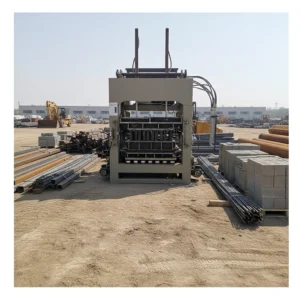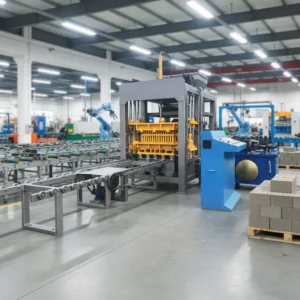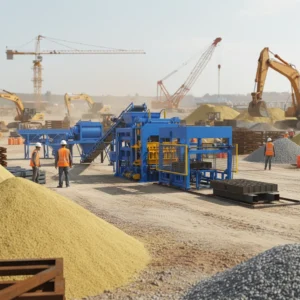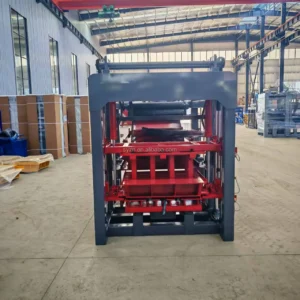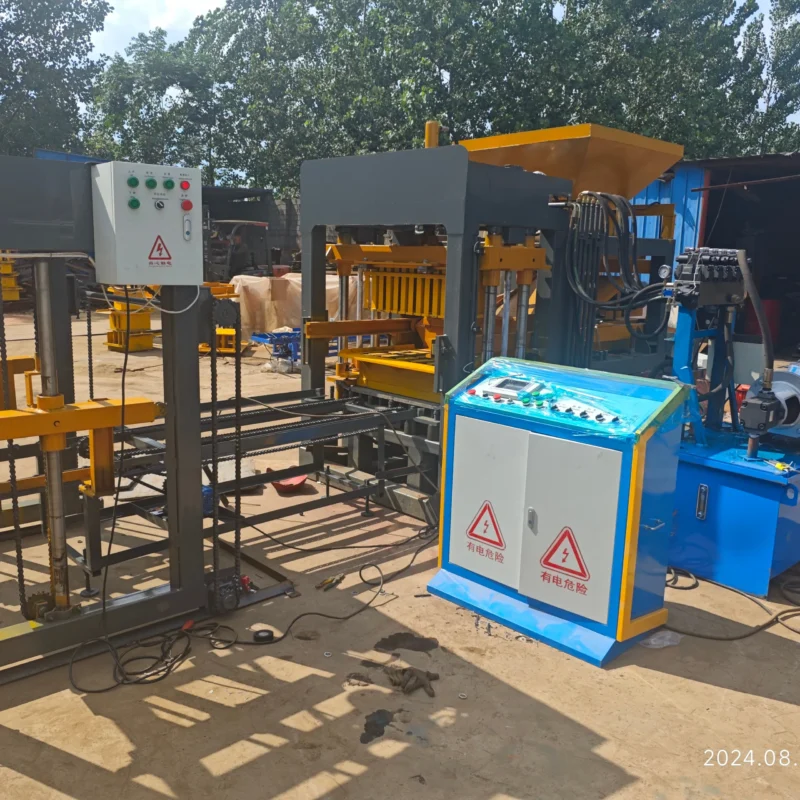
Line-Wide Synchronization — The QT4-18 block production line equipment is configured so the mixer, pallet feeder, and press cycle times are matched before dispatch, preventing the bottleneck that occurs when supporting stations are sourced separately.
Technical Specifications
| Parameter | Value |
|---|---|
| Model | QT4-18 |
| Product Type | Fully Automatic Concrete Block Making Machine |
| Overall Dimensions (L×W×H) | 3900×1600×2300 mm |
| Total Weight | 3T |
| Rated Power | 24KW |
| Molding Cycle | 15-25s |
| Vibration Force (Exciting Power) | 40-50KN |
| Mixer Model | JQ350 |
| Pallet Size | 850×550×25mm |
| Hydraulic System | Hydraulic station for high pressure and stable running |
| Applied Products | Paver, solid block, hollow block, curbstone |
| Output Capacity (Hollow Block 400×200×200mm) | 1200-1680 Pcs/Hr, 9600-13440 Pcs/8hr |
| Output Capacity (Hollow Block 400×150×200mm) | 1800-2400 Pcs/Hr, 14400-19200 Pcs/8hr |
| Output Capacity (Solid Brick 240×115×53mm) | 3240 Pcs/Hr, 16200-19440 Pcs/8hr |
| Automation Level | Semi-automatic / Full Automatic options available |
| Standards | CE declaration where applicable |
Application Suitability
| Application | Material or Output |
|---|---|
| Hollow block production plants | Crushed stones, sand, cement, fly ash forming 400×200×200mm and 400×150×200mm blocks |
| Solid brick manufacturing | Cement and aggregate mixes producing 240×115×53mm standard bricks |
| Paver and curbstone production | High-density concrete mixes for interlocking pavers and kerbstones |
| On-site contractor block production | Local aggregate and cement for project-specific block formats |
| Building material distributor product lines | Multiple format output from a single press with mould changes |
Why the Supporting Block Making Equipment Matters More Than the Press Alone
A press that cycles every 15-25 seconds is useless if the mixer cannot deliver a fresh batch in time or the pallet feeder jams on the return loop.
I spent years watching block production line equipment underperform not because the press was wrong, but because the stations around it were mismatched. A client once paired a fast-cycling press with an undersized mixer — the press sat idle nearly half the time waiting for material. The daily output fell far below what the press alone was rated to produce. That is the gap between catalogue capacity and actual throughput, and it is where most line configurations fail [NEED_CITE: common causes of block line throughput shortfall].
How the JQ350 Mixer Keeps Pace with the Press Cycle
The JQ350 mixer is selected specifically to match the QT4-18’s 15-25 second molding cycle. When the supporting block making equipment is sized correctly, each batch arrives at the hopper before the press completes its current cycle, eliminating the dead time that kills daily output. The raw material feeding configuration — whether loading crushed stone, sand, cement, or fly ash — must also be calibrated so that the mixer receives consistent input without surging or starving.
Pallet Circuit Management Across the Full Shift
The 850×550×25mm pallet size determines how many pallets you need in circulation for an uninterrupted 8-hour shift. Too few pallets and the press waits for returns from the curing area; too many and you are spending on inventory that sits idle. The pallet material — whether fiberglass, bamboo, or treated wood — must also suit your local curing conditions and the forklifts already in your yard. Getting this wrong means the automatic stacker has nothing to collect, and the entire line stalls at the exit end [NEED_CITE: pallet circuit sizing methodology for block plants].
Reading the Specs That Actually Determine Line Performance
The vibration force of 40-50KN working together with the hydraulic station determines block density and strength, but only when the mix design and local aggregate are accounted for during configuration. A high vibration force applied to a mix that is too wet will produce weak blocks regardless of pressure. The 24KW rated power must be verified against your site voltage and frequency before the line ships — a mismatch here delays commissioning by weeks. The 15-25 second molding cycle varies by block format: a 400×200×200mm hollow block cycles differently than a 240×115×53mm solid brick, and the supporting block making equipment must accommodate the slowest format you intend to run. The total line footprint, anchored by the 3900×1600×2300mm press dimensions plus mixer, conveyor, and stacker stations, defines your building envelope before ground is broken.
The Hidden Cost of Treating the Press as a Standalone Purchase
When the quotation covers the press but omits pallet handling, stacking, and curing rack systems, the buyer inherits a line that produces blocks faster than they can be moved. Workers end up stacking output by hand at the end of the conveyor, which caps real throughput regardless of what the press can theoretically cycle. I have seen plants where the pallet return system was an afterthought, forcing the operator to manually shuttle pallets back to the feeder — a task that pulls labor away from quality checks and mould changes [NEED_CITE: manual pallet handling impact on block line output].
Why Buyers Source the Full Line Here
Block machinery is our single focus, so the QT4-18 press, JQ350 mixer, pallet feeder, and stacker are specified as one matched system rather than assembled from separate suppliers who do not communicate on cycle times. Every line configuration is set against the buyer’s actual mix design, local aggregate, and target block format — not a catalogue default that assumes materials you cannot source. Mould design covers the formats your market actually sells, with custom drawings available when standard moulds do not match. The automation level is selectable: start with manual pallet handling and add automatic stacking later as volume grows. Installation and commissioning include operator training so the line runs at rated parameters from the first week.
Documentation & Verification
- Line layout drawing with capacity calculation stated per block format for every station
- Pallet specification sheet confirming size, material, and quantity for full-shift circulation
- Voltage, frequency, and PLC display language confirmation before production begins
- Hydraulic and electrical schematics showing press-to-feeder-to-stacker connections
- Factory test record on your target block format before container loading
Installation, Commissioning & Support
- Foundation plan based on the 3T total weight and 3900×1600×2300mm press footprint plus supporting stations
- Electrical supply verification for 24KW rated power against local voltage and frequency before dispatch
- Machine dismantling and container loading sequence documented with packing photographs
- On-site commissioning with cycle time adjustment to your specific mix and block format
- Operator training covering mould change procedure, pallet circuit management, and daily maintenance routines
- Wear parts and mould list provided with recommended replacement intervals for your production volume
What We Need to Configure Your Line
To size the supporting block making equipment around the QT4-18, share your target block formats, daily output requirement, local raw material types and availability, and the curing area layout you have or plan to build. We also need your site voltage, frequency, and preferred control language so the entire line — not just the press — arrives ready to commission.
Frequently Asked Questions
Q: How do I ensure the mixer and conveyor keep up with the QT4-18’s 15-25s cycle time?
A: The JQ350 mixer is matched to the press cycle during line design. We calculate batch volume per cycle and verify that the conveyor transfer time plus mixer discharge time fits within the shortest molding cycle for your target block format. If your mix includes fly ash or high-clay materials that slow blending, we adjust the feeder configuration accordingly before the line ships.
Q: What pallet quantity and material should I plan for an 8-hour shift?
A: Pallet count depends on your curing rack capacity and the distance between press and curing area. We calculate the total pallets in circuit — on the press, on the conveyor, in the stacker, on curing racks, and in return — based on the 850×550×25mm size. Material selection accounts for your local humidity and the forklifts already operating in your yard.
Q: Can I start semi-automatic and add pallet handling automation later?
A: Yes. The QT4-18 is available in both semi-automatic and full automatic configurations. The line layout reserves space and connection points for an automatic stacker and pallet return system, so upgrading later means adding stations rather than reconfiguring the entire press and conveyor arrangement.
Q: What raw material feeding setup does the JQ350 mixer need for consistent block density?
A: Consistent density starts with consistent input. We configure the feeding system — whether belt conveyor, screw feeder, or hopper with vibrator — based on your specific aggregate gradation and cement ratio. Materials with high moisture or clay content may need a different feeder type to prevent bridging and ensure the mixer receives a steady, measured flow each cycle.
Q: How does the line documentation confirm capacity for my specific block format?
A: The line layout includes a capacity calculation that states output per format — not a single headline number. You receive a breakdown showing cycle time, mould cavity count, and realistic hourly and daily output for each block type you plan to produce, so you can match production planning to actual line performance.