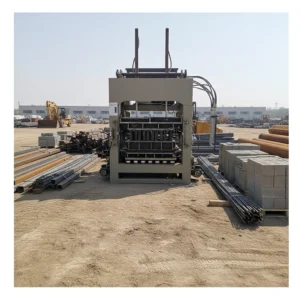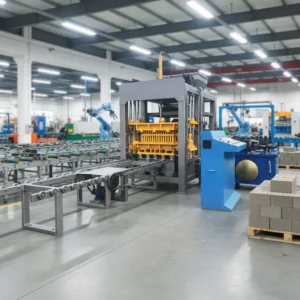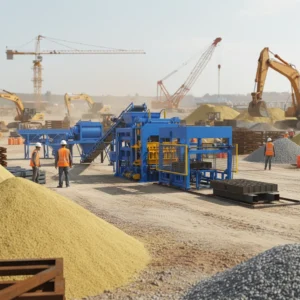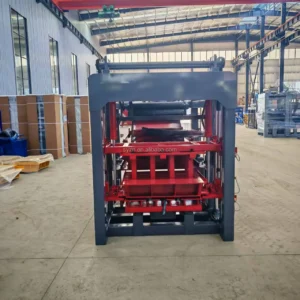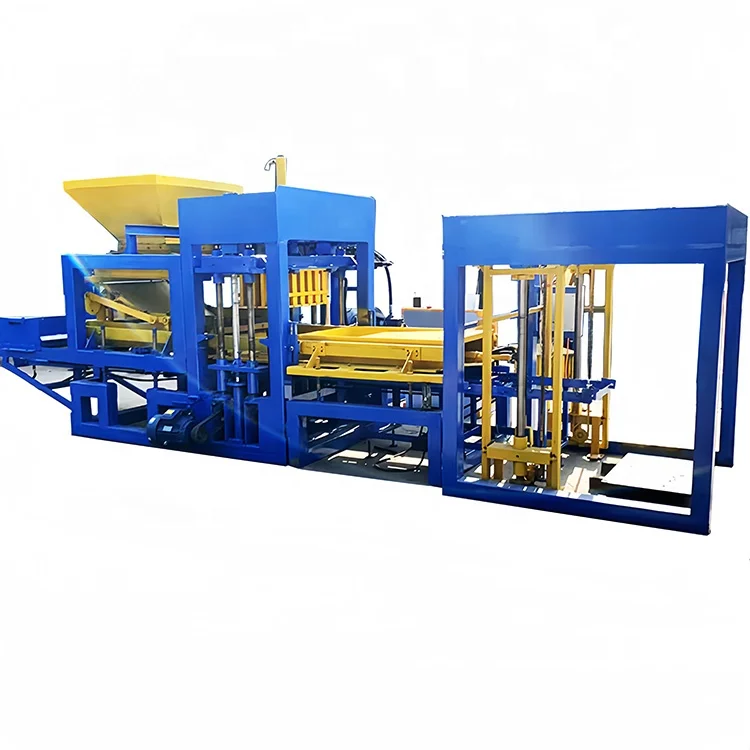
Matched Line Configuration — the QT4-18 block machine, mixer, pallet feeder, conveyor and sweeper are specified as one timed system rather than sourced as separate items.
Technical Specifications
| Parameter | Value |
|---|---|
| Product Type | Hydraulic Concrete Block Making Machine |
| Model | QT4-18 |
| Overall Dimensions (L×W×H) | 3900 × 1600 × 2300 mm |
| Molding Cycle | 15–25 s |
| Vibration Force (Exciting Power) | 40–50 kN |
| Total Power | 24 kW |
| Mixer Model (Included) | JQ350 |
| Pallet Size | 850 × 550 × 25 mm |
| Total Weight | 3 T |
| Control System | PLC control system |
| Hydraulic Station | High-pressure hydraulic system included |
| Included Line Equipment | Block making machine, hydraulic station, PLC control system, pallet feeder, brick conveyor, block sweeper |
| Output Capacity (Hollow block 400×200×200 mm) | 1200–1680 pcs/hr; 9600–13440 pcs/8hr (basis: 15–20 s cycle, 4 pcs/mould) |
| Output Capacity (Hollow block 400×150×200 mm) | 1800–2400 pcs/hr; 14400–19200 pcs/8hr (basis: 15–20 s cycle) |
| Output Capacity (Solid brick 240×115×53 mm) | 3240 pcs/hr; 16200–19440 pcs/8hr (basis: 15–20 s cycle) |
| Mould Format Options | Hollow block, solid brick, paver, curbstone |
| Automation Level | Semi-automatic (PLC-controlled with pallet feeder and conveyor) |
| Stacking Method | Manual |
| Voltage & Frequency | Configurable to site supply (confirm before order) |
| Hydraulic Pressure | Confirm with manufacturer for specific block density requirements |
| PLC Display Language | Configurable (confirm before order) |
| Free Accessories | Manual hydraulic trolley, spare parts and tools |
Application Suitability
| Application | Material or Output |
|---|---|
| Block production plants | Hollow blocks, solid bricks, pavers, and curbstones from crushed stone, sand, cement, fly ash |
| Construction contractors on-site | Pavers and solid blocks for project-specific needs using local aggregates |
| Entrepreneurs setting up a first plant | Moderate-volume output of standard formats with manageable investment |
| Manufacturers expanding product range | Additional block formats via mould change on an existing production footprint |
Why the Mixer Feed Rate Dictates Your Real Daily Output
A fast press idling for a slow mixer is the most common hidden loss in block plant layout.
Many buyers focus entirely on the cycle time of the host machine, forgetting that the raw material must arrive at the hopper at the exact rhythm the press demands. If the JQ350 mixer or the belt conveyor cannot clear a batch within the 15–25 second molding window, the QT4-18 waits, and the daily output drops regardless of the machine’s rated speed. This mismatch is rarely visible in a catalogue [NEED_CITE: typical block line bottleneck causes in small to medium plants]. It only appears once the line is running and the operators are standing around waiting for the next batch to drop.
Synchronizing the Feeder, Press and Conveyor Loop
The concrete block making machine production line functions as a continuous loop where the pallet feeder must advance a fresh board the instant the press finishes a cycle. On the QT4-18 setup, the PLC control system coordinates this timing so the vibration and hydraulic pressure are applied only when a pallet is correctly seated. If the conveyor lags, the sweeper cannot clear the table, and the entire sequence pauses.
Designing the Line Around the Block Format You Actually Sell
Output figures change drastically depending on whether you are running 400×200×200 mm hollow blocks or standard solid bricks. A line configured for high-volume solid brick production requires a faster pallet return speed than one running large hollow blocks, because the cycle time is shorter and the mould fills more frequently. Specifying the conveyor speed and mixer batch size against the target format ensures the auxiliary equipment does not become the limiting factor [NEED_CITE: block format impact on line synchronization and daily capacity].
Interpreting the Vibration and Hydraulic Balance
The 40–50 kN vibration force works in tandem with the high-pressure hydraulic station to compact the mix into the mould. For porous pavers or face-mix blocks, this balance must be adjustable to avoid crushing the aggregate structure or leaving weak edges. The 24 kW total power rating covers the host machine, the hydraulic pump and the feeder motors, meaning the electrical supply must be sized to handle the peak draw when all stations start simultaneously. The 850 × 550 × 25 mm pallet size is fixed, so the curing rack spacing and forklift tines must be planned to match this dimension before the line arrives.
The Cost of Ignoring the Pallet Return Speed
When the pallet return system is undersized, the press completes its cycle and then sits idle while the board travels back to the start. Over an eight-hour shift, these few seconds of dead time accumulate into thousands of missing blocks. Buyers often blame the host machine for low output, not realizing the bottleneck was in the return conveyor they treated as an afterthought. This leads to unnecessary wear on the clutch and motor as they start and stop out of rhythm [NEED_CITE: impact of auxiliary equipment mismatch on press wear and daily yield].
Why We Specify the Line as a Single Package
We focus on block machinery as a single discipline, so the QT4-18 is never quoted without confirming that the JQ350 mixer volume and the conveyor speed match the target cycle. The pallet specification is tied to the curing area and forklift the buyer already owns, avoiding a situation where the boards do not fit the racks. Voltage, frequency and PLC display language are confirmed before production begins, preventing delays at commissioning. Every configuration is set against the buyer’s actual mix design and local aggregate, not a default catalogue setting.
Documentation & Verification
- Line layout drawing showing station positions and material flow from the JQ350 mixer through to the block exit point.
- Capacity calculation stating the specific block format and cycle time assumed for each output figure.
- Pallet specification sheet confirming the 850 × 550 × 25 mm size, material grade and quantity included.
- Factory test record demonstrating the PLC timing between the pallet feeder, press and conveyor under load.
- Voltage and control language confirmation sheet signed off before the electrical panel is wired.
Installation, Commissioning & Support
- Foundation plan detailing the load points for the 3 T machine weight and the vibration isolation requirements.
- Electrical schematic listing the 24 kW total draw and the dedicated circuit needed for the hydraulic station.
- PLC parameter sheet showing the adjustable timer settings for the 15–25 s molding cycle range.
- Operator training covering the mould change procedure for switching between hollow block and paver formats.
- Wear parts list identifying the high-wear items in the hydraulic station and vibration box for first-year spares planning.
What We Need to Configure Your Line
To size the concrete block making machine production line correctly, we require the specific block formats you intend to sell and the daily volume target for each. Please provide the local raw material source, particularly the aggregate type and cement grade, so the mixer and vibration settings can be matched to your mix design. Confirming the available voltage, frequency and the language required for the PLC display ensures the control system is ready for immediate start-up upon arrival.
Frequently Asked Questions
Q: How are the mixer batch size and conveyor speed matched to the QT4-18 press cycle?
A: We calculate the batch volume of the JQ350 mixer against the mould fill requirement and the 15–25 s cycle time. The conveyor motor speed is then set so that a fresh pallet arrives at the press table exactly as the previous one is discharged, ensuring the host machine never idles due to upstream or downstream delays.
Q: What block format is the output capacity based on, and how does that affect my daily plan?
A: The quoted output figures are specific to the block dimensions listed in the specifications, such as the 400×200×200 mm hollow block at a 15–20 s cycle. If you switch to a larger format or a slower cycle for a denser mix, the daily output will decrease proportionally, which is why we calculate capacity per format rather than offering a single maximum number.
Q: Is the 850 × 550 × 25 mm pallet size compatible with standard curing racks?
A: This pallet size is a common standard, but curing racks and forklift tines vary by region and supplier. We confirm your existing rack dimensions and handling equipment before finalizing the pallet specification to ensure the boards fit your curing area without requiring modification or custom handling gear.
Q: Which line stations are included in the quotation and which are optional?
A: The standard package includes the block making machine, hydraulic station, PLC control system, pallet feeder, brick conveyor and block sweeper. Automatic stacking, curing rack handling and cubing systems are optional additions that can be integrated later if the production volume or labor cost justifies the upgrade.