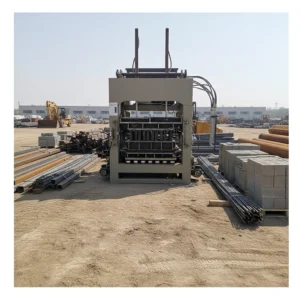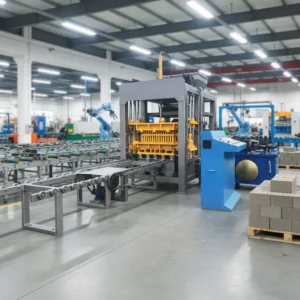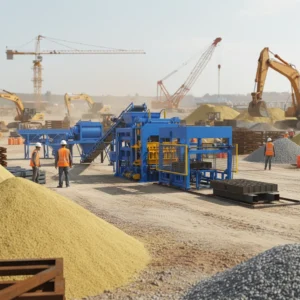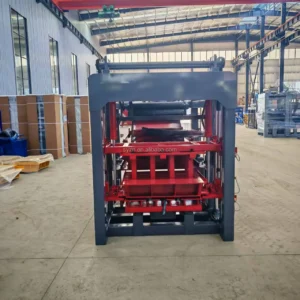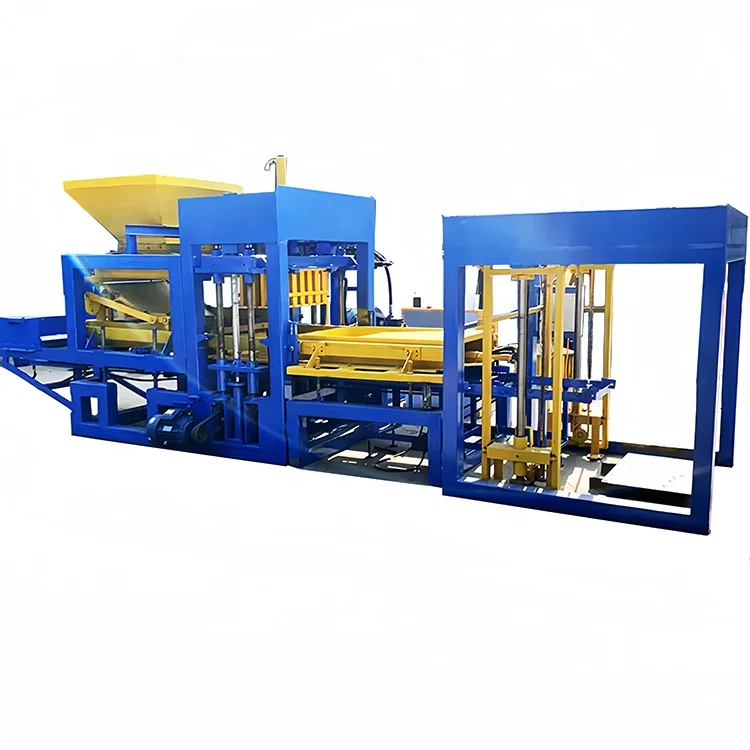
Matched System Engineering — the QT4-18 line balances press cycle, pallet feeding and conveying so no station starves the next, preventing the half-capacity surprise that hits when handling gear is sourced separately.
Technical Specifications
| Parameter | Value |
|---|---|
| Model | QT4-18 |
| Product Type | Automatic Hydraulic Concrete Block Making Machine |
| Overall Dimensions (L×W×H) | 3900×1600×2300 mm |
| Moulding Cycle | 15–25 s (basis not stated in source — confirm block format / material / thickness) |
| Vibration Force (Exciting Power) | 40–50 kN |
| Total Installed Power | 24 kW |
| Mixer Model | JQ350 |
| Pallet Size | 850×550×25 mm |
| Net Weight | 3 T |
| Control System | PLC control system |
| Hydraulic Station | Integrated |
| Included Line Equipment | Block making machine, hydraulic station, PLC control system, pallet feeder, brick conveyor, block sweeper |
| Output — Hollow Block 400×200×200 mm | 1200–1680 pcs/hr (based on 15–20 s cycle) |
| Output — Hollow Block 400×150×200 mm | 1800–2400 pcs/hr (based on 15–20 s cycle) |
| Output — Solid Brick 240×115×53 mm | 3240 pcs/hr (based on 15–20 s cycle) |
| 8-Hour Output — Hollow 400×200×200 mm | 9600–13440 pcs/8 hr |
| 8-Hour Output — Hollow 400×150×200 mm | 14400–19200 pcs/8 hr |
| 8-Hour Output — Solid 240×115×53 mm | 16200–19440 pcs/8 hr |
| Applicable Products | Paver, solid block, hollow block, curbstone |
| Raw Materials | Crushed stones, sand, cement, dust, fly ash |
Application Suitability
| Application | Material or Output |
|---|---|
| Hollow block production for masonry walls | Crushed stone, sand, cement, fly ash blends |
| Solid brick manufacturing for load-bearing structures | Sand and cement mixes with fine aggregate |
| Paving block runs for driveways and walkways | High-density crushed stone and cement |
| Curbstone and kerb production for road edges | Coarse aggregate with cement binder |
| On-site block production for housing projects | Locally sourced sand, dust and cement |
Why "Rated Output per Hour" Misses the Real Bottleneck on a Block Line
A press only runs as fast as the slowest station around it.
I once watched a buyer receive a block press rated at an impressive hourly figure, only to find the pallet feeder could not keep pace once the mix got sticky in humid weather. The press sat idle while operators hand-fed pallets, and daily tonnage dropped to a fraction of the brochure number [NEED_CITE: typical cycle mismatch losses in concrete block production]. When evaluating a concrete block making machine production line, the question is never just what the press can do in isolation — it is whether the pallet feeder, brick conveyor and sweeper are timed to hand work back to the press before the next moulding cycle begins.
How Station Timing Keeps the Press Fed
The QT4-18 line ships with a pallet feeder, brick conveyor and block sweeper already matched to the press cycle. The PLC control system coordinates feeder advance with mould descent, so a fresh pallet is in position before the press completes its vibration and lift sequence. This removes the dead seconds that accumulate into lost thousands of blocks over a shift.
Where Block Line Supporting Equipment Decides Daily Tonnage
Block machine supporting equipment is often treated as an afterthought, quoted separately or left to local fabricators. On this line, the brick conveyor carries wet blocks away at a speed calibrated to the moulding cycle, while the sweeper clears pallet faces before they return to the feeder. If any of these stations lag, the press waits — and the rated output becomes theoretical rather than actual [NEED_CITE: importance of integrated line design in block plant throughput].
Reading the Specs Beyond the Press
The 40–50 kN vibration force and integrated hydraulic station work together: hydraulic pressure compacts the mix while vibration settles aggregate into voids. The result is a block that holds its shape on the conveyor without slumping. The 850×550×25 mm pallet size is not arbitrary; it dictates the curing rack spacing and forklift tine width the plant will need downstream. Buyers who check pallet dimensions against their existing curing area before ordering avoid a costly rack rebuild after the line arrives.
The Cost of Sourcing Stations Separately
When a plant owner buys the press from one supplier and the feeder from another, timing signals rarely align on first power-up. Operators end up running the press in manual mode, feeding pallets by hand, which defeats the automation the PLC was supposed to deliver. Mismatched conveyor speeds also cause wet blocks to collide, chipping edges and raising the reject pile [NEED_CITE: common faults from mismatched block line stations].
Why Buyers Specify the Whole Line Here
The QT4-18 is quoted as one matched system: press, hydraulic station, pallet feeder, brick conveyor and sweeper on a single packing list. Configuration starts with the buyer’s actual block format and local aggregate, not a catalogue default. Pallet size is confirmed against the curing racks the buyer already has. Voltage, frequency and PLC display language are locked before production begins, so commissioning is not delayed by a wrong motor winding or an unreadable screen. Factory testing covers the full line running together, not just the press on a bench.
Documentation & Verification
- Line layout showing pallet feeder and conveyor positions relative to the press
- Capacity calculation sheet stating the block format assumed for each output figure
- Pallet specification matched to buyer’s curing rack and forklift dimensions
- Hydraulic and electrical schematic for local maintenance teams
- Factory test record covering full line cycle before dispatch
Installation, Commissioning & Support
- Foundation plan referencing the 3900×1600 mm press footprint and 3 T net weight
- Power supply checklist for the 24 kW total load across press, mixer and conveyor
- JQ350 mixer positioning relative to the block making machine feed hopper
- PLC language and voltage confirmed before production to avoid on-site rewiring
- Operator training on pallet feeder timing adjustment and mould change procedure
- Wear parts list covering hydraulic seals, vibration motor brushes and conveyor belts
What to Share When Requesting a Line Proposal
To size the QT4-18 line accurately, provide the target block format and daily output you need to hit, the local aggregate and cement type available, and the curing area dimensions already on site. Confirm the plant voltage and frequency, the PLC language your operators read, and whether existing forklifts or racks constrain pallet size.
Frequently Asked Questions
Q: How do the pallet feeder and brick conveyor cycle times match the press to avoid idle press time?
A: The PLC control system on the QT4-18 coordinates pallet advance with mould descent and lift. The feeder releases a pallet so it arrives before the press completes its vibration cycle, and the conveyor speed is set to carry blocks clear before the next pallet enters. This timing is verified during factory testing.
Q: What block formats are included in the quoted output, and what happens when switching moulds?
A: Output figures are stated for 400×200×200 mm hollow blocks, 400×150×200 mm hollow blocks and 240×115×53 mm solid bricks, each based on a 15–20 s cycle. Switching formats requires a mould change; the time this takes depends on the mould clamping system chosen and should be factored into daily planning.
Q: Is the 850×550×25 mm pallet compatible with my existing curing racks and forklift?
A: Check rack slot width and forklift tine spacing against this pallet size before ordering. If your curing area uses different dimensions, pallet size can be discussed during configuration so that racks, forklift and line remain aligned from day one.
Q: What supporting equipment is included in the quotation, and what must I source separately?
A: The QT4-18 line includes the block making machine, hydraulic station, PLC control system, pallet feeder, brick conveyor, block sweeper and a JQ350 mixer. Raw material silos, curing racks and forklifts are typically buyer-supplied unless added to the scope.
Q: How is the full line commissioned before shipment?
A: The press, pallet feeder, conveyor and sweeper are wired together and run as one system during the factory test. Cycle timing, hydraulic pressure and vibration force are recorded, and the test record is shared with the buyer before the line is dismantled for container loading.