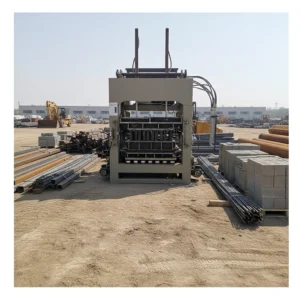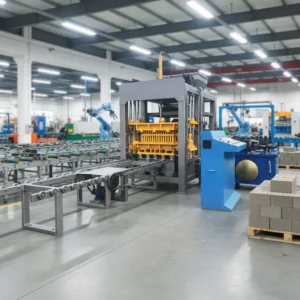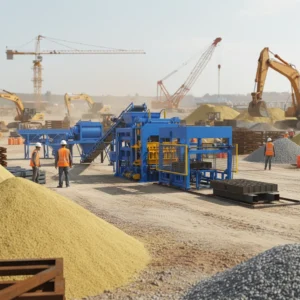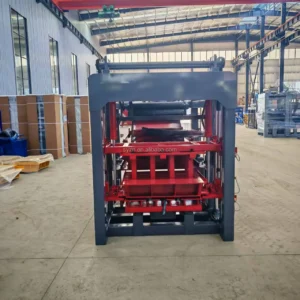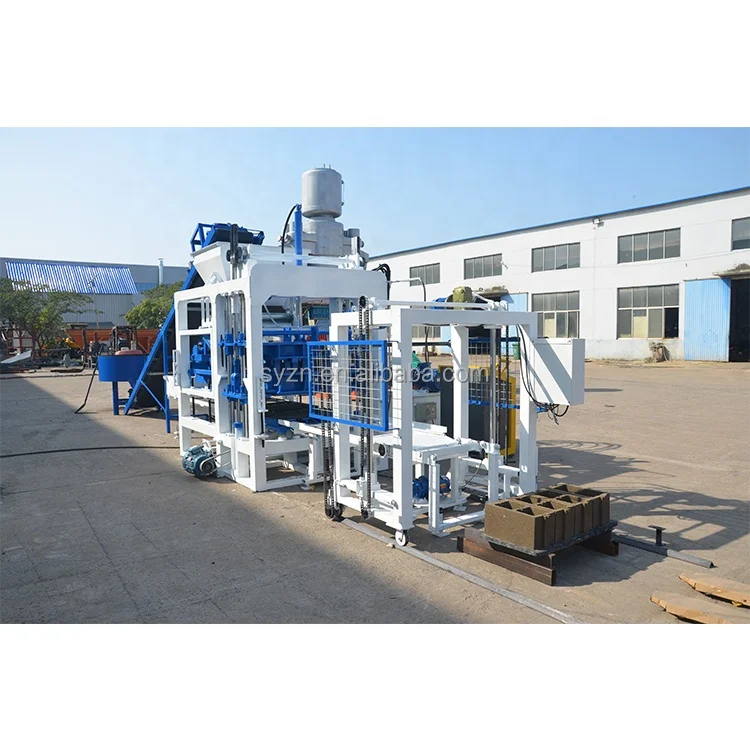
Line-Scale Matching — Every station on the QT4-18 concrete block making machine line is specified so that pallet feeding, block sweeping and conveying hold pace with the 15-25 s press cycle, preventing the press from idling between stations.
Technical Specifications
| Parameter | Value |
|---|---|
| Model | QT4-18 |
| Product Type | Automatic Hydraulic Concrete Block Making Machine |
| Overall Dimensions (L×W×H) | 3900×1600×2300 mm |
| Molding Cycle | 15-25 s |
| Vibration Force (Exciting Power) | 40-50 kN |
| Total Power | 24 kW |
| Mixer Model | JQ350 |
| Pallet Size | 850×550×25 mm |
| Net Weight | 3 T |
| Applied Products | Paver, solid block, hollow block, curbstone |
| Raw Materials | Crushed stones, sand, cement, dust, fly ash |
| Control System | PLC control system |
| Hydraulic System | Hydraulic station included |
| Output Capacity (400×200×200 mm hollow block) | 1200-1680 pcs/hr (basis: stated block format) |
| Output Capacity (400×150×200 mm hollow block) | 1800-2400 pcs/hr (basis: stated block format) |
| Output Capacity (240×115×53 mm solid brick) | 3240 pcs/hr (basis: stated block format) |
| Included Equipment | Block making machine, hydraulic station, PLC control system, pallet feeder, brick conveyor, block sweeper |
| Free Accessories | Manual hydraulic trolley, spare parts and tools |
| Voltage & Frequency | To be confirmed with buyer’s local grid |
| Automation Level | Automatic (pallet feeder, conveyor, sweeper included) |
| Mould Change System | (basis not stated in source) |
| Stacking Method | (basis not stated in source) |
| Standards | CE declaration (where applicable) |
Application Suitability
| Application | Material or Output |
|---|---|
| Hollow block production for masonry walls | Crushed stone, sand, cement, fly ash, dust |
| Solid brick manufacturing for load-bearing structures | Cement-aggregate mix with local sand |
| Paving stone production for driveways and walkways | High-density mix with fine aggregates |
| Curbstone and kerbstone for road infrastructure | Coarse aggregate and cement blends |
| On-site block production by construction contractors | Locally sourced crushed stones and cement |
| Multi-format output for concrete product manufacturers | Format changes via mould swap on the same line |
What "Pieces per Hour" Leaves Out in a Block Production Line
A press quoted in isolation rarely tells you what the line will actually produce in an eight-hour shift.
Most buyers focus on the cycle time of the block production line press itself, but the real bottleneck often sits upstream at the mixer or downstream at the pallet handling station. I once watched a fully automatic hydraulic concrete block making machine line sit idle for nearly half the day because the pallet feeder could not keep up with the press, and the conveyor jammed every time the sweeper fell behind. The press was rated well, but the surrounding stations had been sourced separately and never synchronized [NEED_CITE: block production line station synchronization practices]. Capacity figures only hold meaning when every station from raw material feed to wet block output is timed against the same molding cycle.
Station Interfaces Defined Before the Line Ships
The QT4-18 block production line package includes the hydraulic press, PLC control system, pallet feeder, brick conveyor and block sweeper as one quoted unit. Rather than assembling stations from separate vendors and discovering timing mismatches during commissioning, the interfaces between pallet feed rate, press cycle and conveyor speed are matched at the specification stage. This approach removes the most common cause of idle press time in a concrete block making machine line: a station that is either too fast or too slow for the cycle next to it.
Pallet Specification Locked to Downstream Handling
Pallet size on this line is set at 850×550×25 mm, a dimension that directly determines curing rack spacing, forklift tine width and the layout of the wet block transfer area. Confirming this measurement against your existing curing infrastructure before production begins avoids a situation where pallets arrive and cannot fit the racks already on site [NEED_CITE: pallet dimension standards in concrete block production]. The pallet feeder is sized to deliver boards at a rate consistent with the 15-25 s molding window, so the press does not wait for the next board to register.
Reading the Numbers Behind the Press Cycle
The vibration force range of 40-50 kN works in combination with the hydraulic station to compact the mix inside the mould cavity. Higher vibration is generally needed for drier mixes with coarser aggregate, while lower settings suit finer sands and fly ash blends. The total power draw of 24 kW covers the press motor, hydraulic pump and PLC panel, which matters when sizing the dedicated circuit at the plant. Pallet thickness at 25 mm must be rigid enough to survive repeated vibration cycles without warping, as warped boards cause misalignment at the feeder and lead to skewed block output on the conveyor.
The Cost of Stations That Do Not Talk to Each Other
When the pallet feeder runs ahead of the press, boards pile up on the transfer table and operators pull them off by hand. When the conveyor lags behind the sweeper, freshly pressed blocks scrape against each other and chip before they even reach the curing area. These problems do not show up during a factory test with a single operator watching every station — they appear three weeks into production when the line is running at full shift tempo and nobody has time to babysit one junction [NEED_CITE: common failure modes in block production line integration]. The damage is measured in rejected blocks and lost shift hours rather than a single dramatic breakdown.
Why Source the Full Line From One Scope
Block machinery is our single focus, so the press, mould, pallet and handling equipment are specified as one matched system rather than assembled from separate suppliers. Configuration is set against the buyer’s actual mix design, local aggregate and target block format instead of a catalogue default. Mould design covers the formats the buyer’s market sells, with custom drawings available. Automation level is selectable, so a plant can start with the included pallet feeder and conveyor, then add automatic stacking later. Installation support includes operator training focused on station-to-station timing, and wear parts lists cover the hydraulic and mould components that need scheduled replacement.
Documentation & Verification
- Line layout drawing showing station spacing and pallet flow path for the QT4-18
- Capacity calculation sheet stating the block format behind each output figure
- Pallet specification confirming 850×550×25 mm dimensions and material grade
- Hydraulic and electrical schematic for the 24 kW system and PLC panel
- Voltage, frequency and PLC display language confirmation record before production
- Factory test record covering press cycle, feeder timing and conveyor rate
Installation, Commissioning & Support
- Foundation plan accounting for the 3900×1600 mm footprint and vibration isolation requirements
- Dedicated power circuit sized for the 24 kW total draw with voltage and frequency confirmed on-site
- Pallet feeder and conveyor alignment checked against the 15-25 s molding cycle during commissioning
- PLC control language and display set to operator preference before first production run
- Operator training on mould change procedure, pallet loading sequence and sweeper maintenance
- Wear parts list covering hydraulic seals, vibration springs and mould liners with reorder codes
Preparing a Line Inquiry That Gets a Useful Response
To size the QT4-18 block production line to your operation, share the block formats your market demands and the daily volume you plan to run for each. Confirm the voltage, frequency and phase available at the site, along with the PLC display language your operators need. Let us know what downstream curing and stacking infrastructure already exists so the line scope can be drawn around it rather than duplicated.
Frequently Asked Questions
Q: How are line stations matched so the QT4-18 press is not left waiting?
A: The pallet feeder speed, brick conveyor rate and block sweeper timing are all set against the 15-25 s molding cycle during specification. Each station is sized so material arrives just before the press needs it, and finished blocks clear the mould table before the next cycle begins. This matching is done before the line ships, not adjusted on site after problems appear.
Q: What equipment is included in the QT4-18 line scope and what must the buyer supply?
A: The quoted package covers the hydraulic press, hydraulic station, PLC control system, pallet feeder, brick conveyor, block sweeper, manual hydraulic trolley and spare parts. The buyer typically supplies the curing rack area, automatic stacking or cubing system if required, and the raw material batching plant upstream of the mixer.
Q: How does capacity change when switching between hollow block and solid brick formats?
A: Capacity is tied to the block format and the molding cycle. For a 400×200×200 mm hollow block the rated output is 1200-1680 pieces per hour, while a 240×115×53 mm solid brick yields a higher count at 3240 pieces per hour, both based on the stated formats. Daily scheduling should be planned around the specific format the market requires.
Q: What voltage, frequency and PLC language options should be confirmed before production?
A: These values depend on the buyer’s local grid and operator requirements and must be confirmed before manufacturing begins. Specifying voltage, phase, frequency and the PLC display language upfront prevents commissioning delays once the line arrives at the plant and avoids rewiring or panel replacement after delivery.
Q: How does the 850×550×25 mm pallet size affect the curing area layout?
A: Pallet dimensions dictate curing rack spacing, forklift tine width and the distance between the conveyor discharge point and the first rack row. Verifying these measurements against existing infrastructure before the line ships ensures that pallets move from the sweeper to the curing area without requiring new handling equipment or rack modifications on arrival.