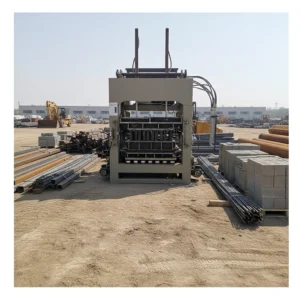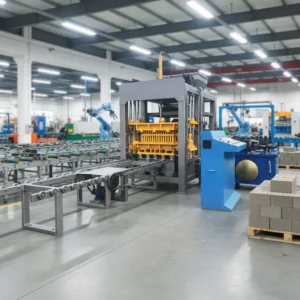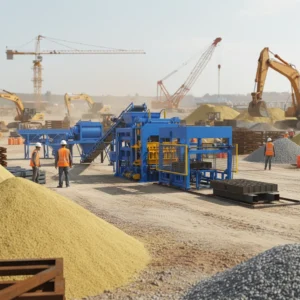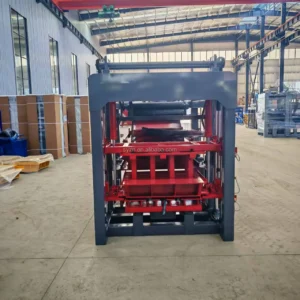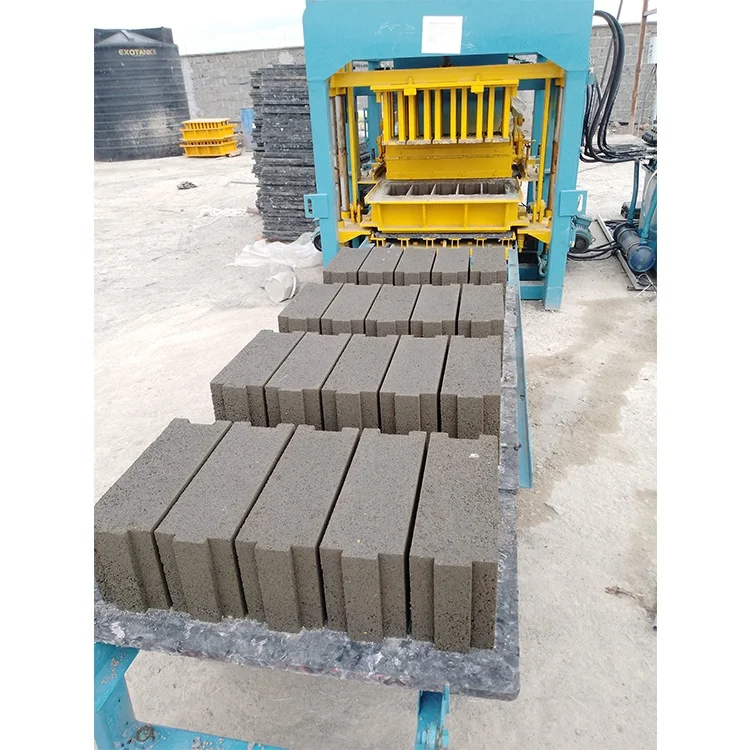
Balanced Line Flow — every station in the QT4-15A hydraulic block making machine production line is specified around the press cycle so the mold is never left waiting for a pallet or a fresh mix.
Technical Specifications
| Parameter | Value |
|---|---|
| Model | QT4-15A |
| Product Type | Hydraulic Block Making Machine |
| Overall Dimensions (L×W×H) | 7100×1600×2610 mm |
| Molding Cycle | 15–25 s |
| Vibration Frequency | 4600 r/min |
| Exciting Power (Vibration Force) | 40–50 kN |
| Total Power | 18.45 kW |
| Mixer Model | JQ350 |
| Pallet Size | 850×550×25 mm |
| Total Weight | 3 T |
| Control System | PLC control system |
| Hydraulic Station | Included |
| Output Capacity (400×200×200 mm hollow block) | 408 pcs/h, 3264 pcs/8 hr (basis: stated block format) |
| Output Capacity (400×150×200 mm hollow block) | 510 pcs/h, 4080 pcs/8 hr (basis: stated block format) |
| Output Capacity (240×115×53 mm solid brick) | 2100 pcs/h, 17000 pcs/8 hr (basis: stated block format) |
| Automation Level | Semi-automatic (basis to be confirmed) |
| Voltage & Frequency | To be confirmed per site |
| Included Line Equipment | Block making machine, hydraulic station, PLC control system, pallet feeder, brick conveyor, block sweeper |
| Free Accessories | Manual hydraulic trolley, spare parts and tools |
Application Suitability
| Application | Material or Output |
|---|---|
| Hollow block production for building walls | Crushed stone, sand, cement, fly ash |
| Solid brick manufacturing | Sand, cement, stone dust |
| Paver production for walkways and yards | Crushed stone, sand, cement |
| Curbstone forming for road edges | Coarse aggregate, cement, sand |
Why Pallet Handling Decides Real Output on a Hydraulic Block Making Machine Production Line
A block press only runs as fast as the slowest station feeding or clearing it.
I once watched a contractor in Southeast Asia lose nearly half a shift because the pallet feeder on his line could not keep pace with the press cycle. The quoted capacity assumed every pallet would be in position before the mold closed, but manual pallet handling introduced delays that no one had calculated. The press sat idle while workers shuffled pallets by hand, and the daily output fell far below what the sales sheet promised. That gap between quoted and actual production is where most block plant disputes begin [NEED_CITE: common causes of block plant output shortfall].
How the QT4-15A Line Stations Connect
The QT4-15A is supplied as a matched hydraulic block making machine production line rather than a standalone press. The pallet feeder, brick conveyor, and block sweeper are included in the scope, meaning the upstream and downstream stations are specified to match the 15–25 second molding cycle. When the press completes a vibration and compression sequence, the conveyor is ready to receive the loaded pallet, and the feeder has the next empty pallet positioned. This sequencing prevents the press from standing idle between cycles.
Where Bottlenecks Hide in Medium-Capacity Lines
Even with matched equipment, a bottleneck can shift depending on the block format being produced. A 400×200×200 mm hollow block requires a longer vibration hold than a 240×115×53 mm solid brick, which changes the rhythm of the entire line. The PLC control system on the QT4-15A allows the operator to adjust the molding cycle within the 15–25 second range, and the pallet feeder speed follows accordingly. Without this coordination, a format change that should take minutes can cost an entire morning of lost production [NEED_CITE: block format changeover impact on line throughput].
Reading the Specs That Matter on the Shop Floor
The vibration force of 40–50 kN at 4600 r/min determines how densely the concrete mix is compacted inside the mold. Higher vibration frequency with adequate force produces blocks with consistent wall thickness and compressive strength, which is critical when local building codes require a minimum load rating. The 850×550×25 mm pallet size defines the maximum mold footprint and must align with the curing racks and forklifts already on site — a mismatch here means either replacing the curing infrastructure or accepting slower handling. The JQ350 mixer must discharge a full batch within the press cycle window; if the mix arrives late, the press waits and daily output drops. Total power of 18.45 kW across all stations means the site needs a dedicated circuit with adequate breaker capacity to avoid tripping during simultaneous motor starts.
The Cost of Ignoring Line Balance
When a buyer focuses only on the press and treats pallet feeding and conveying as optional add-ons, the consequences show up in the first week of production. Workers end up carrying loaded pallets by hand because the conveyor was never ordered. Blocks arrive at the curing area chipped from rough manual handling. The press operator develops a habit of pausing the machine to wait for pallets, and that habit becomes the new normal cycle time. Over a month, the gap between promised and actual output turns into a dispute with the equipment supplier — but the root cause was never the press itself [NEED_CITE: hidden costs of incomplete block line configuration].
What This Line Arrives With
The QT4-15A ships with the hydraulic station, PLC control system, pallet feeder, brick conveyor, and block sweeper already matched to the press. Every station has been selected so that cycle times align and the press is not left waiting. The machine, mold, pallet, and handling equipment are specified as one system rather than assembled from separate suppliers. The PLC display language, voltage, and frequency are confirmed before production so that commissioning proceeds without electrical or interface delays. Molds for hollow block, solid brick, paver, and curbstone formats are available with drawings provided so the buyer can verify dimensions before the molds are built. A manual hydraulic trolley and a set of spare parts and tools ship with the line so that the first mold change and initial maintenance do not require a separate purchase.
Documentation & Verification
- Line layout showing station spacing and pallet flow path for the QT4-15A configuration
- Capacity calculation stating the exact block format behind each quoted hourly figure
- Pallet specification confirming 850×550×25 mm dimensions and material grade
- Voltage, frequency, phase, and PLC display language written confirmation before production
- Hydraulic and electrical schematics for on-site troubleshooting
- Factory test record on the buyer’s target block format before dispatch
Installation, Commissioning & Support
- Foundation pad sized to the 7100×1600 mm footprint with anchor bolt template supplied
- Dedicated circuit rated for 18.45 kW total draw with correct breaker and cable sizing
- Machine arrives dismantled for container loading; reassembly guided by the hydraulic schematic
- First-run commissioning includes molding cycle adjustment within the 15–25 s range for each block format
- Operator training covers PLC navigation, mold change procedure, and daily greasing points
- Wear parts and mold list provided so first replacements can be sourced before they are needed
Before You Request a Quote
To configure the QT4-15A line for your site, share the block formats your market actually sells and the daily volume you need to hit. Include your local raw materials — the type of aggregate, sand source, and whether fly ash is available — so the vibration and pressure settings can be matched to your mix. Confirm your site voltage, frequency, and the language you want on the PLC display so the line is ready to run the day it is powered on.
Frequently Asked Questions
Q: How are the press cycle time and the pallet feeder and conveyor speeds matched?
A: The pallet feeder and brick conveyor are specified to match the QT4-15A molding cycle of 15–25 seconds. The PLC control system coordinates the sequence so the next empty pallet is positioned before the press completes its current cycle, preventing the press from idling between operations.
Q: Which block formats are included in the quoted capacity figures?
A: The published output figures are based on specific formats: 400×200×200 mm hollow block, 400×150×200 mm hollow block, and 240×115×53 mm solid brick. When you switch to a different format, the daily output must be recalculated against that mold’s cycle time.
Q: What equipment is included in the line scope?
A: The QT4-15A line includes the block making machine, hydraulic station, PLC control system, pallet feeder, brick conveyor, and block sweeper. Raw material feeding and mixing equipment, stacking systems, and curing rack handling can be added based on your automation requirements.
Q: Can the automation level be expanded after initial installation?
A: The QT4-15A is supplied as a semi-automatic line. The configuration allows for future addition of automatic stacking and cubing stations as production volume grows, provided the PLC system and physical layout are planned with that upgrade path from the start.
Q: How are electrical specifications confirmed before the machine ships?
A: Voltage, frequency, and phase are confirmed during the quotation stage and written into the production order. The PLC display language is agreed at the same time so the control interface is readable for your operators on the day the line is commissioned.