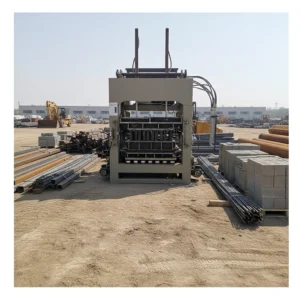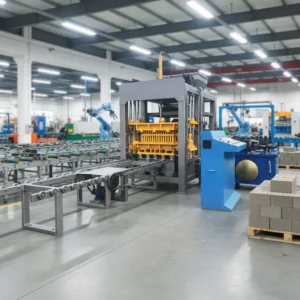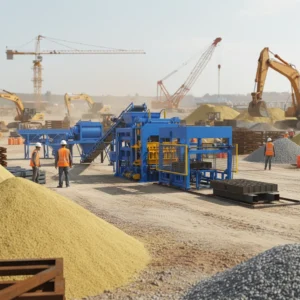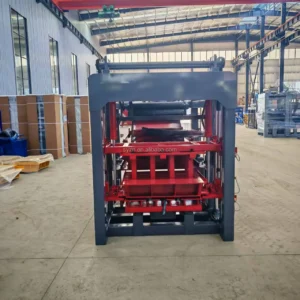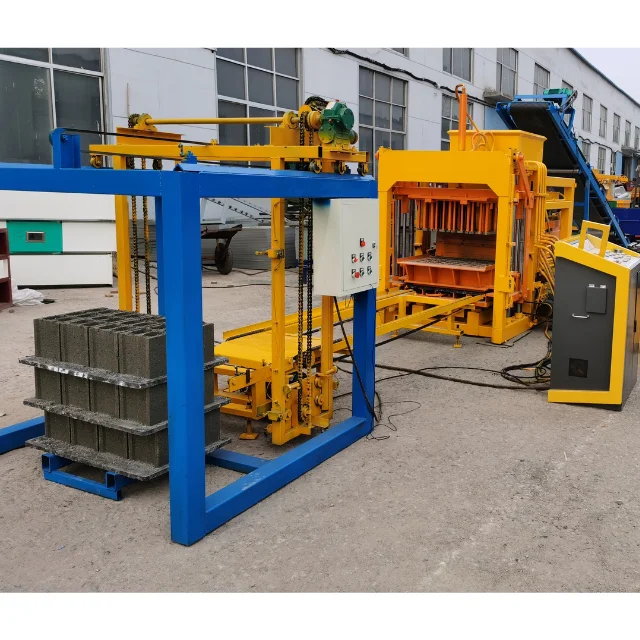
Line-Synchronized Throughput — the QT4-15A is specified against raw material feeding, mixing, pallet handling, and stacking stations so the press cycle is never delayed by upstream or downstream bottlenecks.
Technical Specifications
| Parameter | Value |
|---|---|
| Model | QT4-15A |
| Product Type | Hydraulic Block Making Machine |
| Overall Dimensions (L×W×H) | 4100×1600×2600 mm |
| Rated Pressure | 16–21 MPa |
| Main Vibration Form | Platform Vibration |
| Vibration Frequency | 4200 r/min |
| Vibration Force | 55 kN |
| Pallet Size | 880×550 mm |
| Molding Cycle | 25–30 s (basis to be confirmed per block format) |
| Overall Power | 18.45 kW |
| Total Mass | 4 T |
| Demolding Method | Hydraulic |
| Factory Area Required | 300 m² |
| Applied Products | Concrete blocks, hollow/solid blocks, pavers, interlocking blocks, curbstone |
| Raw Materials | Crushed stone, sand, cement, fly ash, gravel, slag |
| Warranty | 1 year |
Application Suitability
| Application | Material or Output |
|---|---|
| Hollow block production for building walls | Crushed stone, sand, cement mix |
| Solid block manufacturing for load-bearing structures | Gravel, cement, fly ash blend |
| Paving block and interlocking brick for walkways | Colored concrete aggregates |
| Curbstone and kerb production | High-density crushed stone mix |
| On-site block production for housing projects | Locally sourced sand and gravel |
Why a Block Making Machine Production Line Needs More Than a Press Spec Sheet
A press that waits for pallets or mix is not producing — the turnkey block plant only delivers rated output when every station upstream and downstream is timed to the same cycle.
I spent a week in a Middle Eastern plant where the owner had purchased a well-specified hydraulic press but treated supporting equipment as optional extras. The mixer discharged batches slower than the press consumed them, and the pallet return conveyor ran two positions behind. The result was a line that produced noticeably fewer blocks per shift than the quoted figure, and the operator spent half the day manually shuttling pallets. That mismatch is the single most common reason plant owners feel misled after commissioning. The cycle time printed on a brochure assumes a continuous feed of mix and an uninterrupted pallet circuit [NEED_CITE: block plant throughput assumptions in manufacturer literature].
Matching Every Station to the QT4-15A Cycle
The block making machine production line starts at the raw material batcher and ends at the curing rack, and each segment must match the 25–30 s molding cycle of the QT4-15A. If the mixer takes longer to deliver a homogeneous batch than the press takes to complete a cycle, the press sits idle and daily output drops. The pallet feeder must return clean, cured pallets to the loading position before the press is ready for the next stroke, and the stacker must clear finished blocks from the delivery table without causing a queue.
How the Turnkey Block Plant Layout Prevents Bottlenecks
Laying out a turnkey block plant around the 300 m² factory area requirement means positioning the mixer within conveyor reach of the press hopper, routing the pallet return path beneath or alongside the main frame, and reserving curing rack space that matches the 880×550 mm pallet footprint. When the block making machine production line is configured this way, the operator monitors a continuous loop instead of manually intervening at each station. Every connection point — mixer discharge gate, pallet feed sensor, stacker lift height — is specified before production so the press never waits [NEED_CITE: block plant line synchronization principles].
Reading the Specs That Actually Shape Output
The 16–21 MPa rated pressure and 55 kN vibration force work together: hydraulic pressure compacts the mix from above while platform vibration at 4200 r/min settles aggregate particles into a dense matrix. If either value is too low for the buyer’s local aggregate — particularly when sand has high clay content — the resulting block may crack during curing. The 880×550 mm pallet size determines how many blocks fit per cycle and how pallets stack on standard curing racks; choosing a pallet dimension without checking the buyer’s existing forklift capacity or curing area leads to handling problems on day one. The 18.45 kW overall power draw dictates the electrical supply and dedicated circuit requirements at the installation site, which must be confirmed against local voltage and frequency standards before the machine ships.
What Happens When Supporting Equipment Is Overlooked
A press rated at a given cycle time can lose significant output per shift when the pallet return loop falls behind or the mixer cannot keep pace. I have seen plant owners add overtime labor to compensate, paying workers to hand-carry pallets and shovel mix into the hopper, which also introduces inconsistency in fill depth and block weight. In one North African project, the local aggregate had high clay content and the mixer retention time was too short, producing blocks that cracked under demolding pressure. Resolving it required adjusting the mix design and extending mixing time, changes that only surfaced because the line was treated as a connected system rather than a standalone press [NEED_CITE: effects of aggregate clay content on block strength].
Why Sourcing the Full Line Matters
Block machinery as a single focus means the QT4-15A press, mould, pallet, and handling equipment are specified as one matched system instead of assembled from separate suppliers. The configuration is set against the buyer’s actual mix design and local aggregate, not a catalogue default, so vibration force and hydraulic pressure correspond to real material behavior. Mould design covers the block formats the buyer’s market actually sells, including custom drawings when standard formats do not apply. The automation level is selectable, allowing a buyer to start with semi-automatic pallet handling and add full stacking and cubing later without replacing the press. Installation support includes operator training on the complete line, not just the press controls.
Documentation & Verification
- Line layout and capacity calculation stating the block format assumed for each cycle time figure
- Machine specification sheet covering the QT4-15A hydraulic and vibration ratings
- Mould drawing and format list for every block type in the buyer’s product range
- Pallet specification matched to the 880×550 mm size and buyer’s curing setup
- Voltage, frequency, and PLC display language confirmation before production starts
- Factory test record and packing photographs before dispatch
Installation, Commissioning & Support
- 300 m² factory area requirement confirmed against site dimensions and curing rack layout
- 18.45 kW overall power supply verified with dedicated circuit at local voltage and frequency
- QT4-15A dismantled for container loading and reassembled on-site with alignment checks
- Platform vibration frequency calibrated at 4200 r/min against the buyer’s actual mix during commissioning
- Operator training covers the full line: mixer timing, pallet feed, press cycle, and stacking
- Wear parts and mould list provided with recommended replacement intervals for hydraulic seals and vibration components
What to Include in Your Inquiry
Provide the block formats your market sells and the target daily output for each, so the block making machine production line can be calculated per format rather than as a single aggregate number. Share your local raw material source — particularly aggregate type and any clay or silt content — along with the voltage and frequency at your site. If you already have curing racks or forklifts, include the pallet dimensions they accept so the 880×550 mm pallet size can be confirmed or adjusted before the line layout is finalized.
Frequently Asked Questions
Q: How is the 25–30 s cycle time verified for each block format I need?
A: The molding cycle is measured during factory testing using the buyer’s specified block format, mix design, and target thickness. A capacity calculation is then produced for each format, showing the realistic blocks per hour based on that measured cycle rather than a generic catalogue figure.
Q: Which supporting stations are included and where are they optional?
A: Raw material feeding, mixing, pallet feeding, stacking, and curing rack handling can all be included in the block making machine production line. Stations the buyer already has — such as an existing mixer or manual pallet handling — can be omitted, with the remaining equipment timed to match.
Q: How do you ensure the pallet size matches my existing curing area and forklift?
A: The 880×550 mm pallet is confirmed against your curing rack dimensions and forklift fork width before the line layout is drawn. If your existing equipment uses a different size, the pallet specification and press tooling are adjusted accordingly.
Q: What happens at the bottleneck — how do you prevent the press from waiting?
A: Each station’s throughput is calculated against the QT4-15A cycle time. The mixer discharge rate, pallet return speed, and stacker cycle are all specified so that no single segment runs slower than the press, and buffer positions are added where timing is tight.
Q: Can the line start semi-automatic and upgrade to full stacking and cubing later?
A: Yes. The QT4-15A supports a selectable automation level. A buyer can begin with manual or semi-automatic pallet handling and add automatic stacking, cubing, and curing rack handling as a later phase without replacing the press or altering the foundation.