
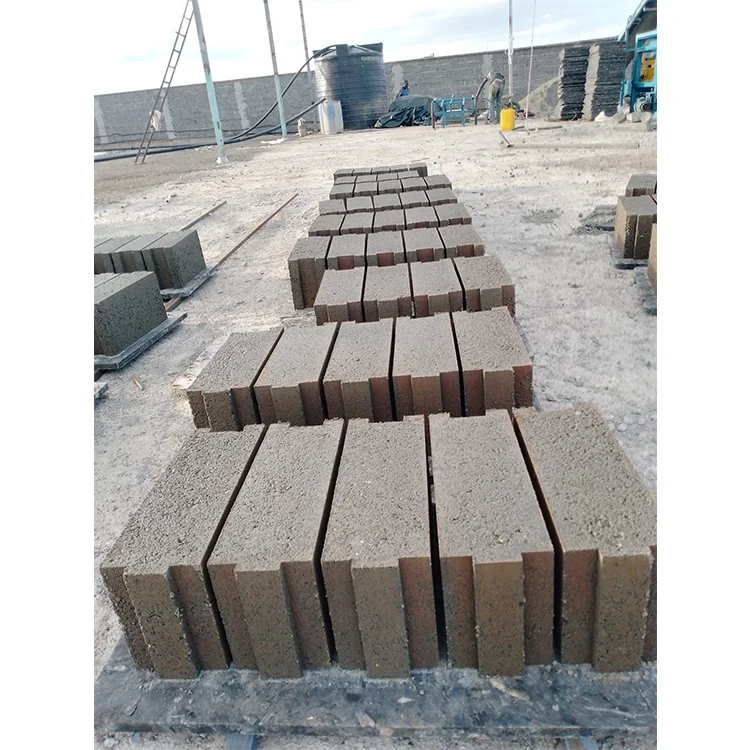
Matched Line Sizing — every upstream and downstream station is calculated against the QT4-15 press cycle so no single point creates a bottleneck or forces the operator to wait.
Technical Specifications
| Parameter | Value |
|---|---|
| Model | QT4-15 |
| Product Type | Hydraulic Solid Block Making Machine |
| Molding Cycle | 15-30s (basis not stated in source — confirm block format / material / thickness) |
| Pallet Size | 900×500 mm |
| Vibration Type | Platform vibration |
| Vibration Frequency | 50-70 Hz |
| Product Height Range | 50-220 mm |
| Overall Power (Press Unit) | 24.5 kW |
| Demolding Method | Hydraulic |
| Control System | PLC |
| Automation Level | PLC controlled with automatic pallet feeding, material feeding, vibrating, and demoulding |
| Block Capacity — Hollow Block 400×200×200 mm | 4 pcs/mould, 900-1200 pcs/hour, 7200-9600 pcs/8hr (based on 15-20s cycle) |
| Block Capacity — Hollow Block 400×150×200 mm | 5 pcs/mould, 1080-1440 pcs/hour, 8640-11520 pcs/8hr (based on 15-20s cycle) |
| Block Capacity — Hollow Block 400×100×200 mm | 8 pcs/mould, 1440-1920 pcs/hour, 11520-15360 pcs/8hr (based on 15-20s cycle) |
| Block Capacity — Paver 200×100×60 mm | 16 pcs/mould, 2880-3840 pcs/hour, 23040-30720 pcs/8hr (based on 15-20s cycle) |
| Block Capacity — Solid Brick 240×115×53 mm | 28 pcs/mould, 5930-6720 pcs/hour, 47400-53700 pcs/8hr (based on 15-20s cycle) |
| Raw Materials | Fly ash, slag, gangue, sand, water, crushed stone, cement |
| Block Compressive Strength | More than 15 MPa |
| Key Features | PLC-controlled automatic sequence, hydraulic demoulding, platform vibration, interchangeable moulds for hollow / solid / paver formats |
Application Suitability
| Application | Material or Output |
|---|---|
| Hollow block production for masonry walls | Crushed stone, sand, cement, fly ash, slag, gangue |
| Solid brick production for load-bearing and partition structures | Sand, cement, industrial residues including fly ash and slag |
| Paver brick production for walkways and driveways | Fine aggregate, cement, crushed stone with controlled grading |
| Medium and small factory block plants | Daily output scaled to local construction demand across multiple formats |
| On-site production for housing and development projects | Locally sourced aggregate combined with cement and water |
Why the Pallet Feeder Determines Your Real Daily Output
A hydraulic block making machine production line that outpaces its pallet return loop will spend more time idle than pressing.
I have watched plant owners quote cycle times from the spec sheet only to discover that their pallet feeder runs two seconds slower per cycle than the press. Over an eight-hour shift those seconds accumulate into hundreds of lost cycles. The press sits waiting, the operator watches the hopper, and the daily count falls far short of what was promised. This is the reason every station in a hydraulic block making machine production line must be sized as one system rather than assembled from separate supplier catalogues. [NEED_CITE: typical pallet return cycle times in stationary block plants]
Synchronising Every Station Around the Press Cycle
The QT4-15 completes its automatic sequence — pallet feed, material feed, vibration, hydraulic demoulding — within a 15-30 second window depending on block format and material. Each upstream and downstream station in the hydraulic block making machine production line must deliver its output inside that same window. The batching mixer must discharge a fresh batch before the hopper empties, the pallet return conveyor must present a clean pallet before the next cycle begins, and the stacking station must clear finished product before the demoulded block arrives.
How Line-Level Power Draw Differs From Press-Only Figures
The 24.5 kW figure in the spec sheet covers the QT4-15 press unit alone. A complete hydraulic block making machine production line adds power demand from the raw material feeder, the pan mixer, the pallet return conveyor, and any stacking or cubing equipment. When planning your electrical infrastructure you need the combined draw of every station, not just the press motor. Confirming voltage, frequency and phase rotation for the full line before production starts prevents commissioning delays once the equipment arrives on site. [NEED_CITE: voltage and frequency standards by export market]
Reading the Specs That Actually Affect Your Floor Plan
Platform vibration at 50-70 Hz combined with hydraulic demoulding means the press applies vertical compaction force through the pallet rather than through the mould walls. This approach allows the 900×500 mm pallet to carry a wider range of block heights — from 50 mm pavers up to 220 mm hollow blocks — without requiring a separate mould cassette for each format. The pallet size also dictates your curing rack dimensions, your forklift tine spacing, and the turning radius needed between the press output and the curing yard.
Mould change across hollow block, solid brick, and paver formats happens on the same pallet footprint, so the curing area and handling equipment do not need reconfiguration when you switch products within a shift. The PLC controls the vibration duration and hydraulic pressure for each format independently, which means the operator selects the recipe on the display rather than adjusting mechanical stops by hand.
The Cost of Specifying the Press Without the Line
When a buyer purchases the press alone and sources the feeder, mixer, and stacker from different vendors, cycle time mismatches surface only during commissioning. The mixer may discharge faster than the press can accept material, causing overflow in the hopper. The stacker may require a pallet orientation that the press conveyor does not provide. These problems are solvable but they consume days of adjustment that a pre-matched line avoids entirely. [NEED_CITE: CE machinery directive requirements for industrial equipment integration]
Mismatched pallet material is another hidden cost. Bamboo pallets, PVC pallets, and steel pallets each have different friction coefficients on the return conveyor and different load capacities when stacked in the curing rack. Choosing a pallet without considering the forklift capacity and curing rack spacing already in use at your site leads to cracked pallets and toppled stacks during the first week of production.
Why Procurement Should Happen as One Package
The QT4-15 and its supporting stations are specified together so that cycle time calculations cover every hand-off point from raw material hopper to cured block stack. This matched approach is one of our core strengths as a manufacturer focused exclusively on block machinery.
Line layout drawings show the block format assumed for each station capacity figure rather than quoting only the press cycle. Pallet specification is confirmed against your existing curing area and forklift before production begins. Voltage, frequency, and PLC display language are locked in at the quotation stage so that commissioning proceeds without electrical surprises. Hydraulic and electrical schematics are supplied in full so your maintenance team can trace faults on site without waiting for a factory visit.
Documentation & Verification
- Line layout drawing stating block format assumed at each station
- Machine specification sheet covering press and every auxiliary station
- Pallet specification matched to your curing rack and forklift
- Hydraulic and electrical schematic for on-site fault tracing
- Voltage, frequency, and PLC display language confirmation record
- Factory test record on your target block format before dispatch
Installation, Commissioning & Support
- Foundation plan sized for QT4-15 vibration load and platform footprint
- Electrical panel rated for 24.5 kW press plus line-level auxiliary draw
- Machine shipped in assembly state verified against line layout drawing
- Commissioning includes cycle time verification across every station
- PLC display language set to operator preference before power-on
- Wear parts list and mould drawing supplied with first shipment
What We Need From You to Size the Line
To configure the QT4-15 and its supporting stations accurately, share your target block formats and the daily output you need for each one. Tell us about your local raw materials — aggregate type, grading, and any industrial residues like fly ash or slag you plan to use — so we can set the vibration and pressure parameters before factory testing. Confirm your site voltage, frequency, and the language your operators will need on the PLC display so that the electrical build matches your infrastructure from day one.
Frequently Asked Questions
Q: How is each station in the line sized so the press cycle is never interrupted?
A: We calculate the throughput of the feeder, mixer, pallet return, and stacker against the QT4-15 cycle time for your specific block format. Every station must deliver within the 15-30 second press window so that no single point creates a queue. The line layout drawing shows these calculations station by station.
Q: What upstream batching accuracy is needed to keep block strength consistent?
A: Consistent compressive strength above 15 MPa requires that the cement-to-aggregate ratio stays within a narrow band across every batch. The mixer and feeder in the line are selected to match the batch volume the QT4-15 consumes per cycle, preventing stale mix from sitting in the hopper and losing workability.
Q: How do pallet size and material affect curing rack layout and forklift compatibility?
A: The 900×500 mm pallet dimension determines your curing rack shelf spacing, stack height, and forklift tine width. We confirm pallet material — bamboo, PVC, or steel — against your existing forklift capacity and curing yard conditions so that handling remains safe and stable from press output through to final stacking.
Q: What is included in the line quotation versus what the buyer sources separately?
A: The quotation covers the QT4-15 press, moulds, pallets, feeder, mixer, pallet return conveyor, and stacking equipment as a matched set. Items the buyer typically provides include the air compressor, water supply connection, curing area enclosure, and the forklift used to move racked pallets to the yard.
Q: How does the line configuration change when switching between formats within the same shift?
A: The PLC stores separate recipes for hollow block, solid brick, and paver formats, each with its own vibration duration and hydraulic pressure settings. Mould changeover on the 900×500 mm pallet platform allows format switching without altering the pallet return path, curing rack layout, or downstream stacking position.


