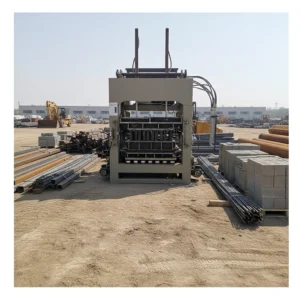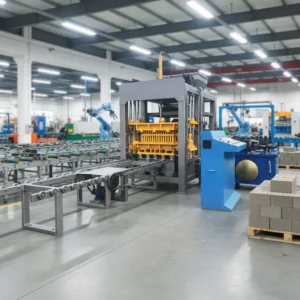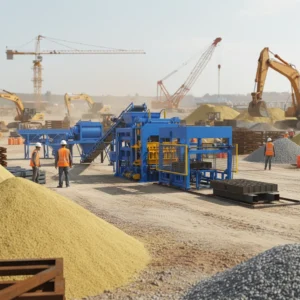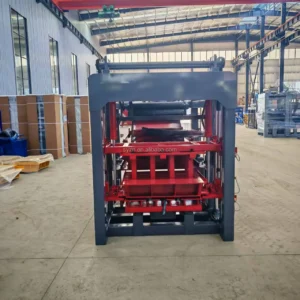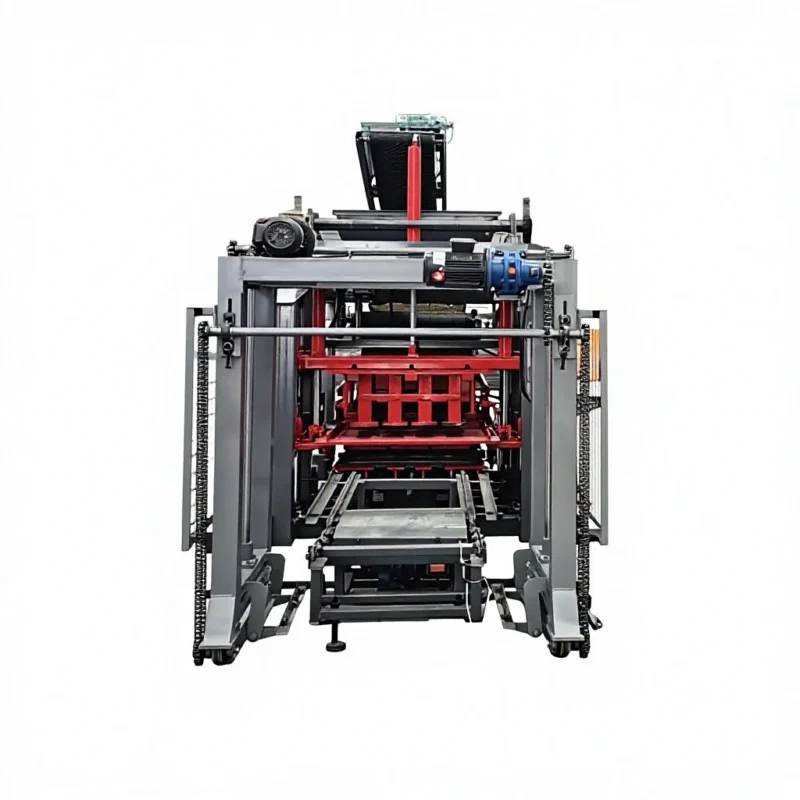
Coordinated Line Throughput — every station from the mixer to the stacker is timed against the QT4-15A press cycle so no single unit dictates the daily output.
Technical Specifications
| Parameter | Value |
|---|---|
| Model | QT4-15A |
| Product Type | Fully Automatic Hydraulic Concrete Block Making Machine |
| Overall Dimensions (L×W×H) | 4100×1600×2600 mm |
| Rated Hydraulic Pressure | 16–21 MPa |
| Main Vibration Form | Platform Vibration |
| Vibration Frequency | 4200 r/min |
| Vibration Force | 55 kN |
| Pallet Size | 880×550 mm |
| Molding Cycle | 25–30 s (basis to be confirmed per block format and material) |
| Overall Power | 18.45 kW |
| Total Mass | 4 T |
| Demolding Method | Hydraulic |
| Factory Area Required | 300 m² |
| Automation Level | Fully Automatic |
| Control System | PLC |
| Applied Products | Hollow blocks, solid blocks, pavers, interlocking blocks, curbstone |
| Raw Materials | Crushed stone, sand, cement, fly ash, gravel, slag, dust |
| Shipping Configuration | 1×40HQ container (basic equipment) |
| Warranty | 1 year for whole machine (excluding spare parts) |
| Certification | CE (declared where applicable) |
Application Suitability
| Application | Material or Output |
|---|---|
| Hollow block production for residential and commercial walls | Crushed stone, sand, cement, fly ash blends |
| Solid load-bearing block manufacturing | Dense aggregate and cement mixes |
| Interlocking paver and colored paver runs | Fine sand, cement, pigment additives |
| Curbstone and kerb production for roadworks | Coarse gravel and high-strength cement |
| On-site block production for housing projects | Locally sourced aggregate and cement |
Why the Press Cycle Is Never the Whole Story
Real line throughput depends on how fast the mixer, pallet feeder, and stacker can keep pace with the press.
Many buyers receive a quotation that quotes the QT4-15A molding cycle in isolation. The block production line equipment is only as productive as its slowest station. If the mixer takes longer to discharge a batch than the press takes to complete a cycle, the press sits idle. If pallets are not returned to the feed conveyor quickly enough, the press waits again. I have seen lines where the press was rated for a fast cycle, yet the actual daily count fell well short because upstream and downstream stations were never calculated together [NEED_CITE: line balancing principles in block production].
Matching Mixer Batch Time to Press Demand
A concrete block making line turnkey setup begins with the raw material feeding and mixing station. The mixer must deliver a homogeneous batch to the press hopper before the previous batch is fully consumed. For the QT4-15A, the 25–30 s molding cycle means the mixer discharge interval must be equal to or shorter than that window. When the local aggregate is coarse or the mix design is stiff, mixing time extends, and the entire block production line equipment slows down. Sizing the mixer to the press — not the other way around — is the first step in line layout.
Pallet Circulation as the Hidden Bottleneck
Pallets carry the freshly pressed block from the QT4-15A through the curing rack lanes and back to the feed conveyor. The 880×550 mm pallet size determines how many pallets fit in a curing rack row, how the forklift handles them, and how fast the return conveyor can recycle them. If the curing area is undersized or the pallet return path is too long, pallets queue up and the press halts. In one project I worked on, the buyer added curing rack lanes after the initial layout and recovered meaningful daily output without touching the press itself [NEED_CITE: pallet circulation impact on block plant throughput].
Reading the Numbers Behind the Press
The QT4-15A combines 55 kN vibration force at 4200 r/min with 16–21 MPa hydraulic pressure. These two values work together: vibration settles the aggregate into the mould cavity, while hydraulic pressure compresses it to final density. If the local sand is fine and the cement ratio is low, higher vibration amplitude helps fill the mould; if the aggregate is coarse and angular, sustained hydraulic pressure does more of the work. The platform vibration form means the force is applied through the pallet, so pallet stiffness and flatness directly influence block consistency. The 18.45 kW total power covers the press station alone — the mixer, conveyor motors, and stacker drives add their own load, which must be accounted for when sizing the main electrical panel and transformer for the block production line equipment.
The Cost of Misaligned Station Speeds
When the mixer, pallet feeder, or stacker is specified independently from the QT4-15A, the buyer often discovers the mismatch only after installation. The press idles between cycles, operators stand by, and the daily block count drops without any obvious mechanical fault. I have walked into plants where the owner believed the press was underperforming, when in fact a slower pallet return conveyor was the actual constraint [NEED_CITE: common causes of idle time in automated block plants]. Correcting this after the concrete block making line turnkey installation means repositioning equipment, lengthening conveyors, or replacing the mixer — all of which cost far more than specifying the line as one system from the start.
What Sets This Line Configuration Apart
The QT4-15A is specified as the centre station of a matched system, not sourced separately from the mixer, pallet handler, and stacker. Every configuration starts from the buyer’s actual mix design and local aggregate, so vibration force and hydraulic pressure are set to produce consistent block strength with available materials. Pallet size and material are confirmed against the buyer’s existing curing area and forklift before the line layout is drawn. Automation level is selectable, allowing a buyer to begin with semi-automatic pallet handling and add full stacking and cubing later. Installation includes operator training so the crew understands how each station’s cycle relates to the next.
Documentation & Verification
- Line layout drawing with capacity calculation stated per block format at each station
- Pallet specification sheet cross-checked against curing rack spacing and forklift dimensions
- Hydraulic and electrical schematics for the QT4-15A and all supporting stations
- Voltage, frequency, and PLC display language confirmation signed before production
- Factory test record documenting press cycle, mixer batch time, and pallet feed rate
- Wear parts and mould list with recommended replacement intervals
Installation, Commissioning & Support
- Foundation plan sized to the 4100×1600 mm press footprint and vibration isolation needs
- Dedicated electrical circuit for the 18.45 kW press plus separate feeds for mixer and conveyors
- Machine shipped dismantled in one 40HQ container with reassembly on site
- PLC parameter setting for molding cycle, vibration duration, and hydraulic dwell during commissioning
- Operator training covering mould change procedure and daily pallet inspection routine
- Spare hydraulic seals and vibration motor brushes supplied for the first maintenance cycle
Planning Your Line Inquiry
To size the QT4-15A within a complete block production line equipment layout, share the target block format and daily volume, the local aggregate type and cement source, and the available factory floor area. Confirm the site voltage and frequency, the PLC language preference, and whether existing curing racks or forklifts must be accommodated. If the line replaces an older press, note the current mixer model and pallet size so upstream and downstream stations can be matched.
Frequently Asked Questions
Q: How is line throughput calculated across stations?
A: Each station — mixer, QT4-15A press, pallet feeder, stacker — has its own cycle time. Line throughput equals the slowest station’s rate, calculated for the specific block format. The layout drawing shows per-station timing so you can see where capacity is set.
Q: What supporting equipment comes with the quotation?
A: The quotation can include the raw material feeder, mixer, pallet circulation system, stacking unit, and curing rack handling. Each item is listed separately so you can accept or defer stations based on your current setup and investment plan.
Q: How do pallet dimensions affect the curing area?
A: The 880×550 mm pallet determines rack lane width, forklift fork spacing, and how many pallets fit per curing row. We confirm your existing rack dimensions and forklift capacity before finalising pallet material and thickness to avoid layout conflicts.
Q: Can automation be upgraded after initial installation?
A: Yes. The QT4-15A control system supports a path from semi-automatic pallet handling to fully automatic stacking and cubing. Additional sensors and conveyor drives are added without replacing the press PLC or hydraulic circuit.
Q: Which electrical details must be confirmed before dispatch?
A: Voltage, frequency, and PLC display language are confirmed in writing before production begins. This ensures the motor windings, transformer taps, and HMI text match the site supply and operator language upon arrival.