
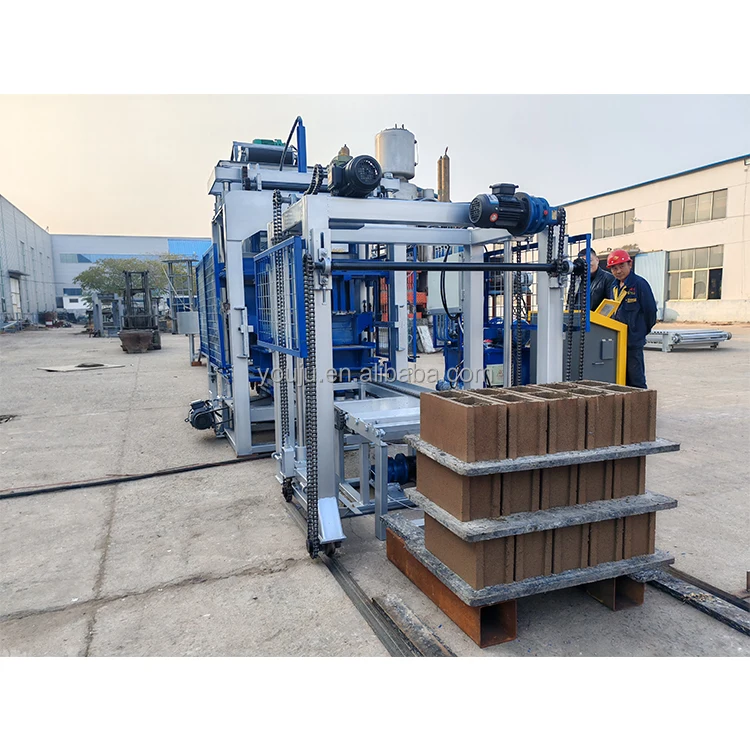
Line-wide cycle matching — we size every upstream and downstream station to the QT4-15’s 15-30s moulding cycle so the press never waits for material, pallets, or stacking.
Technical Specifications
| Parameter | Value |
|---|---|
| Model | QT4-15 |
| Product Type | Hydraulic Concrete Block Making Machine |
| Molding Cycle | 15-30s |
| Pallet Size | 900×500 mm |
| Vibration Type | Platform vibration |
| Vibration Frequency | 50-70 Hz |
| Product Height Range | 50-220 mm |
| Overall Power | 24.5 kW |
| Demolding Method | Hydraulic |
| Control System | PLC controlled with approach switch monitoring |
| Output — Hollow Block 400×200×200 mm | 900-1,200 pcs/hour (4 pcs/mould, 15-20s cycle) |
| Output — Hollow Block 400×150×200 mm | 1,080-1,440 pcs/hour (5 pcs/mould, 15-20s cycle) |
| Output — Hollow Block 400×100×200 mm | 1,440-1,920 pcs/hour (8 pcs/mould, 15-20s cycle) |
| Output — Paver 200×100×60 mm | 2,880-3,840 pcs/hour (16 pcs/mould, 15-20s cycle) |
| Output — Solid Brick 240×115×53 mm | 5,930-6,720 pcs/hour (28 pcs/mould, 15-20s cycle) |
| Compressive Strength of Blocks | >15 MPa |
| Raw Material Compatibility | Fly ash, slag, gangue, sand, crushed stone, cement, water |
| Voltage & Frequency | Configurable — confirm before order |
| Hydraulic Pressure | Confirm against hydraulic schematic |
| Vibration Force | Confirm against spec sheet |
Application Suitability
| Application | Material or Output |
|---|---|
| Mid-scale hollow block plant | Fly ash or crushed stone mixed with cement, producing 400×200×200 mm masonry blocks |
| Paving block production line | Sand and aggregate blends forming 200×100×60 mm interlocking pavers for roads and walkways |
| Solid brick manufacturing | Gangue or slag-based mixes pressed into 240×115×53 mm structural bricks |
| Industrial residue recycling plants | Fly ash and slag blended with local aggregate for all block formats within the height range |
| Contractor on-site block production | Portable batching feeding into the QT4-15 line for project-specific hollow and solid formats |
What a Quoted Cycle Time Hides About Your Real Daily Output
A press that cycles in 15-20 seconds is useless if the mixer takes 40 seconds to discharge or the pallet return conveyor runs too slow.
I have stood on shop floors where the operator watched the QT4-15 block machine production line sit idle for half of every cycle, waiting for concrete from a mixer that was never specified to match the press speed. The daily count fell far short of what the sales brochure promised. The buyer assumed the machine was underperforming. In reality, the line was poorly balanced. [NEED_CITE: concrete batching throughput matching block press cycle time]
This is why the concrete block production line equipment must be quoted as a coordinated system — mixer batch size, belt conveyor speed, pallet magazine capacity, and stacking station cycle all calculated against the same target block format.
How the QT4-15 Press Coordinates With Every Station Around It
The PLC-controlled sequence on the QT4-15 block machine production line monitors each station through approach switches. When the pallet is in position, the feeder advances. Once material is distributed into the mould, platform vibration engages at 50-70 Hz, followed by hydraulic demoulding. The entire sequence depends on the pallet return conveyor delivering the next pallet within the same 15-30 second window. If any upstream station falls behind, the PLC holds the cycle and the press idles.
Where Line Balancing Fails — and What to Check Before You Order
The most common imbalance happens at the mixer. A pan mixer that discharges one batch every 45 seconds cannot feed a press cycling every 15-20 seconds without a buffer hopper. Downstream, if the pallet return belt runs slower than the moulding cycle, the press waits again. And if the stacking station uses manual labour to pull fresh blocks off the line, the pallet inventory runs out mid-shift. [NEED_CITE: pallet return speed requirements for automatic block press lines] A line layout drawing that shows cycle times at every station — not just the press — is the document that prevents these mismatches.
Reading the Specs That Actually Matter for Line Performance
The overall power of 24.5 kW covers the press station only. When you add the mixer motor, conveyor drives, and pallet return system, the total connected load for the concrete block production line equipment will be higher, and your electrical room must be planned accordingly. The 900×500 mm pallet size is not a catalogue default — it determines how many blocks travel per cycle, how many pallets fit on your curing racks, and whether your existing forklift can handle the loaded weight. The 50-220 mm product height range means the QT4-15 can switch from hollow blocks to pavers on the same press, but each format has a different mould weight and demoulding stroke, which affects how quickly the hydraulic system must respond. The vibration frequency range of 50-70 Hz works across multiple mix designs, but the force must be matched to your specific aggregate grading and cement content to achieve the stated >15 MPa compressive strength. [NEED_CITE: vibration frequency and hydraulic pressure matching for concrete block density]
The Hidden Cost of Quoting the Press Alone
When a quotation covers the press but omits pallet feeding, automatic stacking, and curing rack handling, the buyer discovers mid-installation that workers must manually pull pallets, carry blocks to the curing yard, and return empty pallets by hand. The concrete block production line equipment that was supposed to reduce labour ends up depending on a crew that the shift plan did not account for. Output per hour drops because the bottleneck moved from the press to the pallet logistics. [NEED_CITE: labour allocation for semi-automatic versus automatic block production lines]
Why Buyers Come Back for the Full Line
We specify the QT4-15 as part of a system where the mixer, belt conveyor, pallet magazine, and stacking station are all sized against the same target block format and daily output. The pallet specification is confirmed against your existing curing racks and forklift capacity, not chosen from a standard list. Voltage, frequency, and PLC display language are verified before production so the electrician on site can connect and commission without delays. The factory test runs the full sequence — from batching to stacking — using the block format you will actually produce, so the cycle time numbers on paper match what the line delivers in your plant.
Documentation & Verification
- Line layout drawing with cycle time stated for each station and the block format assumed
- Hydraulic and electrical schematic showing utility connections and PLC wiring for your local electrician
- Pallet specification sheet confirming size, material, and loaded weight against your curing racks
- Factory test record running the full QT4-15 sequence on your specified block format before dispatch
- Voltage, frequency, and PLC display language confirmation signed off before production begins
- Operation and maintenance manual covering press and all supporting stations in the line
Installation, Commissioning & Support
- Foundation plan drawn to the full QT4-15 line footprint including mixer, conveyor, and stacking station
- Electrical load schedule listing the 24.5 kW press plus all supporting motors for your utility connection
- PLC approach switch calibration performed on site during commissioning to match actual pallet speeds
- Operator training covering the full sequence from raw material batching through pallet return and stacking
- Wear parts list covering hydraulic seals, vibration motor components, and mould liner replacements
- Pallet inventory calculation based on your curing area size and the QT4-15 cycle rate
What We Need to Size Your Line Correctly
Tell us which block format you will produce most often and your target daily output, so we can match the mixer batch size and pallet return speed to the QT4-15 cycle. Confirm the voltage and frequency at your site, along with the PLC display language your operators need. If you already have curing racks and a forklift in place, send us the rack dimensions and the forklift rated capacity so the pallet specification fits what you already own.
Frequently Asked Questions
Q: How is the QT4-15 cycle time matched to the mixer output and pallet return speed?
A: We calculate the mixer discharge rate and pallet return conveyor speed against the 15-30 second moulding cycle. If the mixer batches slower than the press cycles, we add a buffer hopper or specify a larger mixer. The pallet return belt is sized so an empty pallet reaches the press before the next cycle begins.
Q: Is pallet feeding, stacking, and curing rack handling included in the quotation?
A: These stations can be included or quoted separately depending on your automation preference. If omitted, your operators must handle pallets manually, which affects your labour plan and real daily output. We confirm the scope before the quotation is finalised.
Q: What pallet size and material are specified, and how does that relate to my existing setup?
A: The QT4-15 uses 900×500 mm pallets. We confirm the material — bamboo, PVC, or steel — and the loaded weight against your curing rack spacing and forklift rated capacity so the pallets you receive work with the infrastructure you already have on site.
Q: How are voltage, frequency, and PLC language confirmed before shipment?
A: We ask for your site voltage, frequency, and preferred PLC display language during the inquiry stage. These are written into the production order and verified during the factory test so your electrician can commission the line immediately upon arrival without rewiring or reprogramming.
Q: What supporting equipment must be in place for the QT4-15 to reach its stated capacity?
A: The mixer must discharge fast enough to fill the mould each cycle, the pallet magazine must hold enough pallets for continuous operation, and the stacking station must clear finished blocks before the next pallet arrives. Each station cycle is stated in the line layout drawing.


