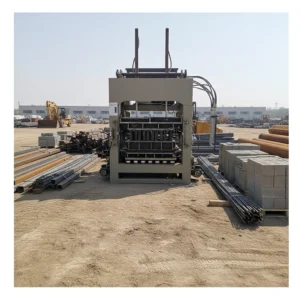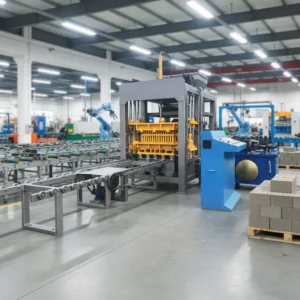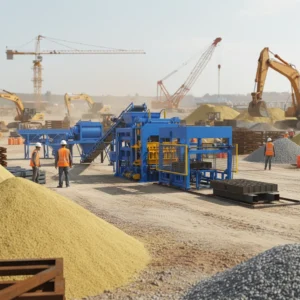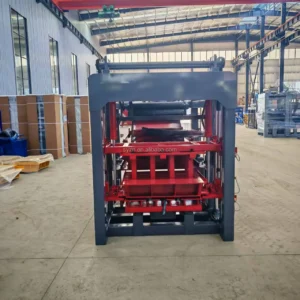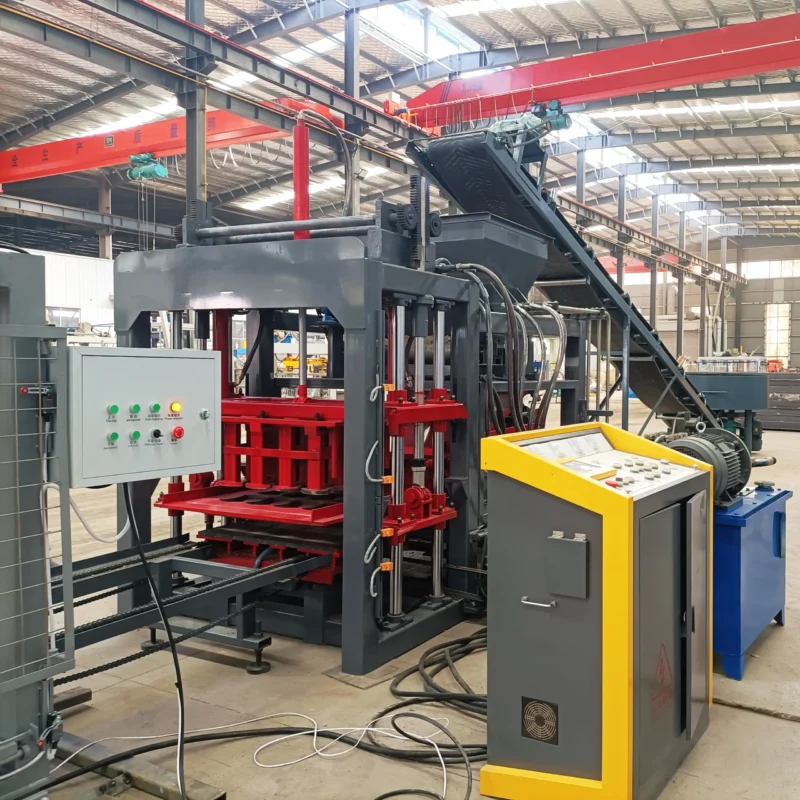
Integrated line pacing — every station from raw material intake to curing rack is timed against the 25–30 s press cycle so the QT4-15A never waits for pallets or mix.
Technical Specifications
| Parameter | Value |
|---|---|
| Model | QT4-15A |
| Product Type | Fully Automatic Concrete Block Making Machine |
| Overall Dimensions (L×W×H) | 4100×1600×2600 mm |
| Rated Pressure | 16–21 MPa |
| Vibration Force | 55 kN |
| Vibration Frequency | 4200 r/min |
| Main Vibration Form | Platform Vibration |
| Pallet Size | 880×550 mm |
| Molding Cycle | 25–30 s (basis not stated in source — confirm block format / material / thickness) |
| Overall Power | 18.45 kW (source value listed as 18.45W — verify against manufacturer catalog) |
| Total Mass | 4 T |
| Demolding Method | Hydraulic |
| Factory Area Required | 300 m² |
| Automation Level | Fully automatic |
| Control System | PLC (inferred from fully automatic designation — verify against catalog) |
| Loading | 1×40HQ container (basic equipment) |
Application Suitability
| Application | Material or Output |
|---|---|
| Hollow block production | Crushed stone, sand, cement, fly ash |
| Solid block manufacturing | Gravel, slag, cement blends |
| Paving block and colored paver runs | Fine aggregate with pigment additives |
| Interlocking brick and kerbstone | Local aggregate matched to mix design |
| On-site contractor block production | Project-volume runs with mobile batching |
Why "Cycles per Hour" Misses the Real Daily Output
The press cycle only matters if every upstream and downstream station can keep pace.
When a quotation lists cycles per hour without naming the block format, buyers often discover on site that hollow blocks take longer than the quoted figure assumed, or that the mixer cannot deliver fresh batch fast enough. The automatic concrete block making machine production line then spends part of every hour idle, and real daily throughput falls noticeably short of the projection [NEED_CITE: typical capacity calculation assumptions in block machinery quotations]. Pallet handling, stacking and curing rack operation are sometimes left out of the scope entirely, forcing manual labour to fill the gap.
Matching Raw Material Feed and Mixer Output to the Press
The QT4-15A completes a molding cycle in 25–30 s, which means the mixer must deliver a consistent batch within that same window to avoid press idle time. Raw material feeding stations are sized so aggregate, cement and fly ash arrive in proportion before the next cycle starts. When the automatic concrete block making machine production line is laid out with this timing in mind, the press is never left waiting for mix, and block density stays consistent from the first pallet to the last.
Pallet Circulation and Curing Rack Hand-Off
An 880×550 mm pallet leaves the press every cycle and must travel through stacking, curing and return loops without creating a bottleneck. The pallet size is selected against the buyer’s existing curing racks and forklift capacity, not picked from a default list. If the curing area is too small for the pallet flow rate, wet blocks pile up on the floor and strength development suffers [NEED_CITE: curing area sizing relative to daily block output].
Reading the Numbers That Actually Matter
Platform vibration at 55 kN combined with 16–21 MPa hydraulic pressure determines how densely the mix is compacted, which directly controls block strength. The vibration frequency of 4200 r/min is effective only when the mix design and local aggregate grading suit that energy level; a sandy mix may need different force distribution than a coarse crushed-stone blend. Hydraulic demolding lifts the mould without dragging, reducing edge damage on hollow and interlocking formats. The 300 m² factory area figure covers the full line footprint — press, mixer, pallet return conveyor and curing rack space — not the press alone, so buyers can plan civil works before equipment arrives.
What Happens When Line Stations Are Mismatched
A mixer that delivers faster than the press can accept simply overflows the hopper, while a slower mixer forces the press into repeated pauses that cut daily output. Pallets specified without regard to the buyer’s forklift fork width or curing rack slot spacing lead to manual re-handling at the very stage where automation was supposed to eliminate labour. Voltage and frequency left unconfirmed until the machine arrives can delay commissioning by days while transformers or motor replacements are sourced locally [NEED_CITE: voltage and frequency standards by export market].
Why Buyers Source the Full Line Here
Block machinery is the single focus, so the QT4-15A press, moulds, pallets and handling equipment are specified as one matched system rather than assembled from separate suppliers. Configuration is set against the buyer’s actual mix design and local aggregate, not a catalogue default. Mould design covers the formats the buyer’s market sells, including custom drawings when standard options do not fit. Automation level is selectable, allowing a plant to start with semi-automatic pallet handling and add stacking later. Installation support includes on-site commissioning and operator training so the line reaches steady-state output without extended trial-and-error.
Documentation & Verification
- Line layout drawing with capacity calculation stating the assumed block format
- Pallet specification confirming size, material and forklift compatibility
- Hydraulic and electrical schematic covering the full line, not only the press
- Voltage, frequency and PLC display language confirmation sheet before shipment
- Factory test record on buyer’s target block format before dispatch
- Wear parts and mould list with part numbers for first reorder
Installation, Commissioning & Support
- 300 m² floor plan requirement confirmed before civil works begin
- 18.45 kW total power load checked against site transformer capacity
- Machine dismantled into 40HQ container sections and reassembled on site
- PLC language set to operator preference before first production run
- Mould change procedure trained on buyer’s target block formats
- Hydraulic hose and seal kit supplied for first scheduled maintenance interval
Before You Send the Inquiry
Share the block formats your market actually sells, along with the daily volume you need to hit and the raw materials available within haul distance of your plant. Confirm the voltage and frequency at your site, the PLC display language your operators read, and the curing area dimensions you have planned. If you already own forklifts or batching equipment, include their specifications so the automatic concrete block making machine production line can be paced around them from the start.
Frequently Asked Questions
Q: How is daily output calculated, and which block format is assumed in the cycle time figure?
A: The 25–30 s molding cycle is a starting reference that must be tied to a specific block format, mix design and thickness before it translates into daily output. We calculate capacity per format and state the assumption in the line layout, so you know exactly how many hollow blocks versus pavers the QT4-15A will produce in a shift.
Q: How do upstream stations match the press cycle so the machine is never left waiting?
A: Raw material feeding, mixer batch size and pallet return speed are each timed against the 25–30 s press window. If any station runs slower, we resize it or add buffer capacity before the line layout is finalized, ensuring the automatic concrete block making machine production line maintains continuous flow.
Q: Is pallet handling, stacking and curing rack operation included in the quotation?
A: These stations are part of the line scope when specified. We confirm pallet size against your curing racks and forklift, then include the return conveyor and stacking system in the same quotation so there are no manual gaps between press output and curing.
Q: How is pallet size chosen to fit my existing curing area and forklift?
A: The 880×550 mm pallet is verified against your curing rack slot dimensions and forklift fork width before production. If your existing infrastructure requires a different size, the pallet specification is adjusted and the press tooling is matched accordingly.
Q: What voltage, frequency and PLC language options are confirmed before shipment?
A: Voltage and frequency are confirmed during the quotation stage to match your site supply, and the PLC display language is set to your operator preference. These details appear on the pre-shipment confirmation sheet so commissioning starts without electrical or interface delays.