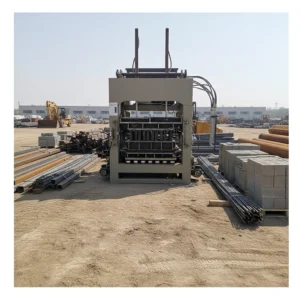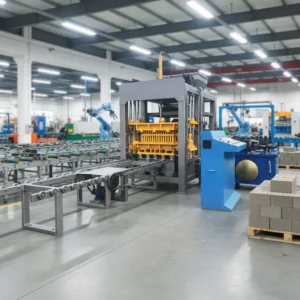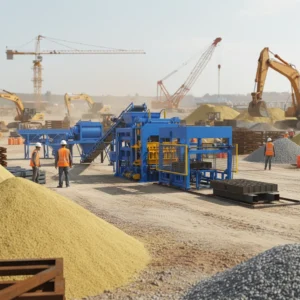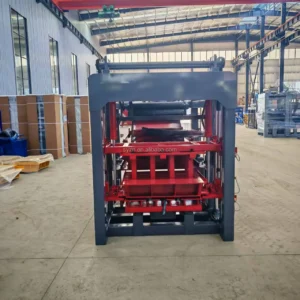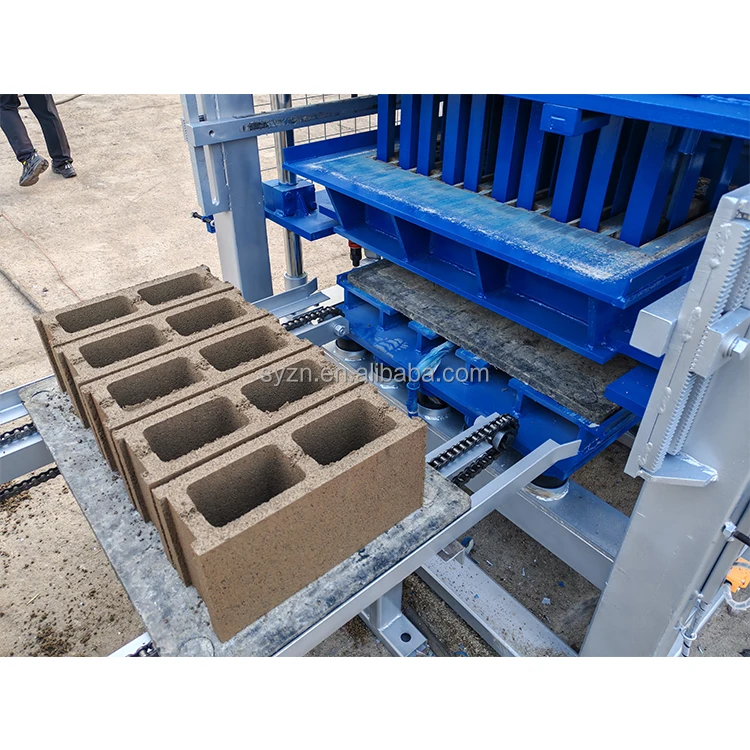
Matched Line Integration — The QT4-15 is specified as the center of a coordinated block production line where feeding, pallet circulation, and stacking stations are timed to its cycle so the press never waits upstream or downstream.
Technical Specifications
| Parameter | Value |
|---|---|
| Model | QT4-15A |
| Product Type | Fully Automatic Concrete Block Making Machine |
| Overall Dimensions (L×W×H) | 4100×1600×2600 mm |
| Rated Pressure | 16-21 MPa |
| Main Vibration Form | Platform Vibration |
| Vibration Frequency | 4200 r/min |
| Vibration Force | 55 kN |
| Pallet Size | 880×550 mm |
| Molding Cycle | 25-30 s (basis not stated in source) |
| Overall Power | 18.45 kW |
| Total Mass | 4 T |
| Demolding Method | Hydraulic |
| Factory Area Required | 300 m² |
| Applied Products | Concrete blocks, hollow/solid blocks, pavers, interlocking blocks, curbstone, colored pavers |
| Raw Material | Crushed stone, sand, cement, dust, fly ash, gravel, slag |
| Automation Level | Fully automatic |
Application Suitability
| Application | Material or Output |
|---|---|
| Hollow block production for building walls | Crushed stone, sand, cement, fly ash |
| Solid block manufacturing for load-bearing structures | Gravel, cement, slag blends |
| Paving block and colored paver output | Fine aggregates with cement and pigment |
| Interlocking brick production for retaining walls | Sand, crushed stone, cement |
| Curbstone forming for road and sidewalk edges | Coarse aggregate, cement, slag |
Why Cycle Time Claims Fall Short Without Line Context
A 25–30 second molding cycle only translates into real daily output when every station around the automatic block making machine production line is balanced to that rhythm.
I have watched buyers receive a press rated for a fast cycle, only to find pallets arriving late from the feeder or stacking falling behind because those stations were never part of the original quotation [NEED_CITE: common causes of throughput shortfall in block plants]. When the press sits idle between cycles waiting for upstream material or downstream pallet removal, the effective output drops well below what the spec sheet suggests. The QT4-15 operates within a line where raw material feeding, mixing, pallet circulation, stacking, and curing rack handling must each be specified to keep pace with the press.
How Station Timing Keeps the Press Running
Every station in an automatic block making machine production line has its own cycle, and the slowest station sets the actual throughput. The QT4-15 press completes a molding cycle in 25–30 seconds, which means the mixer must deliver a fresh batch within that window, the pallet feeder must present a clean pallet before the press opens, and the stacker must clear the finished pallet before the next one arrives. If any station lags, the press waits and daily output falls.
Matching Pallet Circulation to Curing Area Layout
The 880×550 mm pallet size on the QT4-15 determines not only the block layout per cycle but also how pallets move through curing racks and back into circulation. A buyer’s existing curing area dimensions and forklift rated capacity must be confirmed before the line is finalized, because pallets that do not fit the rack spacing or exceed the forklift limit create a bottleneck after the press [NEED_CITE: pallet and curing area coordination in block plants]. This is why pallet specification is part of the line quotation, not an afterthought.
Pressure, Vibration, and Mix Design Alignment
The rated pressure of 16–21 MPa and the platform vibration at 4200 r/min with 55 kN force work together to compact the mix into a dense block. However, the right balance depends on the buyer’s local aggregate grading and cement ratio. A mix that is too dry will not consolidate under this vibration frequency, while a mix that is too wet will slump before demolding. The automatic block making machine production line must be configured against the actual raw materials the buyer can source, not a generic catalogue default.
What Happens When Line Stations Are Mismatched
When a buyer purchases the press alone and adds supporting equipment later, the result is often a line where the mixer is undersized or the stacker cannot keep up with the press output. Pallets pile up on the floor, blocks are stacked by hand, and the labor cost that automation was supposed to eliminate returns through the back door [NEED_CITE: hidden costs of unmatched block line stations]. The 300 m² factory area requirement for the QT4-15 only makes sense when the full line — mixer, pallet feeder, stacker, curing racks — is laid out within that footprint.
Why Sourcing the Full Line from One Supplier Matters
Block machinery is our single focus, so the press, mould, pallet, and handling equipment are specified as one matched system rather than assembled from separate vendors. The line layout we provide states which block format the cycle time assumes, so there is no guesswork about real daily capacity. Voltage, frequency, and PLC display language are confirmed before production begins, preventing the kind of three-week commissioning delay I have seen when a control cabinet arrives and the local supply does not match. Mould design covers the formats the buyer’s market actually sells, including custom drawings. Automation level is selectable, so a buyer can start with semi-automatic pallet handling and add full stacking later without replacing the press.
Documentation & Verification
- Line layout with capacity calculation stating the block format assumed for the QT4-15 cycle
- Voltage and frequency confirmation sheet signed before production starts
- Pallet specification matched to buyer’s curing rack spacing and forklift capacity
- Factory test record on the buyer’s target block format before dispatch
- Hydraulic and electrical schematic for the complete line, not the press alone
Installation, Commissioning & Support
- 300 m² floor plan reviewed to confirm mixer, press, stacker, and curing rack placement
- Dedicated circuit sized for the 18.45 kW total power draw of the QT4-15 line
- Machine dismantled for container loading and reassembled on-site with alignment checks
- Voltage and PLC language verified against the buyer’s配电房 before first cycle
- Operator training covers mould change, pallet feed adjustment, and daily maintenance points
- Wear parts list provided with mould and hydraulic component replacement intervals
What to Include in Your Inquiry
To size the automatic block making machine production line correctly, we need to know your target block format and the daily output you plan to sell, not just the press cycle. Share the local aggregate types and cement ratio you can source, your available floor space and ceiling height, and the voltage and frequency at your site. If you already have curing racks or a forklift, send the pallet dimensions and load rating so the line can be matched around them.
Frequently Asked Questions
Q: How is the 25–30 second molding cycle verified, and which block format does it assume?
A: The cycle figure depends on block format, wall thickness, and mix composition. We verify it during a factory test using the buyer’s target block and local material sample, then state the confirmed cycle per format in the line capacity calculation so daily output projections are realistic.
Q: How do I confirm that pallet size, stacking equipment, and curing rack capacity are all included in the line quotation?
A: Our quotation lists each station — pallet feeder, stacker, curing rack handling — with its own specification and cycle time. The 880×550 mm pallet size is cross-checked against your curing area layout and forklift capacity before the line is finalized and shipped.
Q: What voltage, frequency, and control language should be confirmed before the line ships?
A: We require a photo of your site’s power distribution panel and written confirmation of voltage, frequency, and preferred PLC display language. These are recorded in the contract so the control cabinet is built to match and commissioning is not delayed on arrival.
Q: How is the raw material feeding and mixing station sized to keep up with the press without bottlenecking?
A: The mixer batch volume and discharge time are calculated so a fresh mix is ready within the QT4-15 press cycle. We specify the feeding conveyor width and hopper capacity to match the line throughput, preventing the press from waiting between cycles.
Q: What happens to line throughput if the buyer switches block formats mid-shift?
A: Mould change time and pallet reconfiguration directly affect daily output when formats are swapped. We state the expected changeover duration in the line layout so buyers can plan shift schedules around format rotations without losing unplanned production hours.