
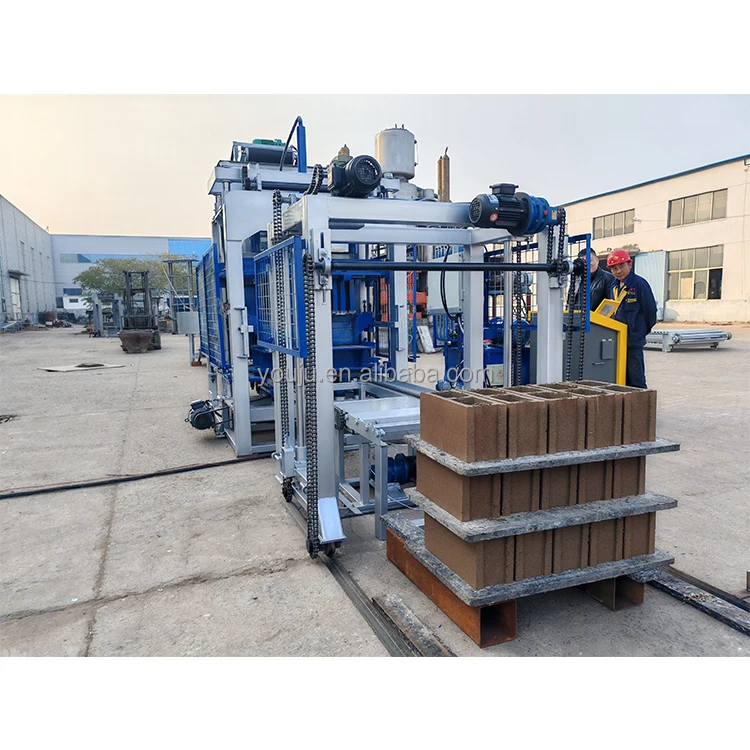
Matched System Integration — every station from raw material feeding through to stacking is timed against the QT4-15 press cycle so the host machine is never left waiting for the next pallet or mix batch.
Technical Specifications
| Parameter | Value |
|---|---|
| Model | QT4-15 |
| Product Type | Hydraulic Block Making Machine |
| Molding Cycle | 15–30 s |
| Pallet Size | 900 × 500 mm |
| Vibration Type | Platform vibration |
| Vibration Frequency | 50–70 Hz |
| Product Height Range | 50–220 mm |
| Overall Power | 24.5 kW |
| Demolding Method | Hydraulic |
| Control System | PLC controlled |
| Hydraulic System | Powered by hydraulic system |
| Electrical & Hydraulic Parts | Original imported or China famous brand |
| Block Compressive Strength | More than 15 MPa |
| Automation Level | Automatic (PLC controlled, automatic pallet feeding, material feeding, vibrating, demoulding) |
| Output — Hollow Block 400×200×200 mm | 900–1200 pcs/hour, 7200–9600 pcs/8hr (basis: 4 pcs/mould, 15–20 s cycle) |
| Output — Hollow Block 400×150×200 mm | 1080–1440 pcs/hour, 8640–11520 pcs/8hr (basis: 5 pcs/mould, 15–20 s cycle) |
| Output — Hollow Block 400×100×200 mm | 1440–1920 pcs/hour, 11520–15360 pcs/8hr (basis: 8 pcs/mould, 15–20 s cycle) |
| Output — Paver 200×100×60 mm | 2880–3840 pcs/hour, 23040–30720 pcs/8hr (basis: 16 pcs/mould, 15–20 s cycle) |
| Output — Solid Brick 240×115×53 mm | 5930–6720 pcs/hour, 47400–53700 pcs/8hr (basis: 28 pcs/mould, 15–20 s cycle) |
| Voltage & Frequency | Configurable to buyer requirement (basis to be confirmed) |
| Hydraulic Pressure | (basis to be confirmed) |
| Vibration Force | (basis to be confirmed) |
Application Suitability
| Application | Material or Output |
|---|---|
| Hollow block production for residential and commercial walls | Fly ash, slag, sand, crushed stone, cement, water |
| Paver brick manufacturing for walkways and driveways | Crushed stone, sand, cement, pigment for colored pavers |
| Solid brick production for load-bearing and partition walls | Gangue, slag, fly ash, cement blends |
| Medium-scale block plant with format flexibility | Mould changeable across hollow, paver, and solid formats |
Why "Cycles per Hour" Tells You Almost Nothing About Your Real Output
A block production line QT4-15 only delivers its rated output when every supporting station feeds, clears, and returns pallets within the press cycle window.
I have watched plant owners sign contracts based on a single cycles-per-hour number, then discover on the first production day that their mixer takes forty seconds to discharge while the press finishes a cycle in twenty. The hydraulic block making machine with supporting equipment sits idle while the belt catches up. Over an eight-hour shift, those dead seconds add up to a noticeable portion of expected daily volume. That is why our capacity table above ties every figure to a specific block dimension, mould cavity count, and confirmed cycle time — so you can calculate against the format you actually sell, not a catalogue abstraction. [NEED_CITE: common causes of output shortfall in block production lines]
How Stations Must Synchronize Around the Press
The QT4-15 completes a moulding cycle in fifteen to thirty seconds depending on block format and mix behaviour. That window sets the pace for the entire block production line QT4-15. Raw material batching must deliver a fresh mix to the hopper before the next cycle begins. The pallet feeder must place a clean pallet on the press table the instant the previous one exits. If any station lags, the PLC holds the press in a wait state and throughput drops.
Where Line Balance Breaks Down in Practice
During a commissioning I handled in South Asia, the mixer discharge gate was undersized for the batch volume. Each discharge took roughly twice as long as the press cycle. We re-matched the belt speed and gate opening until every station cleared within the press window. Only then did the hydraulic block making machine with supporting equipment reach its documented output. Mismatches like this are invisible on a spec sheet but they show up immediately on the first production day. [NEED_CITE: line balancing principles in concrete product manufacturing]
What the Core Parameters Actually Mean on the Floor
The platform vibration at 50–70 Hz works together with hydraulic demolding to compact the mix and release the formed block cleanly. Vibration frequency and hydraulic pressure must both be confirmed against your local aggregate grading and mix design — a sandy mix behaves differently under vibration than one heavy in crushed stone. The 900 × 500 mm pallet size is not arbitrary either; it must fit your existing curing racks and the fork dimensions of the forklift you already run. The product height range of 50–220 mm means one press platform covers hollow blocks, pavers, and solid bricks, provided mould changeover is planned into your shift schedule. Overall power at 24.5 kW determines the electrical supply and dedicated circuit you must arrange before the machine arrives.
The Hidden Cost of Treating the Press as a Standalone Purchase
Quoting the press alone leaves pallet handling, stacking, and curing as manual afterthoughts. I have seen operators spend half a shift moving wet blocks by hand because the stacking station was never included in the order. The result is not just labour cost — it is cracked blocks, uneven curing, and a daily output that never approaches the press rating. When the supporting equipment is sourced from separate suppliers after the press arrives, cycle times are never matched and the bottleneck simply moves from one station to another. [NEED_CITE: impact of incomplete line configuration on block plant productivity]
Why Sourcing the Line as One Package Matters Here
Block machinery is our single focus, which means the QT4-15 press, moulds, pallets, and handling equipment are specified as one matched system rather than assembled from separate suppliers. Configuration is set against your actual mix design and target block format, not a catalogue default. Mould design covers the formats your market sells, with custom drawings available. Automation level is selectable so you can start with semi-automatic pallet handling and add automatic stacking later. Installation support includes operator training so the line runs correctly from day one.
Documentation & Verification
- Line layout showing station positions and pallet flow path for QT4-15 configuration
- Capacity calculation sheet stating block format assumed for each output figure
- Pallet specification matched to your curing rack dimensions and forklift type
- Voltage, frequency, and PLC display language confirmation before production starts
- Factory test record on your specified block format before dispatch
- Mould drawing and format list with estimated changeover procedure
Installation, Commissioning & Support
- Foundation plan accounting for the QT4-15 vibration load and overall power draw of 24.5 kW
- Dedicated electrical circuit sized for confirmed voltage and frequency before machine arrival
- PLC display language and control parameters loaded to match operator requirements
- Pallet feeder and stacking station aligned to the 900 × 500 mm pallet during commissioning
- Operator training covering mould change procedure across hollow, paver, and solid formats
- Wear parts list for hydraulic and vibration components with recommended replacement intervals
Before You Send the Inquiry
To size the block production line QT4-15 correctly around your plant, share the block formats you sell most, your target daily output per format, and the raw materials available locally including aggregate grading. Confirm the voltage, frequency, and PLC language your operators need, and let us know the curing area dimensions and forklift specs you already have on site so pallet size and handling equipment are matched from the start.
Frequently Asked Questions
Q: How is daily output calculated for the QT4-15, and which block format is each figure based on?
A: Every output figure in our table states the block dimension, mould cavity count, and cycle time it assumes. For example, hollow block 400×200×200 mm is rated at 900–1200 pieces per hour based on 4 cavities and a 15–20 second cycle. We do not quote a single cycles-per-hour number without tying it to a specific format.
Q: What supporting equipment is needed around the press to form a complete line?
A: A full block production line QT4-15 includes raw material batching and mixing, pallet feeding, the press itself, block stacking, and curing rack handling. Each station must clear within the press cycle window. We specify every station as one system so cycle times are matched before the line ships.
Q: How should pallet size and material be chosen?
A: The QT4-15 runs 900 × 500 mm pallets. Before confirming, we cross-check this against your curing rack spacing, stacking height, and the fork dimensions of your existing forklift. Choosing pallet material — wood, bamboo, or composite — depends on your curing method and expected pallet lifespan.
Q: When must voltage, frequency, and PLC language be confirmed?
A: These must be locked before production begins. Once the PLC is programmed and electrical panels are wired, changes require rework and delay shipment. We confirm your site voltage, supply frequency, and preferred display language during the proposal stage so commissioning proceeds without holdups.
Q: Does the quotation cover the full line or only the press?
A: Scope depends on what you need. We can quote the QT4-15 press with moulds only, or the hydraulic block making machine with supporting equipment as a complete line from batching through stacking. The quotation clearly lists every included station so there are no manual-handling surprises on arrival.


