
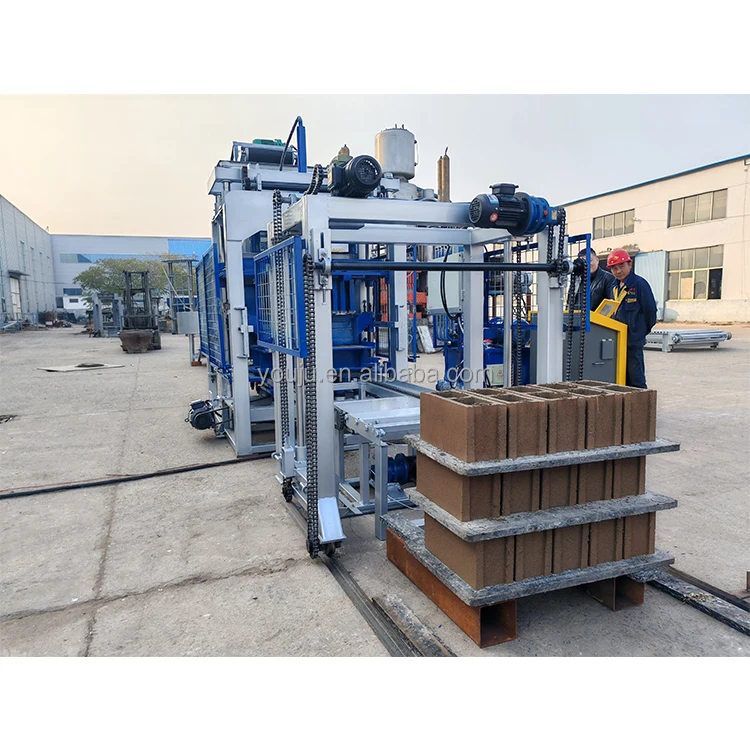
Pallet-to-press line synchronization — the QT4-15 block production line QT4-15 is configured as a matched system where every upstream and downstream station is timed against the 15-30s press cycle, so the host machine is never left idle waiting for material, pallets or stacking clearance.
Technical Specifications
| Parameter | Value |
|---|---|
| Product Type | Automatic Hydraulic Block Making Machine |
| Model | QT4-15 |
| Control System | PLC controlled with approach switch monitoring |
| Molding Cycle | 15-30s (basis not stated in source — confirm block format / material / thickness) |
| Pallet Size | 900 x 500 mm |
| Vibration Type | Platform vibration |
| Vibration Frequency | 50-70 Hz |
| Product Height Range | 50-220 mm |
| Overall Power | 24.5 kW |
| Demolding Method | Hydraulic |
| Mould Format | Hollow block, paver brick, solid brick (interchangeable moulds) |
| Automation Level | Automatic (PLC with approach switch monitoring; automatic pallet feeding, material feeding, vibrating, demoulding) |
| Raw Material Compatibility | Fly ash, slag, gangue, sand, crushed stone, cement, water and other industrial residues |
| Output Capacity | 900-1200 pcs/h based on 400x200x200mm hollow block, 4 pcs/mould, 15-20s cycle |
| Output Capacity | 1080-1440 pcs/h based on 400x150x200mm hollow block, 5 pcs/mould, 15-20s cycle |
| Output Capacity | 1440-1920 pcs/h based on 400x100x200mm hollow block, 8 pcs/mould, 15-20s cycle |
| Output Capacity | 2880-3840 pcs/h based on 200x100x60mm paver, 16 pcs/mould, 15-20s cycle |
| Output Capacity | 5930-6720 pcs/h based on 240x115x53mm solid brick, 28 pcs/mould, 15-20s cycle |
| Block Compressive Strength | >15 MPa (basis not stated in source — verify against manufacturer catalog) |
| Target Plant Scale | Medium and small factory |
Application Suitability
| Application | Material or Output |
|---|---|
| Hollow block production for building walls and partitions | Crushed stone, sand, cement, fly ash, slag |
| Paver brick production for landscaping, walkways and driveways | Sand, crushed stone, cement with fine aggregate face mix |
| Solid brick production for masonry construction | Fly ash, gangue, sand, cement blends |
| Industrial residue utilization in block production | Fly ash, slag, gangue as partial aggregate replacement |
Why the QT4-15 Block Production Line QT4-15 Is More Than the Press Alone
The press sets the heartbeat — every feeder, mixer and stacker must keep that rhythm or output collapses.
A stationary block making machine with supporting equipment like the QT4-15 does not operate in isolation. I once commissioned a line in Peru where the mixer discharged every 45 seconds but the press cycled at 18 seconds. The host machine sat idle one-third of the time, and the plant owner could not understand why daily output fell well short of the quoted figure. [NEED_CITE: mismatched station cycle times in block production lines] The lesson is that a block production line QT4-15 quotation must state the cycle time of every station — raw material feeder, mixer batch discharge, pallet return conveyor, press, wet stacker — not just the press alone.
Upstream Stations That Must Match the 15-30s Press Cycle
The raw material feeding and mixing station upstream of the stationary block making machine with supporting equipment must deliver a homogeneous batch within the press cycle window. At a 15-20 second molding cycle for a 400x200x200mm hollow block, the mixer must discharge a complete batch in under 20 seconds and the belt feeder must refill the press hopper before the next cycle begins. When the mixer is undersized, the press waits, and those idle seconds accumulate into thousands of missing blocks over a shift. Pallet feeding is equally critical — the pallet return conveyor must deliver a clean 900x500mm pallet to the press table within the demoulding and ejection window, or the PLC approach switches will hold the cycle and stall the line.
Downstream Handling: Where Output Is Made or Lost
Once the QT4-15 press completes a cycle, the wet blocks on their 900x500mm pallet must move to the stacking station without delay. If the stacker cycle is slower than the press cycle, the pallet conveyor backs up and the PLC halts the press to prevent a jam. This is where the block production line QT4-15 must be specified as a whole — the stacker lift speed, the curing rack spacing that matches the 900x500mm pallet, and the forklift capacity available to transfer racks to the curing yard all form a single chain. [NEED_CITE: curing rack spacing and pallet size coordination in block plants] A forklift that cannot handle a loaded rack at the required interval becomes the hidden bottleneck that no press specification can fix.
How Vibration, Pressure and Pallet Size Define Block Quality
The platform vibration at 50-70 Hz works together with hydraulic demoulding to compact the mix into the mould cavity. For a hollow block with thin webs, the vibration frequency must be high enough to flow the aggregate into narrow spaces while the hydraulic pressure holds the mould box firm against the platform. The 900x500mm pallet size is not arbitrary — it determines how many blocks fit per mould face, how the curing racks are spaced, and what forklift mast height is required to stack racks in the curing area. Product height range of 50-220mm means the same pallet can carry a 60mm paver or a 200mm hollow block, but the vibration duration and pressure setting must change between formats. A line configured only for hollow blocks will produce weak pavers if the PLC program is not updated when the mould is swapped.
The Hidden Cost of Ignoring Station Compatibility
When a block production line QT4-15 is purchased as a standalone press and bolted onto mismatched upstream and downstream equipment, the consequences are rarely obvious on day one. The mixer may cope at low output, but as the operator pushes toward the upper end of the quoted capacity, the press begins waiting for material, pallets pile up on the return conveyor, and block edges chip during rushed demoulding. [NEED_CITE: consequences of unmatched station capacities in block production] The plant owner then blames the press, when the real fault lies in a line that was never timed as a single system from raw material infeed to cured product out.
Why This Line Is Specified as a Complete System
The QT4-15 stationary block making machine with supporting equipment is offered with a line layout drawing that names every station and its cycle time, not just the press output. The 900x500mm pallet specification is confirmed against the buyer’s curing rack design and on-site forklift before the order is placed. The PLC control language and voltage are locked in before production, so commissioning is not delayed by a display the operator cannot read. Mould formats — hollow block, paver, solid brick — are selected based on the buyer’s market, and the line is laid out so that mould changeover does not require moving the pallet conveyor or stacker. [NEED_CITE: pre-shipment voltage and PLC language confirmation for exported machinery] Each station’s motor rating contributes to the 24.5 kW overall power figure, and the electrical schematic shows how the line draws from the site supply so the buyer can prepare the correct breaker and cable size.
Documentation & Verification
- Line layout drawing showing each station cycle time against the QT4-15 press cycle
- Capacity calculation stating the exact block format and mould cavity count assumed
- Pallet specification sheet confirming 900x500mm size, material and load rating
- Voltage, frequency and PLC display language confirmation record before shipment
- Factory test record on the buyer’s selected block format before dispatch
- Hydraulic and electrical schematic for site preparation and breaker sizing
Installation, Commissioning & Support
- Foundation plan matched to the 24.5 kW overall power draw and vibration isolation requirements
- Electrical supply confirmation covering voltage, frequency and dedicated breaker for the QT4-15 line
- Pallet return conveyor alignment checked against the 900x500mm pallet during on-site assembly
- PLC program verified in the confirmed display language before first production run
- Operator training covering mould change procedure and approach switch troubleshooting
- Wear parts list with hydraulic seal and vibration motor brush replacement intervals
Before You Request a Quotation
To configure a stationary block making machine with supporting equipment that matches your plant, share your target block format, the local aggregate and cement type you plan to use, and your existing curing area dimensions so the 900x500mm pallet and rack spacing can be coordinated. Confirm your site voltage, frequency and preferred PLC display language. If you already operate a mixer or forklift, provide their specifications so upstream and downstream cycle times can be verified against the QT4-15 press cycle.
Frequently Asked Questions
Q: How do I verify the real daily output of the QT4-15 line for my specific block format?
A: Request a capacity calculation document that names the exact block format, mould cavity count and cycle time assumed for each output figure. The QT4-15 outputs vary significantly — 900-1200 pcs/h for a 400x200x200mm hollow block versus 2880-3840 pcs/h for a 200x100x60mm paver — and the line layout must state which format drives the daily target.
Q: What upstream and downstream stations must match the press cycle time?
A: The mixer batch discharge rate, raw material belt feeder, pallet return conveyor and wet product stacker must all complete their operations within the 15-30s QT4-15 molding cycle. If any station is slower, the PLC approach switches will hold the press, reducing actual output below the quoted capacity.
Q: How is the 900x500mm pallet coordinated with curing racks and forklifts?
A: The pallet size determines curing rack shelf spacing, rack width and loaded rack weight. Your site forklift must handle a fully loaded rack at the interval the stacker produces them. The line layout should confirm rack dimensions and forklift capacity before the order is finalized.
Q: What voltage and PLC language options are confirmed before shipment?
A: Voltage, frequency and PLC display language are confirmed during the quotation stage and documented before production begins. This prevents commissioning delays caused by incompatible power supply or an unreadable control interface when the block production line QT4-15 arrives on site.
Q: What installation support is included with the complete line?
A: On-site installation covers station alignment, pallet conveyor calibration, PLC program verification in the confirmed language and operator training. The line layout drawing, hydraulic and electrical schematics and wear parts list are provided so your team can maintain the QT4-15 independently after commissioning.


