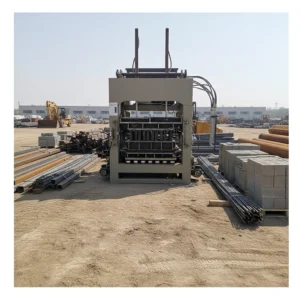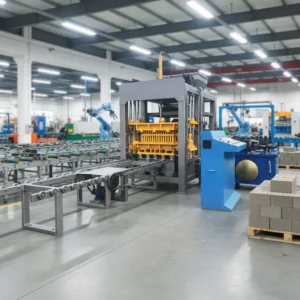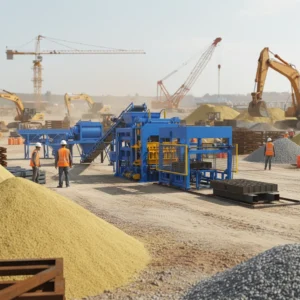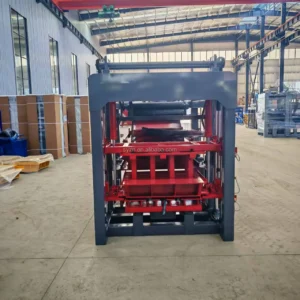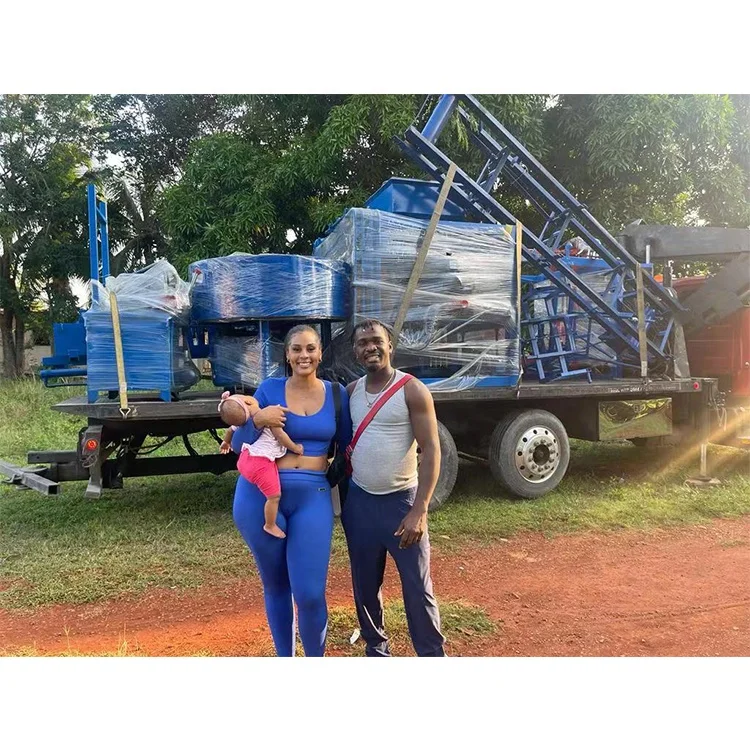
Matched Line Integration — The QT4-15 press is specified alongside its mixer, pallet feeder, and stacker so that every station aligns with the 15–25 s molding cycle, preventing the bottleneck that occurs when supporting equipment is sourced separately.
Technical Specifications
| Parameter | Value |
|---|---|
| Model | QT4-15A |
| Product Type | Fully Automatic Concrete Block Making Machine |
| Overall Dimensions (L×W×H) | 7100×1600×2610 mm |
| Molding Cycle | 15–25 s |
| Vibration Frequency | 4600 r/min |
| Vibration Force | 40–50 kN |
| Total Power | 18.45 kW |
| Mixer Model | JQ350 |
| Pallet Size | 850×550×25 mm |
| Net Weight | 3 T |
| Applied Products | Paver, solid block, hollow block, curbstone |
| Raw Materials | Crushed stone, sand, cement, dust, fly ash |
| Output Capacity (400×200×200 mm hollow block) | 408 pcs/hr, 3264 pcs/8hr |
| Output Capacity (400×150×200 mm hollow block) | 510 pcs/hr, 4080 pcs/8hr |
| Output Capacity (240×115×53 mm solid brick) | 2100 pcs/hr, 17000 pcs/8hr |
| Automation Level | Semi-automatic / Automatic options available |
| Hydraulic System | Hydraulic station equipped (pressure rating to be confirmed) |
| Control System | PLC / MCC options available (type to be confirmed) |
| Stacking Method | Automatic stacker included |
Application Suitability
| Application | Material or Output |
|---|---|
| Hollow block production for building walls | Crushed stone, sand, cement, fly ash — 400×200×200 mm or 400×150×200 mm formats |
| Solid brick production for load-bearing structures | Cement, sand, dust — 240×115×53 mm format |
| Paver production for walkways and yards | Crushed stone and cement mix with pigment additives |
| Curbstone production for road and infrastructure projects | High-density concrete mix with coarse aggregate |
| On-site block production for housing developments | Local aggregate with fly ash or stone dust binder |
Why a Block Making Machine Line Needs More Than Just the Press
Quotations that list only the press leave the buyer to discover, after arrival, that pallet handling, stacking, and curing were never part of the deal.
I have watched buyers receive a well-built block press only to realize the pallets must be moved by hand from the press to the curing yard, and stacked manually onto racks. The press itself hits its cycle time, but the operator spends the rest of the shift moving wet blocks, and actual daily output drops far below what the brochure promised [NEED_CITE: common block plant output gaps from missing line equipment]. A complete block making machine line must account for every station between raw material input and cured product output.
Station-by-Station Integration Across the Block Making Machine Line
The JQ350 mixer feeds the host press through a conveyor sized to deliver a fresh batch within the 15–25 s molding window. When the mixer is undersized, the press sits idle waiting for material, and the effective cycle time stretches well beyond what the specification sheet states. Matching each station to the press rhythm is the foundation of a productive block making machine line.
Pallet Handling and Stacking as Part of the Line Design
The 850×550×25 mm pallet size is selected to match standard curing rack dimensions and common forklift tine widths. An automatic stacker lifts freshly pressed blocks off the press table and places them onto the curing rack without manual intervention [NEED_CITE: automation levels in mid-tier block plants]. If the pallet material or size does not align with the buyer’s existing curing area, the line stalls at the stacking station regardless of how fast the press cycles.
Reading the Specs That Matter on the Production Floor
The vibration system delivers 40–50 kN of force at 4600 r/min through the bed mould, while the upper mould applies compression vibration simultaneously. This combination compacts the concrete mix from both directions, which is what determines block density and compressive strength. A vibration force that is too low for a given aggregate produces blocks that crack during curing; one that is too high causes the mix to segregate, leaving weak spots.
The 18.45 kW total power rating covers the press motor, hydraulic pump, and vibration system together. Buyers should verify that their site electrical supply can sustain this draw continuously, including the startup surge from the hydraulic pump, without tripping upstream breakers [NEED_CITE: electrical supply requirements for concrete block machinery].
The QT4-15A supports hollow block, solid brick, paver, and curbstone formats through mould changes. The cycle time of 15–25 s varies depending on the format being produced and the mix design in use, so the output figures of 3264 hollow blocks per 8-hour shift apply specifically to the 400×200×200 mm format under standard conditions.
What Happens When Line Stations Are Not Matched
When the mixer output does not keep pace with the press cycle, the operator begins shortening the vibration time to compensate, producing blocks with inconsistent density. When pallets arrive at the press table slower than the molding cycle, the press waits and the daily count falls. These problems do not appear in a factory test because the test runs every station in sequence with matched timing [NEED_CITE: block plant commissioning issues from unmatched equipment]. The buyer discovers the mismatch only after the line has been running for a week on their own site with their own material.
Why Procurement Here Covers the Full Line
Block machinery is the single focus of this operation, so the press, mould, pallet, and handling equipment are specified as one matched system rather than assembled from unrelated suppliers. The line configuration is set against the buyer’s actual mix design, local aggregate, and target block format, not pulled from a catalogue default.
Mould design covers the formats the buyer’s market actually sells, and custom drawings are accepted when standard formats do not match local demand. The automation level is selectable, meaning a buyer can start with semi-automatic pallet handling and add an automatic stacker later as production volume grows. Installation support includes operator training so the crew understands not just the press but the full sequence from mixer to curing rack.
Documentation & Verification
- Line layout drawing with capacity calculation stated per block format
- Pallet specification sheet confirming size, material, and load rating
- Hydraulic and electrical schematic with component identification
- Voltage, frequency, and PLC display language confirmation record
- Factory test record on buyer’s specified block format before dispatch
- Wear parts and mould list with replacement part numbers
Installation, Commissioning & Support
- Foundation plan based on the 7100×1600 mm press footprint and vibration load
- Dedicated circuit for the 18.45 kW total draw with hydraulic pump startup surge allowance
- Machine dismantling for container loading and reassembly guidance on site
- First-run parameter setting for vibration force and cycle time against buyer’s mix
- Operator training covering mould change procedure and daily maintenance checklist
- Spare mould and hydraulic wear parts list provided at delivery
Preparing Your Inquiry
To configure a line that matches your site, share the block formats you intend to produce, your target daily output per format, and the local aggregate and cement types available to you. Include your site voltage and frequency, the language you need on the control display, and the dimensions of your curing area so the pallet and stacking system can be sized correctly. If you have existing upstream or downstream equipment, note the model and capacity so the block making machine line can integrate without bottlenecks.
Frequently Asked Questions
Q: How is the output capacity calculated for each block format?
A: Each capacity figure is based on a specific block dimension and an assumed molding cycle within the 15–25 s range. The 408 pieces per hour applies to the 400×200×200 mm hollow block, while the 510 pieces per hour applies to the 400×150×200 mm hollow block. Actual throughput depends on your mix design, pallet handling speed, and curing area logistics.
Q: What stations are included between raw material input and final stacking?
A: The line covers the JQ350 mixer, conveyor feeding, the QT4-15A host press, automatic pallet feeding, and an automatic stacker. Each station is sized to match the press cycle so that no single point creates a bottleneck. Curing rack handling and raw material batching can be added depending on your plant layout.
Q: How do I confirm pallet size against my existing curing area?
A: The standard pallet measures 850×550×25 mm. Before production starts, share your curing rack slot width, rack spacing, and forklift tine dimensions so we can verify compatibility or adjust the pallet specification to match your existing infrastructure without requiring changes to your curing setup.
Q: What electrical and control details must be confirmed before production begins?
A: Voltage, frequency, and PLC display language must be confirmed before the control panel is built. This ensures the machine arrives ready to connect to your site supply and the operator can read all menus and alarms in their working language from the first day of commissioning.
Q: Which raw material feed configuration matches my local aggregate?
A: The feed system is configured after reviewing your aggregate type, particle size range, and moisture content. Send a sample of your sand, crushed stone, or fly ash so the mixer and hopper can be set up for consistent batching without bridging or segregation in the feed path.