
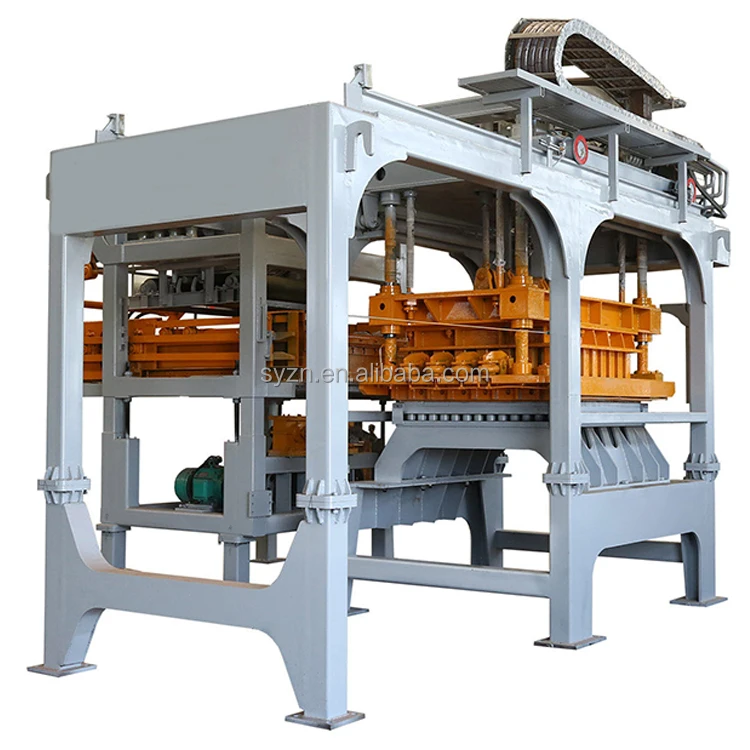
Fully Integrated Line Design — every station from raw material feeding to automatic stacking is timed to the QT18-25 press cycle, preventing the bottleneck effect where the host machine waits on upstream or downstream equipment.
Technical Specifications
| Parameter | Value |
|---|---|
| Model | QT18-25 |
| Product Type | Pallet-free Stationary Block Making Machine Production Line |
| Brick Height Range | 50–300 mm |
| Stacking Height | 0–1200 mm |
| Main Vibration Form | Platform Vibration |
| Vibration Frequency | 2800–4500 r/min |
| Vibration Power | 60 kW |
| Hydraulic System Power | 59 kW |
| Diving Method | Hydraulic |
| Demolding Method | Vibration and Hydraulic |
| Molding Cycle | 15–25 s (basis not stated in source) |
| General Water Consumption | 8 T/day |
| Factory Area | 2000 m² |
| Control System | PLC with person-machine conversation interface |
| Automation Level | Fully automatic, pallet-free direct stacking |
Application Suitability
| Application | Material or Output |
|---|---|
| Hollow Block Production | Crushed stone, sand, cement, fly ash, gravel |
| Solid Block Manufacturing | Cement, dust, slag, and coarse aggregates |
| Paving Block & Interlocking Brick | Colored concrete mixes with fine aggregates |
| Kerbstone Production | High-density concrete with specific structural requirements |
| High-Capacity Local Plants | Direct stacking without pallet circulation infrastructure |
Why Cycle Time Claims Often Fail on the Factory Floor
A pallet-free block making machine production line is only as fast as its slowest station. The host press can never exceed the timing of the mixer discharge or the stacker return loop.
In my years planning line layouts in Shandong, I have found that a quoted molding cycle often assumes an ideal material feed that rarely exists on site. When the mixer discharge gate is slow or the raw material feeder cannot keep the hopper full, the press sits idle for seconds at a time. Over a shift, those seconds turn into thousands of missing blocks. A true pallet-free block making machine production line must be engineered so that the vibration, hydraulic pressure, and material flow are synchronized [NEED_CITE: industrial automation synchronization standards for concrete plants].
Eliminating the Pallet Return Bottleneck
Traditional stationary lines require a massive investment in pallets and a complex return conveyor system. By utilizing the QT18-25 pallet-free block making machine production line, plant owners remove the need for pallet circulation entirely. The fresh blocks are stacked directly from the mould, which simplifies the line footprint and reduces the maintenance associated with pallet return belts and cleaning stations.
Station-to-Station Timing and PLC Control
The PLC with a person-machine conversation interface is the central nervous system of this setup. It does not just control the press; it coordinates the batching plant, the mixer, and the automatic stacker. If the stacker takes too long to clear a finished layer, the PLC must signal the press to delay the next cycle. Without this coordinated timing, the entire pallet-free block making machine production line suffers from micro-stoppages that are difficult to track but devastating to daily output [NEED_CITE: PLC logic for concrete block manufacturing lines].
Engineering the Vibration and Hydraulic Balance
The 60 kW vibration power and 59 kW hydraulic system are paired to achieve high-density compaction. In a pallet-free system, the block must have enough "green strength" to support the weight of the layers above it immediately after demolding. The platform vibration at 2800–4500 r/min ensures the concrete mix is tightly packed, while the hydraulic diving method provides the necessary downward force. The brick height range of 50–300 mm allows the machine to handle everything from thin pavers to large structural hollow blocks, provided the vibration frequency is adjusted to match the aggregate size and cement content.
The Cost of Ignoring Line Integration
Many buyers focus only on the press specifications and ignore the supporting equipment. If the raw material feeding system cannot supply the required volume within the 15–25 s molding cycle, the investment in a high-capacity press is wasted. Furthermore, if the stacking height of 1200 mm is not matched with a curing area that can handle the daily volume, the finished product will be left on the floor, leading to breakage and logistical chaos [NEED_CITE: concrete curing and stacking best practices].
Why This Line Configuration Stands Apart
Our approach to block machinery is based on single-focus integration. Rather than assembling the QT18-25 line from separate suppliers, we specify the mixer, the feeder, and the stacker as one matched system. We provide configuration based on the buyer’s actual mix design and local aggregate, ensuring that the hydraulic pressure and vibration are set for the specific materials available at the project site. This level of detail ensures that the line performs as expected from the first day of production.
Documentation & Verification
- Line layout and capacity calculation stating the specific block format assumed.
- Machine specification sheet with confirmed voltage and control language.
- Hydraulic and electrical schematics for the entire integrated line.
- Factory test record on the buyer’s target block format before dispatch.
- Wear parts and mould list for first-year maintenance planning.
Installation, Commissioning & Support
- Foundation plan based on the 2000 m² factory area and 119 kW total power requirement.
- On-site installation with operator training focused on the PLC person-machine interface.
- Mould change system instruction to ensure format flexibility is maintained.
- Commissioning support to match the molding cycle to the actual raw material feed.
- Technical guidance on the 0–1200 mm stacking height and curing rack handling.
Inquiry and Project Planning
To receive a precise proposal for the QT18-25, please provide your target block format, required daily output, and the characteristics of your local raw materials. We also need to know your site dimensions and the local voltage and frequency standards to ensure the PLC and motors are configured correctly before shipment.
Frequently Asked Questions
Q: How is the 15–25 s cycle time affected by the block format?
A: The cycle time varies depending on the height and complexity of the block. A thin paver requires less vibration time than a 300 mm hollow block. The PLC allows the operator to store different profiles for each format, ensuring the vibration frequency and hydraulic pressure are optimized for the specific product being run on the pallet-free block making machine production line.
Q: How are the station cycle times matched across the line?
A: We calculate the timing of the mixer discharge, the feeder travel, and the stacker return to ensure they all fall within the press’s molding cycle. If one station is slower, it becomes the bottleneck. Our line layout documentation shows the exact timing for each station based on the target block format.
Q: What stacking method is used and what curing area is required?
A: The system uses direct stacking up to 1200 mm without pallets. This requires a flat, reinforced curing area and a forklift or specialized clamp to move the stacked cubes. The reduced footprint means more space can be dedicated to curing and storage rather than pallet circulation.
Q: What PLC language and voltage are confirmed before shipment?
A: We confirm the operator’s preferred language for the person-machine conversation interface and the local industrial voltage and frequency. This ensures that the electrical cabinets and the PLC display are ready for immediate use upon arrival at the buyer’s facility [NEED_CITE: international voltage standards for industrial machinery].


