
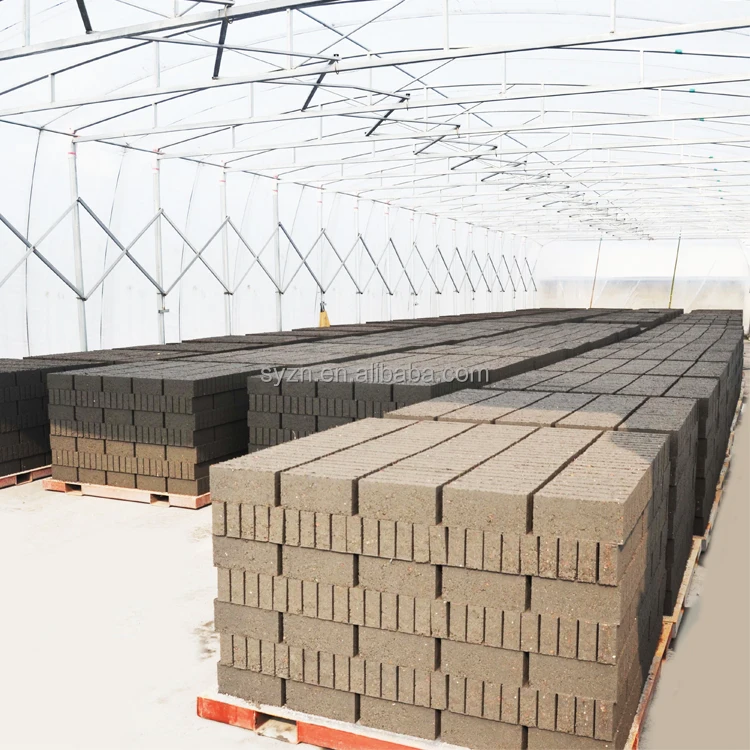
Matched System Configuration — Every upstream and downstream station from raw material feeding to stacking is timed to the QT18-25 press cycle so no station waits on another.
Technical Specifications
| Parameter | Value |
|---|---|
| Model | QT18-25 |
| Product Type | Fully Automatic Pallet-free Block Making Machine |
| Brick Height Range | 50–300 mm |
| Stacking Height | 0–1200 mm |
| Main Vibration Form | Platform Vibration |
| Vibration Frequency | 2800–4500 r/min |
| Molding Cycle | 15–25 s (basis not stated in source — confirm block format / material / thickness) |
| Vibration Power | 60 kW |
| Hydraulic System Power | 59 kW |
| Driving Method | Hydraulic |
| Demolding Method | Vibration and Hydraulic |
| General Water Consumption | 8 T/Day |
| Control System | PLC with person-machine conversation interface |
| Automation Level | Fully automatic, pallet-free stacking |
| Applied Products | Concrete blocks, hollow/solid blocks, pavers, interlocking blocks, curbstone, colored pavers |
| Raw Materials | Crushed stone, sand, cement, dust, fly ash, gravel, slag |
Application Suitability
| Application | Material or Output |
|---|---|
| Hollow block production for residential and commercial walls | Crushed stone, sand, cement, fly ash blends |
| Solid block manufacturing for load-bearing structures | Gravel, sand, cement with high-density compaction |
| Paving block and colored paver runs for roads and walkways | Fine aggregate, cement, pigment additives |
| Interlocking block and curbstone production for infrastructure | Slag, dust, cement mixes adapted to local aggregate |
What "15–25 Seconds per Cycle" Actually Means for Your Daily Output
A cycle time without the block format attached is a number that tells you nothing about real throughput.
I have sat with buyers who compared two block making machine production line quotations side by side, both claiming similar cycle times, yet one line produced noticeably fewer blocks per shift. The reason was simple: the quoted cycle assumed a thin paver while the buyer needed 200 mm hollow blocks. The press itself was not the bottleneck — the mismatch between the stated cycle and the buyer’s actual product was. [NEED_CITE: block format impact on cycle time and daily output in concrete block production]
When we specify a turnkey block plant around the QT18-25, every capacity figure we provide names the exact block format, mix design, and curing assumption behind it. That way you know what the line will produce on your first day, not what it might produce under conditions you will never run.
Balancing Every Station Around the Press
A block making machine production line is only as fast as its slowest station. The QT18-25 press may complete a mold cycle in 15–25 seconds, but if the mixer takes longer to deliver the next batch, or the stacker cannot clear cured product fast enough, the press sits idle. We calculate the cycle at each station — raw material feeding, mixing, molding, stacking, and curing rack handling — and adjust motor sizes, conveyor speeds, and buffer capacities so they align. This is the core of turnkey block plant engineering: not selling a press, but delivering a line where no station waits.
Why Pallet-Free Stacking Changes the Downstream Layout
The QT18-25 stacks blocks directly after molding to a height of 0–1200 mm without pallets, which removes an entire loop of pallet return, cleaning, and recirculation from the line. For a plant owner planning a complete block production setup, this means less floor space dedicated to pallet storage and fewer forklift movements between the press and the curing area. The trade-off is that block geometry and green strength must be sufficient to support stacking immediately after demolding, which we confirm during factory testing with the buyer’s actual mix sample. [NEED_CITE: green strength requirements for pallet-free block stacking systems]
Reading the Specs That Matter for Line Integration
The platform vibration system operating at 2800–4500 r/min works together with the 59 kW hydraulic system to compact the mix and then demold through combined vibration and hydraulic force. Higher vibration frequency improves density for thinner formats like pavers, while the hydraulic pressure ensures consistent fill for taller hollow blocks up to 300 mm. The 60 kW vibration power and 59 kW hydraulic power are closely matched, which matters because an imbalance between the two leads to either under-compacted blocks or excessive wear on the mold. The PLC with person-machine conversation interface allows operators to store recipes per block format, so switching from hollow blocks to curbstones does not require manual pressure and frequency adjustments. A factory area of 2000 m² is indicated for the full line, though actual layout depends on the buyer’s site dimensions, curing area arrangement, and raw material storage position.
The Hidden Cost of Quoting the Press Alone
I configured a full automatic block line early in my career where the quotation covered the press and nothing else. The buyer assumed feeding, mixing, and stacking were included. They were not. The first week, workers moved wet blocks by hand from the press to the curing yard, and the press sat idle for minutes between cycles waiting for someone to clear the output area. [NEED_CITE: hidden costs of incomplete block production line quotations] Daily output fell well below what the press cycle time suggested was possible. Since then, I make sure every quotation for a block making machine production line around the QT18-25 explicitly lists which supporting stations are included, which are optional, and where the buyer’s existing equipment connects.
Why Buyers Spec the Whole Line Here
Block machinery is our single focus, which means the QT18-25 press, its molds, and the supporting handling equipment are specified as one matched system rather than assembled from separate suppliers. We configure the line against the buyer’s actual mix design and local aggregate, not a catalog default — I require raw material samples before finalizing any turnkey block plant quotation. Molds are designed for the formats the buyer’s market actually sells, including custom drawings when standard formats do not match. Automation is selectable, so a buyer can start with semi-automatic upstream stations and upgrade the stacking and cubing section later without replacing the press. Installation support includes on-site commissioning where we verify that every station’s cycle time matches the next, from raw material intake through to cured product output.
Documentation & Verification
- Line layout and capacity calculation stating the block format assumed for each cycle time figure
- Machine specification sheet with hydraulic and electrical schematic for the QT18-25
- Mold drawing and format list covering every block type in the quotation
- Voltage, frequency, and PLC display language confirmation before production starts
- Factory test record showing line-wide cycle synchronization across all stations
- Packing photographs and customs documentation support for export shipment
Installation, Commissioning & Support
- Foundation plan based on the QT18-25 vibration load and 60 kW vibration power requirement
- Dedicated electrical circuit sized for combined 119 kW vibration and hydraulic system load
- Machine dismantling for container loading with reassembly supervised on site
- First-run commissioning verifying 15–25 s molding cycle against the buyer’s confirmed block format
- Operator training on PLC interface recipe storage for each block format and stacking height
- Wear parts and mold list provided at delivery with recommended replacement intervals
Before You Request a Quotation
To configure a block making machine production line that actually meets your daily output target, we need a few details upfront. Send us the specific block formats your market demands, including dimensions and required compressive strength. Provide a sample or analysis of your local aggregate — sand type, moisture content, and maximum particle size — so we can size the mixer and feeding system correctly. Let us know your available floor area, existing curing yard layout, and the voltage and frequency at your site so the electrical and control systems are confirmed before production begins.
Frequently Asked Questions
Q: How is line-wide cycle time balanced so the press is not left waiting for the mixer or stacker?
A: We calculate the cycle at every station — feeding, mixing, molding, stacking, and curing — and adjust conveyor speeds, buffer sizes, and motor ratings so they align with the QT18-25 press cycle. If the mixer batch time exceeds the molding cycle, we increase mixer capacity or add a holding hopper. The goal is zero idle time at the press.
Q: Which supporting stations are included in the quotation and which are optional?
A: The quotation explicitly lists raw material feeding, mixing, pallet-free stacking, and curing rack handling as part of the matched system. Any station the buyer plans to supply themselves — such as an existing mixer or forklift — is marked separately so there is no ambiguity about what is included and where the line connects to existing equipment.
Q: What block format and mix design is the quoted capacity based on?
A: Every capacity figure we provide names the exact block format, dimensions, and mix design assumed. If the buyer switches to a different format — for example, from a 200 mm hollow block to a 60 mm paver — we recalculate the molding cycle and daily output and provide an updated capacity table covering all formats in the mold list.
Q: How does the pallet-free stacking system integrate with an existing curing area?
A: The QT18-25 stacks blocks directly to a configurable height of 0–1200 mm without pallets. We need the buyer’s curing yard dimensions and forklift specifications to set the stacking height and spacing so that cured stacks can be moved without re-handling. Block green strength is confirmed during factory testing with the buyer’s actual mix.
Q: What is the factory area requirement and how should the layout adapt to a specific site?
A: A factory area of approximately 2000 m² is indicated for the complete line including raw material storage, press, stacking, and curing zones. Actual layout depends on the buyer’s site shape, ceiling height, and whether curing takes place indoors or in an open yard. We provide a scaled line layout drawing adapted to the buyer’s confirmed dimensions before production starts.


