
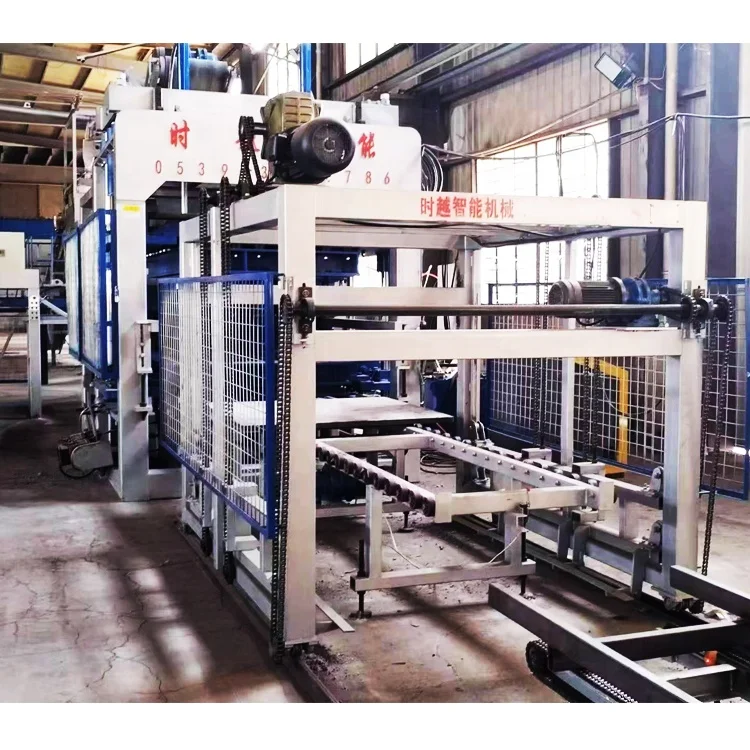
System-Matched Line Configuration — The QT15-15 is specified as a complete stationary block machine production line where press cycle, pallet handling and stacking are balanced as one integrated system rather than sourced from disconnected suppliers.
Technical Specifications
| Parameter | Value |
|---|---|
| Product Type | Stationary Concrete Block Making Machine |
| Model | QT15-15 |
| Overall Dimensions (L×W×H) | 9350×2520×2950 mm |
| Net Weight | 15 T |
| Rated Power | 45.7 kW |
| Voltage | 380V or customized to buyer requirement |
| Hydraulic Pressure | 21 MPa |
| Pallet Size | 1350×850×40 mm |
| Output Capacity (Hollow Block 400×200×200 mm) | 3,600 pcs/hour, 28,800 pcs/day |
| Output Capacity (Hollow Block 400×150×200 mm) | 4,320 pcs/hour, 34,560 pcs/day |
| Output Capacity (Solid Brick 240×115×53 mm) | 14,000 pcs/hour, 112,000 pcs/day |
| Vibration System | Four external vibration motors |
| Upper Mould Synchronization | Dual-side synchronous gear, four-point stabilization |
| Material Feeder | European design, turning-arm cylinder |
| Vibration Damping | Airbag system with adjustable air pressure |
| Control System | PLC (brand and language options to be confirmed) |
| Automation Level | Automatic (stacking, pallet feeding and cubing scope to be confirmed) |
| Standards | ISO 9001:2008, CE |
| Warranty | 1 year |
Application Suitability
| Application | Material or Output |
|---|---|
| High-capacity hollow block production | Crushed stone, sand, cement, fly ash aggregates |
| Solid brick manufacturing for distributors | River sand, quarry dust, cement blends |
| Paving block production for contractors | Coarse aggregate, granite dust, cement mixes |
| Housing project on-site block plants | Locally sourced aggregate and cement |
| Format expansion for existing manufacturers | Interlocking brick, kerbstone and porous brick with confirmed mould |
Why Quoted Cycles per Hour Rarely Match Real Daily Output
Capacity numbers only mean something when the entire line — not just the press — can keep pace.
When a stationary block machine production line is quoted at a headline cycle rate, the figure often assumes a single block format and ignores whether pallets are fed, stacked and cured fast enough to keep the press running. I have watched high-tonnage machines sit idle for minutes each cycle because the downstream handling was specified by a different supplier who never talked to the press maker. The bottleneck shifts from the press to the pallet return or the stacking station, and the real daily output drops well below what the brochure promised. [NEED_CITE: line balancing principles in block production]
Matching Every Station to the Press Cycle
A stationary block machine production line lives or dies by the slowest station. The QT15-15 operates on a 1350×850×40 mm pallet, which sets the physical envelope for the pallet feeder, the wet-block conveyor and the curing rack dimensions. If the pallet return loop takes longer than the press cycle, the press waits. That is why the pallet specification is confirmed against the buyer’s existing forklift capacity and curing floor layout before the line is finalized, not after it arrives on site.
Balancing Raw Material Feed with Mould Filling
The European-design turning-arm feeder on the QT15-15 distributes material across the mould cavity through a cylinder-driven sweep. Uniform fill matters because uneven material distribution causes density variation across the pallet — blocks on one side cure harder than the other. Feed speed must match the press cycle so the hopper never runs dry mid-stroke and never overflows onto the vibration table. [NEED_CITE: material feed uniformity in concrete block forming]
Reading the Specifications That Actually Matter
The 21 MPa hydraulic pressure works together with the four external vibration motors to compact the mix. Pressure alone does not guarantee block strength; the vibration force must match the aggregate particle size and the cement ratio the buyer actually uses. The dual-side synchronous gear with four-point stabilization keeps the upper mould aligned during this combined press-and-vibrate stroke, preventing uneven wear on the mould liner. Airbag damping with adjustable air pressure lets the operator tune vibration intensity by block format — solid brick demands a different damping profile than a large hollow block. The 45.7 kW rated power must be verified against the buyer’s transformer capacity and dedicated circuit rating before installation begins.
The Hidden Cost of Skipping Line Integration
When supporting equipment is left out of the quotation, the buyer sources pallets, mixers and stackers separately. Pallet thickness tolerances from a different supplier can jam the pallet feeder. A mixer with the wrong discharge height forces a manual transfer step that cools the mix before it reaches the hopper. These mismatches surface during commissioning, not during the factory test. The result is a line that technically runs but never reaches the cycle time the press was built for. [NEED_CITE: commissioning delays from mismatched auxiliary equipment]
Why Sourcing the Full Line from One Specification Point Matters
Block machinery is the single focus here, which means the QT15-15 press, mould, pallet and handling equipment are specified as one matched system. Configuration is set against the buyer’s actual mix design and local aggregate, not a catalogue default. Mould design covers the formats the buyer’s market sells, including custom drawings when standard formats do not fit. The automation level is selectable, so a plant can start with semi-automatic pallet handling and add automatic stacking later. Installation support includes operator training so the crew understands cycle balancing from day one.
Documentation & Verification
- Line layout showing capacity calculation per block format assumed
- Pallet specification cross-checked against buyer curing rack and forklift
- Voltage and PLC display language written confirmation before production
- Factory test record on buyer’s target block format before dispatch
- Hydraulic and electrical schematic matching as-built configuration
- Wear parts and mould list with replacement intervals
Installation, Commissioning & Support
- Fixed plant foundation sized for 15 T net weight and 9350 mm length
- Dedicated circuit rated for 45.7 kW at confirmed voltage and frequency
- Dismantled for container loading, reassembled and leveled on site
- First-run cycle test on buyer’s local aggregate and target block format
- Operator training covering PLC controls, mould change and airbag pressure adjustment
- Spare mould liner and hydraulic seal kit supplied for first replacement cycle
What We Need to Configure Your Line
To build a quotation that reflects your actual production conditions rather than a generic package, share your target block formats and daily volume requirement, the local aggregate types and cement ratios available in your region, and your existing curing area dimensions and forklift capacity. We also need your site voltage and frequency, preferred PLC display language, and whether you already have a mixer or batching system in place.
Frequently Asked Questions
Q: How is daily output calculated and which block format does each figure assume?
A: Every output figure on the QT15-15 is stated per block format. For example, 28,800 pieces per day assumes 400×200×200 mm hollow blocks, while 112,000 pieces per day assumes 240×115×53 mm solid bricks. The calculation factors in the press cycle time for that specific format and standard operating hours, so the number reflects what that mould actually produces.
Q: Which supporting equipment stations are included and which are optional?
A: The quotation clearly lists each station — raw material feeding, mixing, pallet feeding, automatic stacking, curing rack handling and cubing — so nothing is missing on arrival. Automation level is selectable, meaning stations like the stacker can be added later. Every included and optional item is line-item separated.
Q: How are pallet size and material matched to my curing area?
A: The 1350×850×40 mm pallet is confirmed against your existing curing rack spacing and forklift fork width before production. Choosing a pallet that does not fit your rack system means blocks must be restacked by hand after pressing, which defeats the purpose of an automatic line.
Q: How is the machine configured to my local aggregate instead of a catalogue default?
A: Configuration starts with your actual mix design and aggregate source. The vibration force and hydraulic pressure are then matched to that mix so block strength stays consistent across every pallet. A machine set for a mix you cannot source locally forces a costly material change after commissioning.
Q: What is the lead time for line configuration and shipment?
A: Typical lead times cover line configuration, production, factory testing on your block format and container loading. The exact dispatch window is quoted upfront once voltage, PLC language and supporting equipment scope are confirmed, so arrival timing is predictable for your project schedule.


