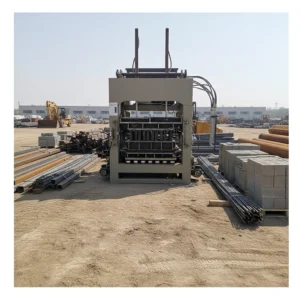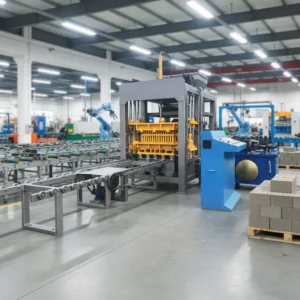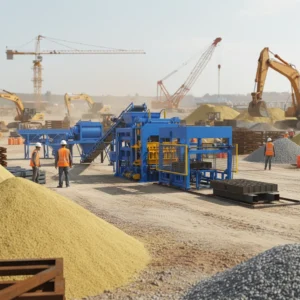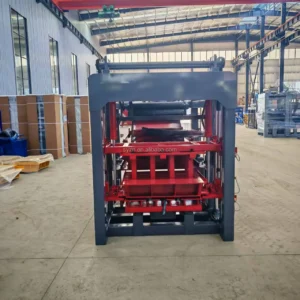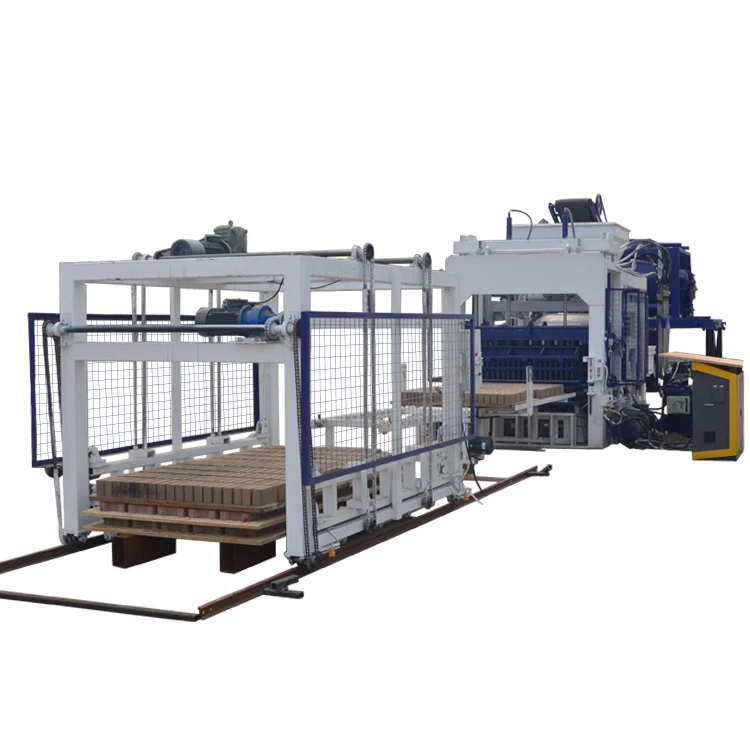
Vibration tuning to pallet format — The QT10-15 is configured as the center of a complete block production line, where the adjustable air bag damping in the mould box lets vibration response be tuned per block format rather than left at a single factory default.
Technical Specifications
| Parameter | Value |
|---|---|
| Model | QT10-15 |
| Product Type | Automatic Concrete Block Making Machine |
| Vibration Technology | Dynamic and static table with frequency conversion control |
| Vibration Acceleration | Up to 20g |
| Vibration System | Four-axis vibration with synchronization frame and forced synchronization gear shaft |
| Material Feeding | 360° press-in arch breaker for consistent material distribution in mould cavity |
| Feeding Platform | Replaceable wear-resistant plate |
| Vibration Damping | Flexible pressure head damping + adjustable air bag damping in mould box |
| Mould Compatibility | Multi-purpose; supports hollow blocks, porous bricks, pavement bricks, slope protection bricks |
| Control System | Frequency conversion control (PLC type to be confirmed per order) |
| Voltage & Frequency | Configurable to site supply (confirm before commissioning) |
| Output Capacity | Per format basis (basis not stated in source — confirm block format, material, and thickness before quoting) |
| CE Compliance | Documentation available where applicable |
Application Suitability
| Application | Material or Output |
|---|---|
| Hollow block production for load-bearing walls | Crushed stone, cement, and fly ash mixes |
| Paving block production for roads and walkways | High-density concrete with fine and coarse aggregate |
| Porous brick manufacturing | Lightweight aggregate blends with controlled porosity |
| Slope protection brick production | Fibre-reinforced concrete for erosion control |
| Solid block production for partition walls | Standard concrete mixes with local sand and gravel |
What Quotations Covering Only the Press Leave Out
A block line stops at the slowest station, not the press.
Quoting only the QT10-15 block making machine production line without specifying pallet return speed, stacking cycle, and curing rack handling leaves the fastest component waiting on manual labor downstream. On sites I have visited in East Africa and South Asia, a high-cycle press sat idle because pallets were being carried back by hand, cutting actual daily output well below what the brochure suggested. The buyer paid for capacity that never materialized because the upstream feeder and downstream stacker were never part of the conversation [NEED_CITE:]. The press itself is only one link in a chain where raw material feeding, mixing, pallet feeding, automatic stacking, and curing rack handling must all run at matched cycle times.
Matching the Raw Material Feed to Press Cadence
The 360° press-in arch breaker on this QT10-15 block making machine production line prevents material bridging inside the hopper, which is a frequent cause of short fills in the mould cavity when working with fine fly ash or damp sand. Consistent material flow into the mould cavity matters more than raw press speed because a single under-filled cycle produces blocks that fail compressive strength tests and must be crushed and re-run.
Balancing Pallet Return Against the Forming Cycle
The forced synchronization gear shaft in the four-axis vibration system ensures the excitation force reaches every corner of the pallet evenly, but that cycle time only translates to real output if the pallet feeder can return a fresh pallet before the next press stroke begins. When line layout skips the pallet return specification, the operator ends up dragging pallets by hand — which is what I have repeatedly seen on poorly scoped installations where the press was ordered alone.
Tuning Vibration to Mould Format and Aggregate
Vibration acceleration reaching up to 20g is only useful when the damping can be adjusted to match the mould sitting on the table. The adjustable air bag damping in the mould box lets the QT10-15 block making machine production line operator change damping response when switching between a tall hollow block mould and a low-profile paver mould, so the machine does not transfer excessive energy into a small format and crack green blocks before they leave the press [NEED_CITE:]. This tuning is especially important when local aggregate varies in hardness and particle shape between batches.
Reading the Specs That Actually Shape Daily Output
The replaceable wear-resistant plate on the feeding platform extends service life before the feed mechanism needs attention, which reduces unplanned stops during long production runs. The frequency conversion control adjusts vibration frequency to suit different block formats, keeping material consolidation consistent whether the mould is producing porous bricks or dense pavement blocks. Four-axis vibration with a synchronization frame means the force does not fade toward the pallet edges, so blocks at the corner of the mould are as dense as those in the center — a detail that matters when buyers test random samples from a pallet for compressive strength certification.
The Hidden Cost of a Press-Only Purchase Order
When the quotation omits automatic stacking and curing rack handling, the buyer hires extra labor to carry wet blocks to the yard — and those workers introduce handling damage that does not show up until the blocks are stacked and begin to crack under their own weight. Pallet size and material chosen without regard to the curing area the buyer already has forces a forklift fleet change or a curing yard re-layout, both of which add cost that was never in the original budget. I have watched sites where the wrong pallet specification delayed commissioning by weeks because the existing forklift tines were too narrow to pick up the new pallets safely [NEED_CITE:].
Why the Line Configuration Matters Here
The machine, mould, pallet, and handling equipment are specified as one matched system rather than assembled from separate suppliers with uncoordinated cycle times. Every line configuration is set against the buyer’s actual mix design, local aggregate, and target block format rather than a catalogue default, which prevents the common failure of receiving a machine configured for a material the buyer cannot source locally. Mould design covers the formats the buyer’s market actually sells, including custom drawings for non-standard block profiles. Automation level is selectable so a buyer can start with semi-automatic pallet handling and add stacking or cubing later without replacing the press. Installation and commissioning support includes operator training so the crew can run the QT10-15 block making machine production line correctly from the first week.
Documentation & Verification
- Line layout and capacity calculation stating the block format assumed for each output figure
- Machine specification sheet with vibration acceleration and hydraulic pressure values per configuration
- Mould drawing and format list covering every block profile the line will produce
- Pallet specification sheet with size and material matched to the buyer’s curing yard and forklift
- Voltage, frequency, and PLC display language confirmation before production begins
- Factory test record and packing photographs before container loading
Installation, Commissioning & Support
- Foundation plan drawn to the QT10-15 footprint and vibration load of the four-axis system
- Dedicated power circuit sized to the confirmed voltage and frequency before equipment arrival
- Pallet size verified against existing curing rack spacing and forklift tine dimensions on site
- Vibration frequency and air bag damping calibrated per mould format during commissioning
- Operator training covers arch breaker maintenance and wear-resistant plate replacement intervals
- Wear parts and mould list supplied with lead times for first reorder before stock runs out
What to Include in Your Inquiry
To scope the QT10-15 block making machine production line correctly, share the target block formats you intend to produce, the daily output you need per format, and the raw material available locally including aggregate type and gradation. Specify your site voltage, frequency, and preferred PLC display language, along with the pallet size your curing yard and forklift already support. If you are adding this line alongside existing equipment, list the upstream mixer capacity and downstream curing rack dimensions so cycle times can be balanced across every station.
Frequently Asked Questions
Q: How is the capacity of the QT10-15 calculated, and which block format is assumed?
A: Output capacity is calculated per block format because cycle time, mould cavity count, and material consolidation vary significantly between a 400mm hollow block and a small paving brick. The capacity document you receive will state the exact format, mix design, and pallet size assumed for each figure so you can compare the numbers against your actual production target rather than a generic brochure value.
Q: What supporting equipment is included, and how are cycle times balanced between stations?
A: The line layout covers raw material feeding, mixing, pallet feeding, the press itself, stacking, and curing rack handling. Each station’s cycle time is calculated so the slowest upstream or downstream component does not leave the press waiting — which is the most common cause of actual output falling short of quoted capacity on incomplete line installations.
Q: What pallet size does this line require, and can it match my existing curing setup?
A: Pallet size and material are selected to match your curing rack spacing, yard area, and the forklift you already operate. Confirming pallet dimensions before production avoids the situation where a new line arrives and the existing forklift cannot handle the pallets, forcing an equipment change or yard re-layout that delays commissioning.
Q: How long does full line installation take, and is operator training included?
A: Installation duration depends on site preparation, foundation readiness, and how many stations are in the line. Commissioning includes vibration tuning per mould format and operator training covering daily maintenance points such as the replaceable wear-resistant plate on the feeding platform and the arch breaker cleaning schedule.
Q: What is the upgrade path if I start with partial automation?
A: The line can begin with manual pallet handling or semi-automatic stacking and add automatic cubing or curing rack handling later. Because the QT10-15 press cycle and pallet specification are documented from the start, adding downstream automation does not require re-configuring the press or changing mould tooling.