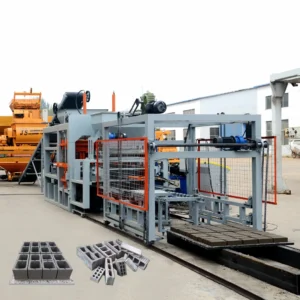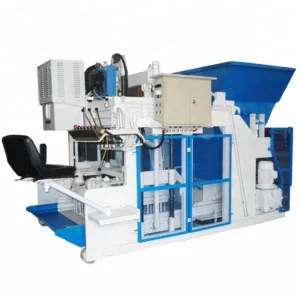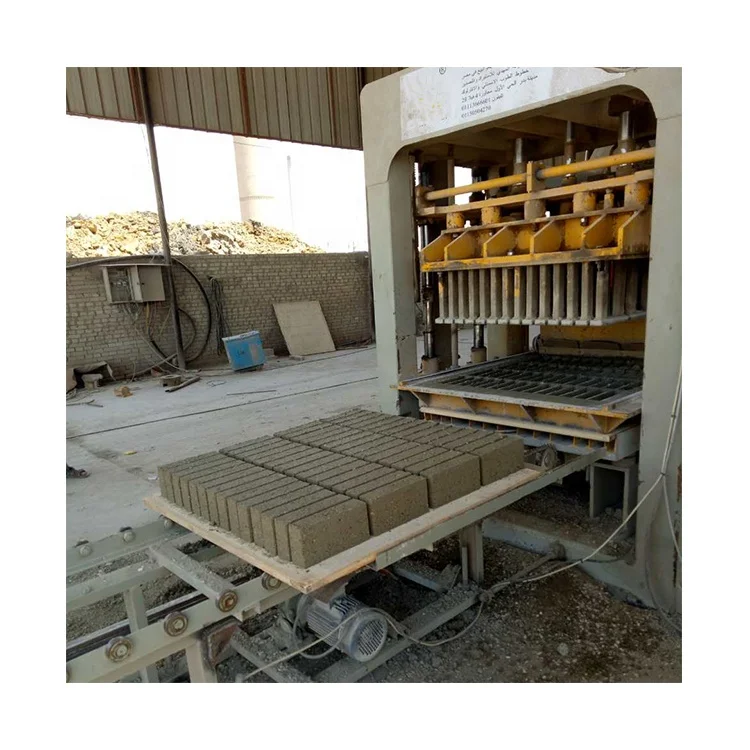
Matched System Engineering — every station around the QT10-15 press is specified together so raw material feeding, mixing, pallet circulation, and stacking run on synchronized cycle times rather than leaving the press waiting between mould charges.
Technical Specifications
| Parameter | Value |
|---|---|
| Product Type | Automatic Hydraulic Concrete Block Making Machine |
| Model | QT10-15 |
| Machine Power | 44 kW |
| Molding Cycle | 15-20 seconds |
| Hydraulic Pressure | 16-21 MPa |
| Main Vibration Form | Platform Vibration |
| Pallet Size | 1100 × 900 mm |
| Machine Weight | 10000 kg |
| Overall Dimensions (L×W×H) | 9350 × 2320 × 2950 mm |
| Voltage | Configurable to buyer’s local voltage, frequency and phase |
| Control System | PLC (brand and display language confirmed before production) |
| Automation Level | Fully automatic |
| Output Capacity | 18,000 pcs/day (basis: 400×200×200 mm hollow block, 10 pcs/mould, 16-20s cycle) |
| Output Capacity | 67,200 pcs/day (basis: 240×115×90 mm porous block, 28 pcs/mould, 15-20s cycle) |
| Output Capacity | 124,800 pcs/day (basis: 240×115×53 mm standard block, 52 pcs/mould, 15-17s cycle) |
| Mould Formats | Hollow block, porous block, standard solid block, pavers, interlocking blocks, curbstone, colored pavers |
| Raw Materials | Crushed stone, sand, cement, fly ash, gravel, slag, industrial waste |
| Warranty | 1 year for the whole machine (excluding spare parts) |
Application Suitability
| Application | Material or Output |
|---|---|
| Hollow block production plants | Concrete, fly ash and gravel mixes for load-bearing and partition walls |
| Paving block manufacturing | High-density concrete with colored face layer for roads, parking lots, plazas |
| Porous brick lines | Lightweight aggregate and industrial waste blends for thermal insulation |
| Interlocking block and curbstone | Standard concrete mixes for landscape, municipal and slope-protection projects |
| Large-scale housing developments | On-site production of standard solid blocks from locally sourced sand and cement |
Why the "18,000 Pieces a Day" Figure Means Nothing Without the Rest of the Line
The press cycle is only half the equation — if the mixer, feeder and stacker cannot keep pace, the QT10-15 sits idle while upstream stations catch up.
I have watched plant owners quote daily capacity from a single machine brochure, then watch their actual output fall far short because the batching station delivered material too slowly or the pallet return loop introduced a gap between every third cycle. The automatic block machine production line only reaches its rated throughput when every station — from the PL1200 batching machine through the JS750 mixer and the 8 m belt conveyor to the stacker — is timed so the press never waits [NEED_CITE: line-wide cycle synchronization in concrete block plants]. That is the reason we calculate capacity per block format and per line configuration, not just per press stroke.
Station Synchronization Across the Automatic Block Machine Production Line
The QT10-15 completes a moulding cycle in 15 to 20 seconds depending on block format and mix stiffness. If the JS750 mixer discharges a batch every 90 seconds, it must feed enough material for roughly five press cycles — any shortfall forces the press into a hold state. We map each station’s throughput to the QT10-15 cycle chart so that pallet feeding, material delivery and stacking all fall within the same timing window, and we document that map in the line layout before production begins.
Pallet Circulation and Curing Rack Handling
With a 1100 × 900 mm pallet, the line moves a significant number of boards per hour through pressing, stacking and curing. If the curing rack handler or the forklift capacity on site cannot clear cured pallets fast enough, fresh pallets run out and the press stops. We confirm pallet material, curing area footprint and forklift specification before finalizing the pallet return loop, because a bottleneck at the far end of the line backs up every station in front of it [NEED_CITE: pallet handling constraints in high-output block plants].
Reading the Specs That Actually Shape Block Quality
Hydraulic pressure at 16-21 MPa works together with platform vibration to compact the concrete mix into the mould. Higher pressure alone does not guarantee stronger blocks — the vibration frequency and amplitude must match the aggregate particle size and the moisture content of the specific mix the buyer sources locally. A fine river sand blend responds differently from a coarse crushed-stone mix, and tuning the vibration parameters on site is often necessary to achieve consistent density across the pallet. The 44 kW motor provides enough power for both vibration and hydraulic pump operation simultaneously, but the electrical supply must be stable at the confirmed voltage and frequency; voltage sag during peak draw will reduce vibration force and produce weaker blocks on those cycles. Pallet size at 1100 × 900 mm determines how many blocks per mould are practical, and changing to a different pallet dimension later would require reconfiguring the entire pallet feeding and stacking system.
What Happens When Stations Are Quoted Separately
Buyers who source the press from one supplier and the mixer, conveyor and stacker from three others often discover that the conveyor belt speed was specified for a smaller press, or the stacker gripper does not match the 1100 × 900 mm pallet. The result is a line that runs but never reaches the rated automatic block machine production line throughput, with operators manually bridging gaps between stations [NEED_CITE: integration failures in multi-supplier block lines]. Resolving those mismatches after installation costs more in downtime and retrofit work than specifying the full line from a single source would have in the first place.
Why Specifying the Full Line Here Matters
Block machinery is our single focus, so the QT10-15 press, its moulds, pallets and every handling station are specified as one matched system rather than assembled from separate catalogues. We set the configuration against the buyer’s actual mix design, local aggregate test report and target block format — not a default that works only under factory conditions. Every voltage, frequency and PLC display language is confirmed in writing before production starts, which removes the most common commissioning delay we see on export projects. The mould design covers the formats the buyer’s market actually sells, and custom moulds can be built from buyer drawings when a non-standard format is required [NEED_CITE: mould customization for regional block formats]. Installation support includes running the entire line — press, feeding, mixing, pallet handling and stacking — together during factory testing before any crate leaves Shandong.
Documentation & Verification
- Line layout and capacity calculation stating the exact block format behind each output figure
- Machine specification sheet with QT10-15 hydraulic and electrical parameters confirmed
- Voltage, frequency and PLC display language confirmation sheet signed off before production
- Hydraulic and electrical schematic for independent maintenance by your local team
- Factory test record showing press, mixer, feeder and stacker running together as one line
- Mould drawing and format list covering every block type in your quotation
Installation, Commissioning & Support
- Foundation plan matched to the QT10-15’s 9350 × 2320 mm footprint and 10000 kg operating weight
- Dedicated electrical circuit sized for the 44 kW total draw at confirmed voltage and phase
- Full line assembly on site with each station cycle-matched to the press during commissioning
- Vibration parameter tuning against your local aggregate and mix design during first production runs
- Operator training covering PLC interface, mould change procedure and daily maintenance checkpoints
- Wear parts list and hydraulic seal kit specified for the first replacement interval
What We Need to Size Your Line Correctly
To move from a general inquiry to a quotation with real cycle-matched capacity, we ask for your target block formats with dimensions, the daily output you need for each format, and a raw material test report showing the aggregate grading and moisture range available locally. We also need your site voltage, frequency and phase, the PLC display language your operators read, and the dimensions of your curing area along with the forklift capacity already on site. If you are integrating the QT10-15 into an existing line, tell us which upstream or downstream stations you plan to keep so we can confirm timing compatibility.
Frequently Asked Questions
Q: How are cycle times matched between the QT10-15 press and the upstream feeding and mixing stations?
A: We calculate the material volume each mould charge requires, then set the JS750 mixer batch size and the PL1200 batching discharge rate so that fresh mix arrives before the press completes its current cycle. The 8 m conveyor belt speed is tuned to carry that volume without surges. The result is a documented timing chart for the full automatic block machine production line before we start building.
Q: Which stations are included in the line quotation and which are optional?
A: The standard line covers the PL1200 batching machine, JS750 mixer, 8 m belt conveyor, the QT10-15 press, pallet feeder and stacker. Curing rack handling and automatic cubing stations are available as add-ons. We quote each option separately so you can see the cost and decide which automation stages fit your current labour setup.
Q: How is the pallet size and material chosen to match our curing area?
A: The QT10-15 uses a 1100 × 900 mm pallet, but the material — wood, bamboo or composite — affects weight, durability and the load on your forklift. We ask for your curing area dimensions and forklift capacity, then confirm pallet material so the return loop and stacking station are set correctly before the line ships.
Q: What happens if our local aggregate differs from the original mix configuration?
A: We request a raw material test report before finalizing vibration and pressure settings. If your aggregate grading or moisture content shifts significantly from what the line was tuned for, we can adjust the vibration parameters and hydraulic pressure within the 16-21 MPa range during commissioning to restore block strength consistency across formats.
Q: What documentation comes with the line for commissioning and maintenance?
A: You receive a line layout drawing, capacity calculation per block format, hydraulic and electrical schematics, PLC program documentation in the confirmed display language, a factory test record showing all stations running together, and a complete wear parts and mould list so your team can service the line independently from day one.