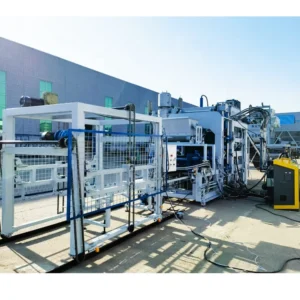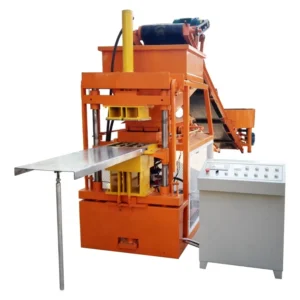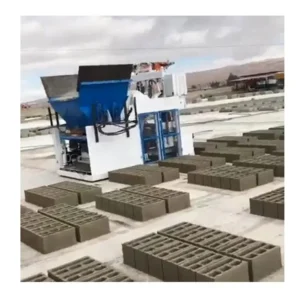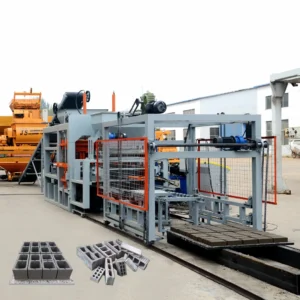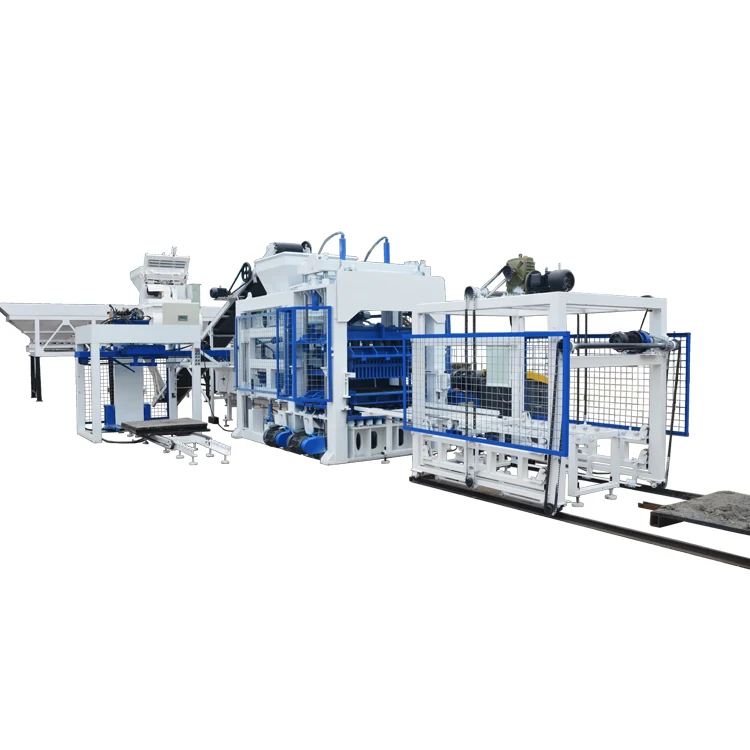
Matched System Configuration — The QT10-15 operates as the press anchor within a complete block line, where raw material feeding, pallet circulation, and stacking stations are specified to keep pace with its four-axis vibration cycle.
Technical Specifications
| Parameter | Value |
|---|---|
| Model | QT10-15 |
| Product Type | Automatic Block Making Machine |
| Vibration Technology | Dynamic and static table with frequency conversion, four-axis vibration |
| Vibration Acceleration | Up to 20g (basis not stated in source — confirm block format, material, and thickness) |
| Feeding System | 360° press-in arch breaker for rapid cavity distribution |
| Vibration Damping | Flexible reduction for pressure head; adjustable air bag for mold box |
| Automation Level | Fully automatic (scope of automation stations to be confirmed) |
| Mould Change System | Replaceable wear-resistant plate on cloth platform |
| Product Compatibility | Hollow blocks, solid blocks, interlocking bricks, porous bricks, pavement bricks, slope protection bricks |
| Output Capacity | Basis not stated in source — confirm block format and cycle time |
| Cycle Time | Basis not stated in source — confirm block format and material |
| Hydraulic Pressure | Not stated in source |
| Pallet Size | Not stated in source |
| Control System | Not stated in source (PLC model and language to be confirmed) |
Application Suitability
| Application | Material or Output |
|---|---|
| Hollow block production for building walls | Crushed stone, sand, cement, and fly ash aggregates |
| Solid block manufacturing for load-bearing structures | Dense aggregate mixes with cement binder |
| Interlocking brick production for paving | Fine aggregate and cement with colour oxide additives |
| Porous brick production for permeable surfaces | Graded aggregate with controlled cement content |
| Pavement brick and slope protection brick | High-strength concrete mix designs |
Why "Cycles per Hour" Tells Only Half the Story
The press cycle means nothing if pallets are not ready when the mold opens.
When I first started walking production floors, I watched a QT10-15 complete its press cycle and then sit idle because the pallet feeder could not keep up. The operator stood watching an empty pallet slot, losing seconds that added up to hours across a shift. Buyers often compare machines on press speed alone, but an automatic block making machine production line only delivers its rated output when every station — feeding, pressing, pallet return, stacking — runs in synchronization. [NEED_CITE: line synchronization principles in concrete block manufacturing]
How Upstream Feeding Keeps the Press Fed
The 360° press-in arch breaker on the QT10-15 addresses a common failure point in block lines: material bridging inside the hopper. When aggregate hangs up, the mold cavity receives an uneven charge and the resulting blocks vary in density and weight. The arch breaker forces material into every cavity corner before the press closes, which matters especially on hollow block formats where wall thickness is narrow and inconsistent fill leads to weak edges. An automatic block making machine production line depends on this feed station completing its cycle within the press window.
Downstream Pallet Circulation and Stacking Rhythm
Once the press releases, the wet block on its pallet must move to the stacking station before the next pallet arrives. If the stacker or the return conveyor falls behind, the press waits. In my line layouts, I calculate the pallet travel distance from press exit to stacker and back, then match the conveyor speed so the QT10-15 never holds a finished pallet longer than necessary. The adjustable air-bag vibration damping in the mold box also plays a role here — it reduces the shock transferred to the pallet, extending pallet life and keeping pallet surfaces flat enough for the stacker to grip consistently. [NEED_CITE: pallet surface flatness requirements for automatic stackers]
Reading the Vibration and Damping Specifications
The four-axis vibration system on the QT10-15 uses both dynamic and static tables with frequency conversion. In practice, this means the vibration frequency can be adjusted to match different mix designs — a stiffer, low-slump mix benefits from higher frequency to achieve full compaction, while a wetter mix needs lower frequency to prevent material segregation. The vibration acceleration rating of up to 20g is the peak figure; actual compaction force depends on block format and mold depth. The flexible vibration reduction on the pressure head isolates the hydraulic cylinder from the vibration energy, which reduces wear on seals and hoses over the operating life of the machine. The replaceable wear-resistant plate on the cloth platform means that when abrasive aggregate wears through the feed surface, maintenance crews swap a plate rather than rebuilding the entire platform — a detail that shortens planned downtime at the feeding station.
What Happens When Line Stations Are Mismatched
I once reviewed a project where the buyer specified a high-output press but accepted a manual pallet return system to reduce the initial quotation. The press ran at full cycle for the first hour, then slowed as operators struggled to move cured pallets off the return conveyor. By end of shift, actual output sat well below what the press could deliver. The lesson applies directly to the QT10-15: its vibration acceleration and feed speed demand that downstream stations — pallet return, stacking, and curing rack handling — are specified with enough capacity margin to absorb the press output without queuing. [NEED_CITE: impact of downstream bottlenecks on block press utilization]
What a Complete Line Specification Covers
Block machinery is our single focus, so the QT10-15 is never quoted as a standalone press. The line proposal includes raw material feeding and mixing stations matched to the aggregate and cement proportions your local supply provides. Configuration is set against your actual mix design and target block format, not a catalogue default. Mould design covers the formats your market sells, including custom drawings when standard molds do not match. Automation level is selectable — you can begin with semi-automatic pallet handling and add stacking or cubing stations later. Pallet size and material are chosen to match your existing curing area dimensions and forklift capacity. Voltage, frequency, and PLC display language are confirmed before production begins.
Documentation & Verification
- Line layout drawing with capacity calculation stated per block format and cycle time
- Machine specification sheet with vibration, hydraulic, and electrical parameters for the QT10-15
- Mould drawing and format list showing cavity dimensions and changeover procedure
- Pallet specification matched to curing yard footprint and forklift rated capacity
- Voltage, frequency, and PLC language confirmation record signed before production
- Factory test record documenting press cycle, feed timing, and pallet return synchronization
Installation, Commissioning & Support
- Foundation plan showing load points and curing yard space needed for the QT10-15 pallet circuit
- Electrical specification confirming voltage, phase, and dedicated circuit breaker rating
- Machine arrives dismantled for container loading; reassembly sequence documented in manual
- First-run commissioning includes cycle timing verification across all line stations
- Operator training covers mold change procedure and air-bag damping adjustment
- Wear parts list identifies replacement plates for cloth platform and vibration isolators
What to Prepare Before Requesting a Line Proposal
To build an accurate line layout around the QT10-15, share the block formats your market sells along with the target daily output for each format. Provide the aggregate types and cement grades available locally so the feeding and mixing stations can be specified for your material. Confirm your site voltage and frequency, and describe the curing yard dimensions and forklift capacity you already operate so the pallet specification fits your existing infrastructure.
Frequently Asked Questions
Q: How is the line capacity calculated and which block format is the basis?
A: The capacity calculation states the specific block format, mold cavity count, and cycle time used as the basis. A hollow block cycle differs from a paving brick cycle, so the quoted daily output reflects the format you intend to produce most. This prevents the situation where the press is rated on one format but the buyer expects the same output from a slower format.
Q: How do upstream feeding and downstream stacking stations stay synchronized with the press?
A: Each station’s cycle time is calculated against the QT10-15 press cycle. The pallet conveyor speed, stacker lift interval, and return path distance are set so that a finished pallet clears the press table before the next cycle begins. If any station runs slower, the line proposal identifies it and offers a capacity upgrade.
Q: What pallet size and material does the line require?
A: Pallet dimensions are selected based on the mold size and the number of cavities per cycle. The material — typically bamboo, PVC, or steel — is chosen to match the curing environment and the forklift capacity on site. A mismatch here forces pallet replacement or handling equipment changes after installation.
Q: Which automation stations are included and which remain manual?
A: The standard automatic block making machine production line proposal specifies each station: raw material batching, pallet feeding, stacking, and cubing. Any station left as manual operation is clearly marked so you know where labor is required and where automation can be added later as production volume grows.