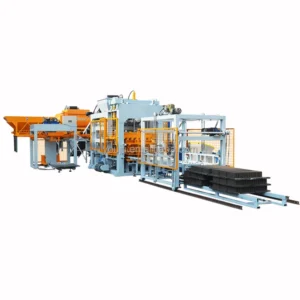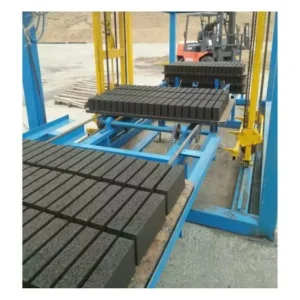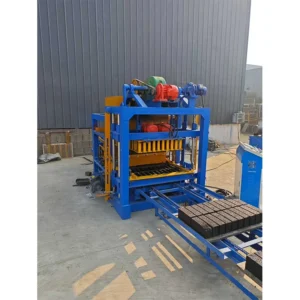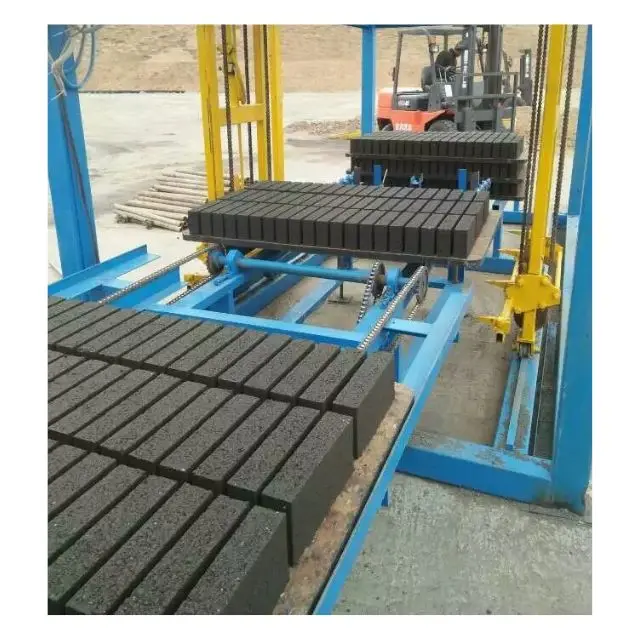
Line-Wide Cycle Synchronization — every station from the JS750 mixer through the pallet return is timed against the press cycle so the host machine never idles waiting for upstream feed or downstream clearance.
Technical Specifications
| Parameter | Value |
|---|---|
| Product Type | Fully Automatic Concrete Block Making Machine |
| Model | QT10-15 |
| Overall Dimensions (L×W×H) | 9350 × 2320 × 2950 mm |
| Rated Power | 44 kW |
| Voltage & Frequency | Configurable to local supply standard (basis to be confirmed) |
| Control System | PLC, Mitsubishi (Japan) |
| Hydraulic Unit | Jiugang (Taiwan) |
| Rated Hydraulic Pressure | 21 MPa |
| Vibration Form | Platform vibration |
| Vibration Frequency | 4500–5100 r/min |
| Pallet Size | 1100 × 900 mm |
| Moulding Area | 1025 × 810 mm |
| Forming Height | 40–250 mm |
| Molding Cycle | 15–25 s |
| Mixer Model | JS750 |
| General Water Consumption | 12 T/day (basis to be confirmed) |
| Electrical Elements | Schneider (France) |
| Switches | Omron (Japan) |
| Host & Mixer Motors | Siemens (Germany) |
| Mould Treatment | High-temperature carburizing heat treatment |
| Steel Construction | National standard steel, special welding technology |
| Key Features | PLC-controlled line coordination, hydraulic pressure with platform vibration, pallet-based forming, heat-treated moulds |
Application Suitability
| Application | Material or Output |
|---|---|
| Hollow block production | Crushed stone, sand, cement, fly ash aggregates |
| Solid brick manufacturing | Cement-bound sand and fine aggregate |
| Paving block forming | High-density concrete mixes with fine gradation |
| Interlocking brick output | Interlocking profile moulds with standard concrete |
| Kerbstone and curb production | Coarse aggregate concrete in large-format moulds |
What a Blanket Output Number Leaves Out of the fully automatic block machine production line
Capacity must be stated per block format, or it means nothing at the loading dock.
Many quotations quote a single pieces-per-hour figure that assumes the smallest or lightest format on the mould list. When the plant starts running the hollow block the local market actually buys, the daily tally falls short and the project schedule slips. I have watched a high-cycle press sit idle for seconds per stroke because the upstream mixer could not match its appetite, turning a fully automatic block machine production line into an expensive bottleneck. [NEED_CITE: line balancing standards for concrete block production]
Matching Every Station to the Press Cycle
The press at the centre of this line completes a stroke within a 15–25 second window depending on the block format being formed. Upstream, the JS750 mixer must deliver a fresh batch before the hopper runs dry; downstream, the pallet feed and return loops must clear and reposition within the same window. When any station runs slower, the press pauses and the cycle time stretches across the entire fully automatic block machine production line.
How Automation Coordinates the Sequence
Mitsubishi PLC logic sequences the hydraulic press, pallet indexing, and material feed so each movement follows the previous one without operator intervention. The control cabinet houses Schneider electrical elements and Omron switches, giving the plant a single point of fault diagnosis rather than scattered relay panels. This level of coordination is what separates a real block line from a collection of standalone machines. [NEED_CITE: PLC-controlled synchronization in block production]
Reading the Numbers That Matter on Site
The 21 MPa hydraulic pressure and the 4500–5100 r/min platform vibration work together: pressure packs the mix while vibration removes air pockets, and the balance between the two determines block density. The 1100 × 900 mm pallet size governs how many blocks are formed per stroke and how the wet products move into the curing yard, so it must align with the curing racks and forklifts already on site. The 1025 × 810 mm moulding area sets the upper limit of the mould footprint, and the 40–250 mm forming height covers everything from thin pavers to full-depth hollow blocks.
The Cost of Ignoring Downstream Integration
A press that runs faster than its stacker or pallet return will pile wet blocks onto the floor, forcing manual handling and defeating the reason for buying automatic equipment in the first place. Voltage and frequency left unconfirmed until the machine arrives can delay commissioning by weeks while transformers and motor replacements are sourced locally. [NEED_CITE: voltage mismatch delays in exported machinery]
Why Buyers Plan the Line Here, Not Just the Press
Block machinery is the only product category this facility builds, which means the press, moulds, pallets, and handling equipment are specified as one matched system rather than assembled from separate vendors. Configuration is set against the buyer’s mix design and local aggregate, not a catalogue default. Mould design covers the formats the buyer’s market actually sells, including custom drawings. The automation level is selectable, so a buyer can start with semi-automatic pallet handling and add full stacking later. Installation support includes operator training on the specific line configuration delivered.
Documentation & Verification
- Line layout showing capacity calculation per block format and assumed cycle time
- Voltage, frequency, and PLC display language confirmed before production starts
- Factory test record run on the buyer’s specified block format before dispatch
- Hydraulic and electrical schematics matching the as-built configuration
- Pallet specification cross-referenced to curing rack and forklift capacity
- CE-relevant documentation for motors and electrical components where applicable
Installation, Commissioning & Support
- Foundation plan sized to the 9350 × 2320 mm footprint and dynamic vibration loads
- Dedicated power circuit rated for the 44 kW total draw with confirmed voltage and frequency
- Dismantled for container loading and reassembled on site with alignment checks
- First-run parameter setting tied to the buyer’s block format and mix design
- Operator training covering PLC interface, mould change, and daily maintenance routines
- Wear parts list and mould inventory plan for the first replacement cycle
What to Share When You Start the Conversation
Provide the block formats your market sells, the daily volume you need for each, and the raw materials available locally including aggregate gradation. Confirm your site voltage, frequency, and the language you want on the PLC display so the electrical build matches your grid and your operators. If you already have curing racks and forklifts, share the dimensions so pallet size and stacking height can be matched before the line is built.
Frequently Asked Questions
Q: How is line capacity verified for each block format?
A: The capacity document states the output per hour for each block format separately, along with the assumed molding cycle time. A 400×200×200 mm hollow block, for example, carries its own figure rather than being lumped into a single plant-wide number, so daily planning reflects the product you actually run.
Q: How do upstream and downstream stations stay synchronized with the press?
A: The Mitsubishi PLC controls the mixer discharge, pallet indexing, and press cycle as one sequence. If any station falls behind, the press waits rather than producing a fault, keeping the fully automatic block machine production line in step without operator intervention.
Q: What electrical details are confirmed before the machine is built?
A: Voltage, frequency, and PLC display language are all locked in before production begins. Siemens motors and Schneider electrical elements are then specified to match the confirmed supply, avoiding on-site rewiring or component swaps after arrival.
Q: How is pallet size chosen for an existing curing yard?
A: The 1100 × 900 mm pallet is cross-referenced against the buyer’s curing rack spacing and forklift fork width. If the existing infrastructure requires a different dimension, the pallet specification is adjusted so wet blocks move from press to cure without manual re-stacking.