
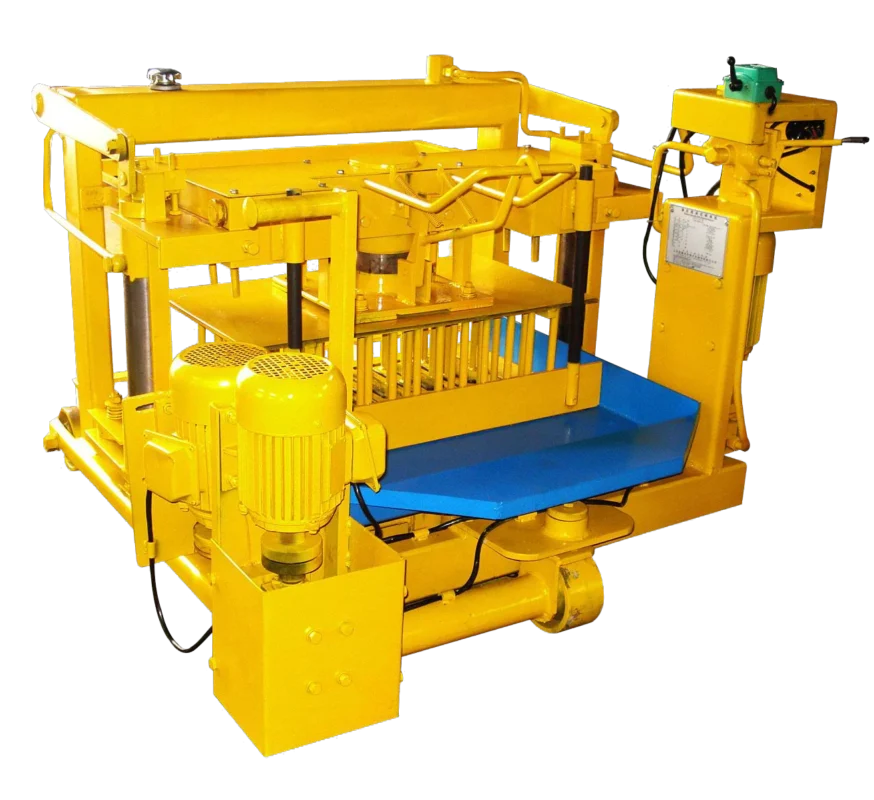
Matched System Design — The QMY4-30 mobile egg-laying block machine, mixing, feeding, and handling stations are specified as one coordinated line rather than sourced separately, so cycle times align and the press never sits idle waiting for material.
Technical Specifications
| Parameter | Value |
|---|---|
| Model | QMY4-30 |
| Product Type | Mobile Egg-Laying Hollow Block Making Machine |
| Machine Type | Mobile / egg-laying (palletless) |
| Hydraulic Transmission | Yes (mold box excitation with hydraulic transmission) |
| Pallet Requirement | None (palletless egg-laying design) |
| Automation Level | Manual operation with hydraulic assist |
| Suitable Block Formats | Hollow brick, solid block (mould-dependent) |
| Operating Environment | Mountainous, hilly, industrial mining, desert, and coastal areas |
| Cycle Time per Format | (basis to be confirmed — confirm block format / material / thickness) |
| Output Capacity | (basis to be confirmed — confirm block format / material / thickness) |
| Vibration Force (kN) | (basis to be confirmed) |
| Hydraulic Pressure (MPa) | (basis to be confirmed) |
| Rated Power (kW) | (basis to be confirmed) |
| Voltage & Frequency | (basis to be confirmed) |
| Overall Dimensions (L×W×H) | (basis to be confirmed) |
| Net Weight | (basis to be confirmed) |
| Control System | (basis to be confirmed) |
| Standards | ISO 9001:2000, CE |
Application Suitability
| Application | Material or Output |
|---|---|
| On-site hollow block production for remote construction projects | Crushed stone, sand, cement, and water mixed to local aggregate gradation |
| Solid block manufacturing at housing development sites | Concrete mix designs using locally available coarse and fine aggregates |
| Small-scale block production by contractors and entrepreneurs | Hollow and solid block formats from standard concrete mixes |
| Project-based production in mountainous, hilly, desert, or coastal terrain | Concrete blocks laid directly on leveled ground without pallets or fixed plant infrastructure |
Why the Mixer Output Speed Decides Your Real Daily Volume
The mobile egg-laying block making machine production line only runs as fast as its slowest feeding station. I once worked with a contractor in West Africa who purchased a mobile egg-laying press on its own. The mixer discharged concrete at roughly half the rate the QMY4-30 could accept. The machine spent most of each shift standing idle, and daily output landed well below what the buyer had planned for. We replaced the mixer discharge gate, reconfigured the belt conveyor angle, and matched the batch size to the press cycle. Production climbed back to where it belonged — but only because the supporting line was rebuilt around the press, not the other way around. [NEED_CITE: material feed rate matching in mobile block production lines]
How the Palletless Design Reshapes the Entire Line Layout
A conventional static block press requires pallet feeding, pallet return conveyors, and curing racks that move loaded pallets through a controlled environment. The QMY4-30 eliminates every one of those stations. Because the machine lays blocks directly on the ground and then moves forward on its own chassis, the supporting equipment footprint shrinks considerably. Raw material mixing, concrete feeding, and the mobile press itself become the complete mobile egg-laying block making machine production line. Curing happens where the blocks were placed, removing the need for rack handling systems or dedicated curing chambers.
What Has to Be Coordinated Between Mixer, Feeder, and Press
Each station in the line has its own cycle. The mixer needs to complete a batch and discharge before the press finishes compacting the previous load. The belt conveyor or hopper feeder must deliver concrete into the mould box faster than the hydraulic cycle completes. If any station runs slower than the others, the press waits, and output drops. On the QMY4-30 line, we map every station’s timing against the target block format and then set the mixer batch size, conveyor speed, and feeder capacity so that none of them create a bottleneck. [NEED_CITE: cycle time synchronization in concrete block production]
Reading the Specs That Actually Determine Block Density
Hydraulic pressure and vibration force work together during compaction. The QMY4-30 uses hydraulic transmission for mold box excitation, which delivers vibration directly into the concrete mass rather than through a separate vibration table. Higher hydraulic pressure forces aggregate particles closer together, while vibration settles fine material into the voids between larger stones. If the pressure is too low for a given mix design, blocks emerge with inconsistent density and lower compressive strength. The mould box must also match the target block format precisely — a hollow block mould requires different compaction energy than a solid block mould of the same footprint, so the hydraulic and vibration settings need adjustment whenever the format changes.
When the Supporting Equipment Gets Overlooked
Buyers often compare mobile egg-laying presses on their press specifications alone and treat the mixer, feeder, and conveyor as commodity items. This leads to a line where the press is rated for a certain output but the concrete delivery cannot keep pace. The consequence is operators standing around waiting for the next batch, or worse, the press compacting partially mixed material because the feeder pushed material through before the mixer finished its cycle. Inconsistent feed quality produces blocks with variable strength, and buyers blame the press when the real issue sits upstream. [NEED_CITE: block strength variation caused by inconsistent concrete batching]
Why Procurement from a Line-Focused Supplier Changes the Outcome
Block machinery is the single product focus here, which means the QMY4-30 press, its moulds, pallets (where applicable), and all handling equipment are specified as one matched system. The line configuration is set against your actual mix design, local aggregate type, and the specific block formats your market requires — not pulled from a catalogue default. Mould design and supply cover the formats that sell in your region, and custom moulds can be built to your drawings. The automation level remains selectable so you can start with manual operation and add automated feeding or stacking later if production grows. Installation support includes on-site commissioning and operator training so the line runs correctly from the first day. [NEED_CITE: matched block machine and supporting equipment specification]
Documentation & Verification
- Line layout drawing showing mixer, feeder, and QMY4-30 press station positions with cycle times stated per block format
- Capacity calculation document specifying the exact block format, mix design, and local aggregate assumed
- Mould drawing and format list covering every block type the QMY4-30 can produce on your line
- Hydraulic and electrical schematic for the complete supporting line, not the press alone
- Factory test record on your specified block format before dispatch
- Voltage, frequency, and control language confirmation document for your target market
Installation, Commissioning & Support
- Ground leveling requirements for the mobile egg-laying block making machine production line curing area so the QMY4-30 lays blocks on a consistent surface
- Power supply specification covering the QMY4-30 rated power, voltage, and frequency for your local grid
- Machine arrives assembled on its mobile chassis; on-site setup covers mixer and feeder positioning relative to the press travel path
- First-run commissioning includes hydraulic pressure and vibration adjustment matched to your concrete mix and target block density
- Operator training covers mould change procedure, hydraulic system checks, and daily maintenance routines for the press and all supporting stations
- Wear parts list and mould maintenance schedule provided with recommended spare inventory for your production volume
What to Include When Requesting a Quotation
To size the supporting equipment correctly around the QMY4-30, share your target block format and dimensions, the daily output you need to meet project deadlines, and details about the raw materials available locally including aggregate type and gradation. Confirm your site’s voltage and frequency supply, the control language your operators require, and whether you already have a mixer or conveyor in place. This information allows the line layout and every station’s capacity to be calculated before the quotation is issued.
Frequently Asked Questions
Q: How do I calculate realistic daily output for my target block format with the QMY4-30?
A: Daily output depends on the block format, your concrete mix design, and the supporting equipment cycle times. The capacity calculation must state which block size and material are assumed. We provide a document showing output per format so you can compare against your project requirements rather than relying on a single headline number.
Q: What supporting equipment is needed to keep the mobile press running without idle time?
A: The mixer batch size and discharge speed, the feeder conveyor capacity, and the raw material loading system must all match the QMY4-30 cycle time. If any station runs slower, the press waits and daily output drops. We map every station’s timing and specify equipment so the line runs continuously.
Q: How does the palletless design change the curing area layout on site?
A: Because the QMY4-30 lays blocks directly on the ground and moves forward, blocks cure where they were placed. This removes the need for pallet return conveyors, curing racks, and the forklift traffic required to move loaded pallets. You need a flat, leveled curing area large enough for the day’s production.
Q: What voltage and frequency options are available for the QMY4-30 and its supporting line?
A: Voltage and frequency must be confirmed before production so the motors, hydraulic pump, and control panel match your local grid. We verify these specifications along with the control system display language during the quotation stage to prevent commissioning delays when the line arrives on site.
Q: Can the line be expanded later from a single mobile machine to a multi-station setup?
A: Yes. The QMY4-30 line starts as a single mobile press with mixer and feeder, but additional presses can operate on the same mixing and feeding infrastructure if the supporting equipment was sized for expansion from the beginning. We can plan the initial layout to accommodate future capacity increases.


