
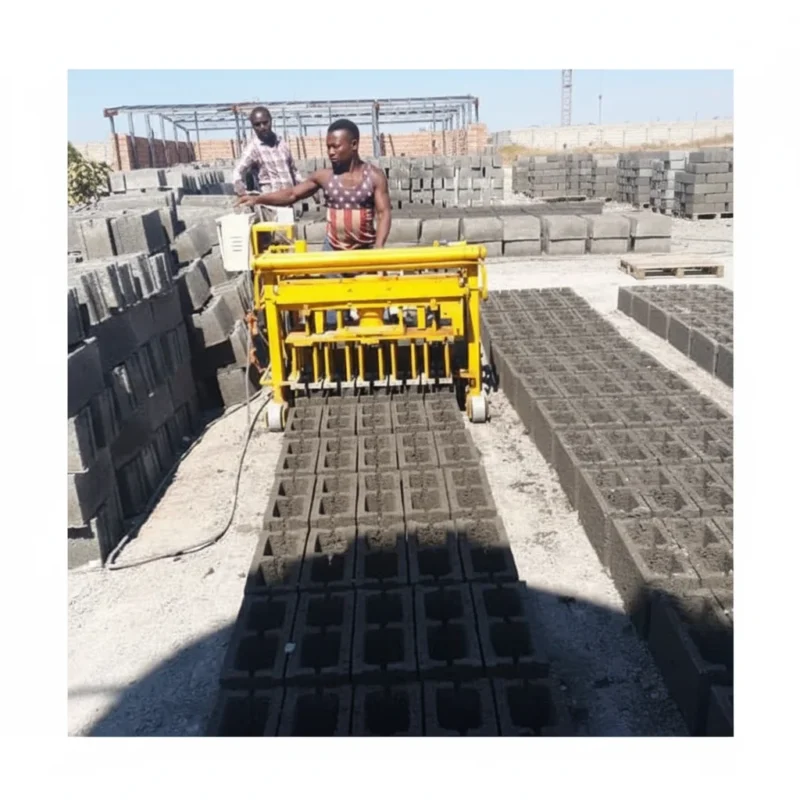
Matching the press to the line — Every station around this mobile block machine is sized against its 4500 r/min mold vibration cycle so material flow never stalls or floods the hopper.
Technical Specifications
| Parameter | Value |
|---|---|
| Model | QMY4-30 |
| Product Type | Mobile Egg-Laying Concrete Block Making Machine |
| Overall Dimensions (L×W×H) | 1300 × 1500 × 1000 mm |
| Total Mass | 950–1000 kg |
| Vibration Method | Mold Vibration |
| Exciting Force | 28.6 kN |
| Excitation Frequency | 4500 r/min |
| Total Installed Power | 5.95 kW |
| Output Capacity | 3000 pcs/day (basis to be confirmed) |
| Voltage & Frequency | 380V ±10% |
| Hydraulic Components | Taiwan-sourced fittings |
| Automation Level | Manual / Mobile egg-laying |
| Assembly State | Mobile, no fixed plant required |
| Key Features | Egg-laying design (no pallets), low total power draw, compact footprint under 1 tonne |
Application Suitability
| Application | Material or Output |
|---|---|
| On-site hollow block production for housing projects | Concrete mixed with river sand and gravel |
| Solid block manufacturing at remote construction camps | Fly ash, cinder, and cement blends |
| Small-scale paving block runs for local contractors | Crushed aggregate with industrial waste residue |
| First-stage plant setup by entrepreneurs | Coal gangue and cement composite mixes |
What the Daily Output Figure Hides From You
A mobile block machine production line is only as fast as its slowest upstream station.
Quoting 3000 pieces per day without naming the block format or wall thickness sets expectations that collapse once the machine runs on your specific product. I have watched contractors lose an entire day because the daily capacity was calculated on a thin solid block while the site needed 200mm hollow blocks that take twice the cycle time. The mixer, the water supply, and the curing ground must all be planned around the actual format you sell, not the factory test format [NEED_CITE: block format impact on mobile press cycle time].
Sizing the Material Feed Around the Press
The QMY4-30 draws from a continuous feed, and its 5.95 kW total power means it is often deployed on sites with limited electrical supply. The mixer feeding it must complete a batch within the press cycle window. If the mixer takes longer than the press consumption rate, the hopper empties and vibration runs on dry mold surfaces, accelerating wear on the mold cavity. A mobile block machine production line built around this press typically pairs it with a pan mixer sized to discharge one batch per two press cycles, keeping the hopper level steady without overflow.
Ground Surface and Curing Area Planning
Since the QMY4-30 lays blocks directly onto the ground, the production surface must be flat, level, and hard enough to support wet concrete without settling. The curing area expands outward from the press path each operating hour. A site producing continuously needs a cleared, compacted area large enough for one full day’s output plus walking clearance. Without this planning, the press stops every few cycles waiting for the previous row to gain enough strength to walk around [NEED_CITE: curing area requirements for egg-laying block machines].
Reading the Vibration and Power Specs
The 28.6 kN exciting force at 4500 r/min is applied through mold vibration rather than table vibration, meaning the energy is concentrated directly into the block cavity. This configuration suits smaller aggregate sizes and produces denser block walls when the mix moisture is controlled within a narrow range. The total installed power of 5.95 kW keeps generator requirements low for remote sites, though the startup current spike of the vibration motor should be accounted for when sizing a portable generator set. Taiwan-sourced hydraulic fittings on the mold clamping circuit reduce the risk of fitting failure during the high-frequency vibration cycles that stress every threaded connection.
The Cost of Undersizing the Mixer
When the mixer feeding a mobile press is too small, the hopper level drops and the mold fills incompletely. Blocks come out with weak corners and low density, and the rejected pieces pile up beside the production path. I once saw a project where an undersized mixer forced the operator to wait between cycles, cutting actual output to roughly half the quoted figure while the crew stood idle. The mobile block machine production line was rated for continuous operation, but the material station turned it into a batch-and-wait process that exhausted the crew and wasted cement in partially mixed loads [NEED_CITE: mixer sizing relative to mobile press consumption rate].
Why Procurement Here Differs
We specify the complete material feed station and curing area plan alongside the QMY4-30 rather than quoting the press alone, so the cycle time at the hopper matches the mixer discharge rate from day one. The mold vibration parameters are cross-checked against your local aggregate type and the specific block format your market demands, not a default factory setting. Voltage and control language are confirmed before the machine leaves the factory, eliminating the commissioning delay that stalls site startups. The compact footprint and sub-one-tonne mass mean the machine can be relocated between project phases using standard site equipment, and we provide the ground surface specification so your team prepares the curing area before the press arrives.
Documentation & Verification
- Line layout showing material feed station, mixer position, and curing area sized to the QMY4-30 cycle rate
- Capacity calculation sheet stating the specific block format and wall thickness used for the output figure
- Voltage and frequency confirmation document matching your site power supply before production begins
- Factory test record demonstrating mold vibration performance on your specified mix design
- Mold drawing with cavity dimensions matched to your target block format
Installation, Commissioning & Support
- Ground surface specification for the egg-laying production path, matched to the 1300 × 1500 mm machine footprint and turning radius
- Electrical connection guide for the 5.95 kW total load on 380V ±10% supply, including startup surge allowance
- On-site commissioning with mold vibration frequency verified at 4500 r/min under your local aggregate load
- Operator training covering hopper level management and mold change procedure for the manual system
- Wear parts list identifying Taiwan-sourced hydraulic fittings by part number for local sourcing
Before You Request a Quote
To size the material feed and curing area correctly around the QMY4-30, share the specific block format and wall thickness your site will produce, the local aggregate type available, and the daily output you need to sustain. Include the site power supply voltage and whether a generator will be used, so the electrical configuration is confirmed before dispatch.
Frequently Asked Questions
Q: How is the 3000 pcs/day capacity verified for the QMY4-30?
A: That figure depends entirely on the block format, wall thickness, and mix design in use. A thin solid block cycles faster than a 200mm hollow block. We calculate realistic daily output based on the specific format you intend to produce, including the cycle time and curing area needed to sustain continuous operation on your site.
Q: What supporting equipment keeps the mobile press running without stops?
A: The QMY4-30 needs a mixer sized to discharge within its consumption window, a consistent water supply, and a material feed arrangement that keeps the hopper level steady. We specify the mixer capacity and feed station layout so the press never waits for material or overflows the hopper during continuous production.
Q: What ground conditions are required for egg-laying block production?
A: The surface must be flat, compacted, and level enough to support wet concrete blocks without settling. You also need sufficient cleared area for one full day’s output plus walking clearance around each row. We provide a ground preparation specification based on your target daily output and block dimensions.
Q: Does the QMY4-30 need a generator on remote sites?
A: With a total installed power of 5.95 kW, the running load is manageable on a portable generator, but the vibration motor startup surge requires additional headroom. We confirm your site voltage and generator capacity before dispatch so the machine commissions without electrical delays or repeated breaker trips.
Q: How does cycle time per format affect upstream equipment sizing?
A: Each block format has a different cycle time, which determines how often the press draws a fresh batch from the mixer. We calculate the mixer discharge rate and material feed speed against your chosen format so every station in the mobile block machine production line stays synchronized with the press cycle.


