
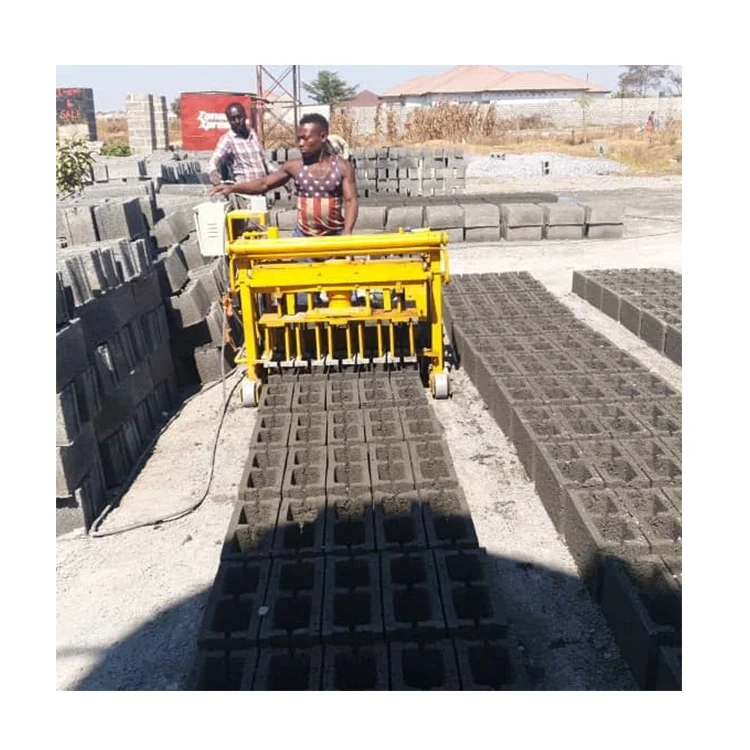
Compact Line Integration — the QMY4-30 mobile block making machine production line is specified as one matched system with mixing, curing, and handling stations timed to its 30-second cycle so the press never waits for material.
Technical Specifications
| Parameter | Value |
|---|---|
| Product Type | Mobile Hydraulic Block Making Machine |
| Model | QMY4-30 |
| Rated Power | 5 kW |
| Voltage & Frequency | Configurable to site requirement (to be confirmed) |
| Control System | Manual hydraulic operation |
| Overall Dimensions (L×W×H) | 1200 × 1200 × 1100 mm |
| Net Weight | 950 kg |
| Cycle Time | 30 seconds |
| Output Capacity | 480 pcs/h based on 400×200×200 mm hollow block, 4 pcs/mould |
| Output Capacity | 600 pcs/h based on 400×150×200 mm hollow block, 5 pcs/mould |
| Output Capacity | 840 pcs/h based on 400×100×200 mm hollow block, 7 pcs/mould |
| Daily Output (8 h) | 3,840 pcs based on 400×200×200 mm hollow block |
| Daily Output (8 h) | 4,800 pcs based on 400×150×200 mm hollow block |
| Daily Output (8 h) | 6,720 pcs based on 400×100×200 mm hollow block |
| Mould Format | Hollow block and solid brick (standard sizes) |
| Mould Change | Changeable moulds |
| Automation Level | Manual / mobile egg-laying type |
| Raw Materials | Cement, sand, crushed stones, slag |
| Assembly State | Fully assembled mobile unit |
Application Suitability
| Application | Material or Output |
|---|---|
| Small-scale block plant startup | Hollow blocks from cement, sand, and crushed stone |
| On-site construction block production | Solid bricks and hollow blocks produced directly on ground |
| Local building material supply | Multiple block formats from a single mobile press |
Why "480 Blocks per Hour" Rarely Survives the First Shift
A mobile block making machine production line only holds its rated cycle when every upstream and downstream station is timed to the press.
I spent a summer in Dubai watching a QMY4-30 sit idle while a slow-discharge mixer starved it and workers hauled cured blocks off the ground by hand. The machine itself was ready every 30 seconds, but the line around it was not. Daily throughput dropped to a fraction of the plan because nobody had mapped the raw material feed rate or the curing-area labour to the press cycle. That mismatch is the most common reason buyers feel misled by capacity figures. [NEED_CITE: typical causes of throughput shortfalls in small block plants]
Matching Every Station to the 30-Second Cycle
The QMY4-30 completes a moulding cycle in 30 seconds, which means the mixer must deliver a fresh batch well inside that window. A pan mixer with a discharge gate matched to the press hopper volume keeps material flowing without overflow or starvation. On the downstream side, the mobile block making machine production line must account for how quickly cured blocks are cleared from the ground path so the machine can advance without hitting obstacles.
Curing Space as Part of the Line, Not an Afterthought
An egg-laying press deposits blocks directly on the floor, so the curing area is effectively the end of the line. Layout planning starts with the daily output for the buyer’s primary format and works backward to the square metres of flat, shaded ground required. Without that calculation, blocks stack against each other before they gain enough strength, and damage rates climb through the first week of production.
Reading the Specs That Actually Shape Output
The 5 kW rated power keeps electrical demands low enough for a portable generator on remote sites, but the buyer must still confirm voltage and frequency before the machine leaves the factory. Mould change capability lets the same press run hollow blocks and solid bricks, though change time should be verified against the buyer’s shift schedule to avoid losing half a day between formats. The 1200 × 1200 × 1100 mm footprint and 950 kg weight allow relocation by a site forklift as curing zones fill, which matters when yard space is limited. [NEED_CITE: electrical supply standards for mobile construction equipment in export markets]
The Cost of Skipping the Line Layout
Buyers who order the press alone and source the mixer and handling labour locally often find the bottleneck has simply moved. A mixer that discharges too slowly forces the operator to wait; a curing area that fills by mid-morning forces an early stop. These are not machine faults — they are line-design gaps. Correcting them after commissioning means buying new equipment or re-pouring ground slabs, both of which cost more than planning the mobile block making machine production line as a single system from the start. [NEED_CITE: common rework costs when block plant stations are not synchronised]
What We Bring to This Machine Class
Block machinery is our single focus, so the QMY4-30 is never shipped as a standalone item without confirming how it connects to mixing, curing, and handling. We configure the line against the buyer’s actual aggregate and target block format, not a catalogue default. Mould drawings are supplied before production so the buyer can verify that every format their market demands is covered. Automation level can be upgraded later, meaning a buyer can start with manual pallet handling and add assisted stacking when volume justifies it. Installation support includes operator training on-site so the crew understands cycle timing from mixer to curing rack.
Documentation & Verification
- Line layout drawing with capacity calculated per the buyer’s chosen block format
- Machine specification sheet confirming voltage, frequency, and control language
- Mould drawing and format list covering every block type the buyer’s market requires
- Factory test record run on the buyer’s target mix before dispatch
- Operation and maintenance manual with wear parts list and replacement intervals
Installation, Commissioning & Support
- Level ground slab prepared to match the 1200 × 1200 mm machine footprint and 950 kg static load
- Dedicated 5 kW circuit at confirmed voltage and frequency, isolated from heavy starting loads
- Machine arrives fully assembled; only electrical connection and mould mounting required on site
- First-run cycle timed against mixer discharge rate to confirm no idle gaps between presses
- Operator training covers mould change procedure and daily hydraulic inspection points
- Wear parts list supplied with recommended reorder intervals for seals and mould liners
Preparing Your Line Inquiry
Share the block formats your market sells, the daily volume you need to hit, and the raw materials available locally. Confirm your site voltage, frequency, and whether a generator or grid supply will power the mobile block making machine production line. Let us know your curing yard dimensions and any existing handling equipment so the layout can be built around what you already have.
Frequently Asked Questions
Q: How is daily output verified per block format on this line?
A: Output is stated per format because cycle time and mould cavity count differ. We provide a capacity sheet showing daily figures for each block size the buyer plans to run, so throughput can be checked against the actual product mix rather than a single headline number.
Q: How must the mixer be timed so the QMY4-30 is never left waiting?
A: The mixer must deliver a fresh batch within the 30-second press cycle. We confirm pan mixer volume and discharge gate speed against the press hopper capacity so material flow stays continuous and the operator does not lose cycles to starvation.
Q: What curing area layout suits an egg-laying machine on the ground?
A: The curing zone must accommodate a full day’s output for the buyer’s primary block format. We calculate the required flat ground area and recommend shading and spacing so blocks cure without damage before being moved to storage.
Q: How is voltage confirmed to avoid delays at commissioning?
A: Voltage, frequency, and control language are locked before production starts. This ensures the motor and hydraulic solenoids match the site supply and the operator can read the controls from day one without rewiring or replacing components.
Q: What supporting equipment completes the QMY4-30 into a full line?
A: A matched pan mixer, raw material feeder, and a planned curing area with handling tools form the complete mobile block making machine production line. We specify each station so cycle times align and the press is never the bottleneck waiting on upstream or downstream steps.


