
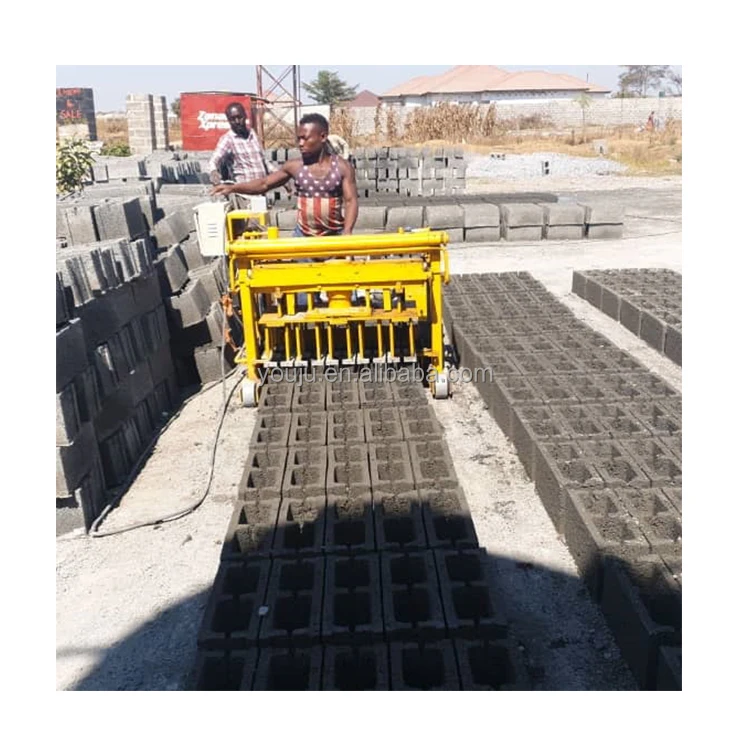
Matched system layout — upstream mixing, the QMY4-30 press rhythm, and downstream curing are specified as one flow so no station sits idle while another catches up.
Technical Specifications
| Parameter | Value |
|---|---|
| Model | QMY4-30 |
| Product Type | Mobile Block Making Machine |
| Rated Power | 5 kW |
| Voltage & Frequency | Configurable to buyer target market (basis to be confirmed) |
| Control System | Manual / semi-automatic operation |
| Overall Dimensions (L×W×H) | 1200 × 1200 × 1100 mm |
| Net Weight | 950 kg |
| Mould Format | Hollow block and solid brick, interchangeable moulds |
| Cycle Time | 30 seconds per mould |
| Output Capacity | 480 pcs/h based on 400×200×200 mm hollow block (4 pcs/mould); 600 pcs/h based on 400×150×200 mm (5 pcs/mould); 840 pcs/h based on 400×100×200 mm (7 pcs/mould) |
| Daily Output (8 h) | 3840 pcs (400×200×200 mm) / 4800 pcs (400×150×200 mm) / 6720 pcs (400×100×200 mm) |
| Raw Materials | Cement, sand, crushed stones, slag |
| Automation Level | Mobile / egg-laying type, manual pallet handling |
Application Suitability
| Application | Material or Output |
|---|---|
| On-site hollow block production for housing projects | Cement, sand, crushed stones laid directly on ground |
| Solid brick manufacturing for local masonry markets | Interchangeable solid brick mould with the same 30-second cycle |
| Start-up block plant with low initial investment | Single-unit mobile press with upstream pan mixer feeding |
| Contractor-produced blocks at infrastructure sites | Relocatable 1200 × 1200 mm footprint moved along the job |
What "480 Pieces per Hour" Actually Requires from the Rest of the Line
The press cycle is only honest when the mixer and curing area keep the same 30-second rhythm.
I once laid out a mobile block making machine production line where the QMY4-30 pressed steadily for the first two hours, then the operator spent the next three shoveling half-mixed material by hand because the pan mixer could not refill the hopper fast enough. Quoted capacity means nothing when the station before or after becomes the bottleneck. [NEED_CITE: line balancing principles in small-scale concrete production]
Every mobile block making machine production line built around this press must answer two questions before the contract is signed: can the mixer deliver a full batch every 30 seconds, and does the curing floor have enough square meters to absorb eight hours of output without stacking freshly pressed blocks on top of each other?
How the 30-Second Cycle Sets the Line Tempo
The QMY4-30 completes one mould every 30 seconds, which translates to 120 cycles per hour regardless of the block format loaded. When the mobile block making machine production line is designed correctly, the raw material feeding station drops a measured batch into the mixer, the mixer discharges into the press hopper, and the press lays eggs on the ground in one uninterrupted sequence. Any delay at the mixer means the press idles, and any shortage of curing space means the operator stops pressing to move blocks by hand.
Sizing the Mixer and Curing Floor Around the Press
A pan mixer capable of discharging one full charge every 30 seconds keeps the press hopper topped up without overflow. Downstream, the curing area must hold at least one full shift of output — for 400×200×200 mm hollow blocks that means floor space for roughly 3840 pieces before any block is moved to the stacking yard. [NEED_CITE: curing area calculation methods for egg-laying block machines] If the curing floor is smaller, blocks are stacked while still green, leading to corner damage and rejected pieces that never reach the customer.
Reading the Specs That Matter for Line Balance
The 5 kW rated power is modest, meaning the press can run from a small diesel generator set common on remote job sites, but the generator must also cover the mixer motor and any water pump in the circuit. The 1200 × 1200 × 1100 mm overall dimension defines the minimum clearance the operator needs to walk around the machine and change moulds safely. Interchangeable moulds for hollow block and solid brick allow format switching on the same mobile unit, yet the changeover time must be factored into the daily schedule so it does not eat into pressing hours. A 950 kg net weight keeps the machine movable by a standard site forklift, which matters when the contractor relocates the press along a long wall or between two project phases.
The Hidden Cost of Ignoring Upstream and Downstream Stations
When the mixer is undersized, the press operator waits between cycles, and the actual daily output drops well below the 3840-piece figure quoted for 400×200×200 mm blocks. When the curing area is too small, freshly laid blocks are bumped or stacked prematurely, and surface cracks appear before the cement has hydrated. Both failures show up as rejected batches at the gate, not as a line-item on the quotation. [NEED_CITE: common causes of output shortfall in mobile block production]
Why Buyers Spec the Line Here
Block machinery is the single focus of the workshop, so the QMY4-30 press, moulds, and handling equipment are sized as one matched set rather than sourced from separate vendors. The configuration starts from the buyer’s actual mix design and local aggregate, not a catalogue default. Mould drawings are produced for the exact block dimensions the buyer’s market sells, and custom formats are available from the buyer’s own drawings. Automation level is selectable — a buyer can begin with manual pallet handling and add semi-automatic feeding later. Installation support includes operator training on the specific line layout delivered to the site.
Documentation & Verification
- Line layout drawing showing mixer, QMY4-30 press position, and curing area with per-station capacity
- Capacity calculation sheet stating the block format assumed for each output figure
- Mould drawing and format list confirming exact block dimensions for the buyer’s market
- Voltage and frequency confirmation document signed before the line ships
- Factory test record on the buyer’s specified raw material mix before dispatch
Installation, Commissioning & Support
- Ground preparation for the 1200 × 1200 mm machine footprint with level concrete strip
- Dedicated 5 kW circuit or generator set sized to cover press and mixer simultaneously
- Machine shipped as a single unit in plywood packing, assembled on site within one day
- First-run parameter setting with the buyer’s local aggregate and cement ratio
- Operator training on mould changeover and daily greasing of vibration shaft bearings
- Wear parts list covering vibration springs and mould liner plates for first reorder
Preparing Your Inquiry
Share the block formats your market actually buys, the daily volume you need to hit, and the raw materials available within hauling distance of the site. Confirm the local voltage and frequency so the motor and control panel are wound correctly before dispatch. If you already own a mixer or plan to use an existing curing yard, provide those dimensions so the mobile block making machine production line is balanced around what you have.
Frequently Asked Questions
Q: How is daily output calculated across the line, and which block format is assumed?
A: Each output figure is tied to a specific block size and mould cavity count. For the QMY4-30, 3840 pieces per 8-hour shift assumes 400×200×200 mm hollow blocks at 4 pieces per mould and a 30-second cycle. Switching to a smaller format changes the hourly rate, so the line layout is recalculated for the format the buyer actually produces most.
Q: What upstream mixer capacity is needed to keep the press running without idle time?
A: The mixer must discharge one full batch within the 30-second mould cycle. A pan mixer rated for continuous discharge at that interval keeps the QMY4-30 hopper topped up. If the mixer cycle is longer, the press idles and daily output falls below the quoted figure.
Q: How should the curing area be sized to match the 30-second cycle output?
A: The curing floor must absorb a full shift of blocks before any piece is moved. For 400×200×200 mm hollow blocks, plan for roughly 3840 pieces of floor space. Undersized curing areas force premature stacking, causing corner damage and rejected batches.
Q: Can the mobile machine join a line that later upgrades to a stationary press?
A: Yes. The QMY4-30 can serve as the initial press while the buyer builds volume. When a stationary press with automatic stacking is added later, the mobile unit continues producing specialty formats or serves a second site, preserving the original investment.


