
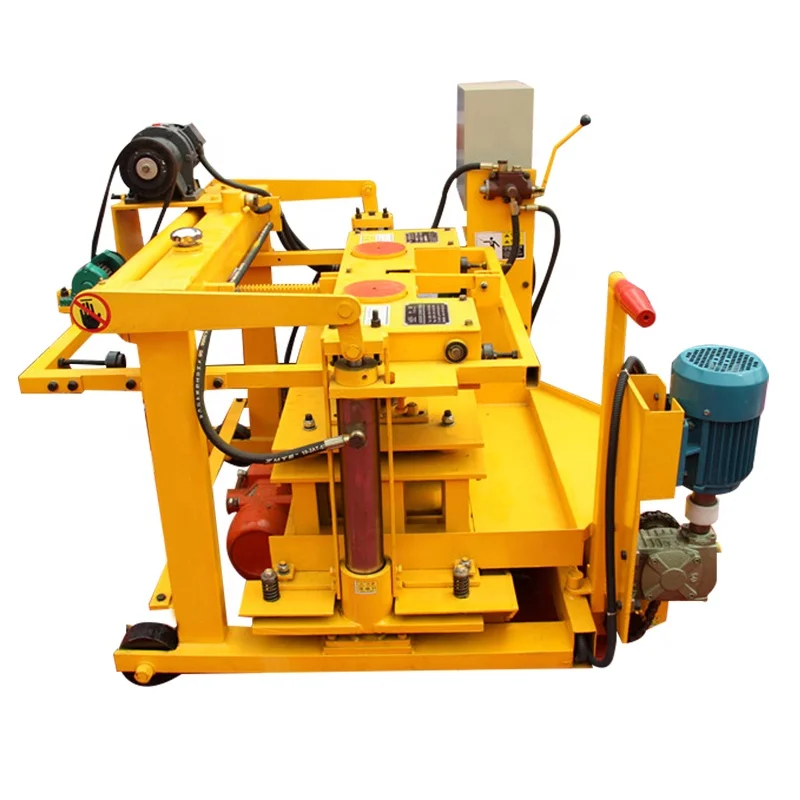
Line-Matched Integration — we configure the QMY4-30 mobile block machine alongside its mixer, feeding conveyor, and curing layout so the press never idles waiting for upstream material or downstream handling.
Technical Specifications
| Parameter | Value |
|---|---|
| Product Type | Mobile Hydraulic Block Making Machine |
| Model | QMY4-30 |
| Overall Dimensions (L×W×H) | 1300 × 1500 × 1000 mm |
| Net Weight | 950 kg – 1000 kg |
| Total Power | 5.95 kW |
| Vibration Force | 28.6 kN |
| Vibration Frequency | 4500 r/min |
| Hydraulic Method | Mold Vibration |
| Molding Cycle | 30 s |
| Output Capacity | 3000 pcs/day (8 h) — basis not stated in source; confirm block format, material and wall thickness |
| Raw Materials | Concrete, sand, cement, fly ash, lime, gypsum, stone dust, construction waste, slag, mine tailings, river sand, coal gangue, porcelain granule, sandrock |
| Transmission | Hydraulic transmission with automatic and manual options |
| Movement | Manual push — forward, backward, cornering |
| Mould Format | Customizable to buyer-supplied block drawing |
Application Suitability
| Application | Material or Output |
|---|---|
| On-site hollow block production at remote construction projects | Crushed stone, river sand and Portland cement blends |
| Small-scale solid block runs for rural housing contractors | Fly ash, lime and stone dust mixes |
| Paving block trials for building material distributors | Porcelain granule and sandrock aggregates |
| Block production in mountainous, desert or coastal sites with no fixed plant | Locally sourced construction waste and mine tailings |
What "3000 Pieces per Day" Actually Means for Your Line Planning
Capacity only holds when feeding, mixing and curing pace all match the 30-second cycle.
Many quotations list a daily output number without naming the block format, wall thickness or aggregate density that figure assumes. On a job site where the mixer batch size is too small or the curing ground is unprepared, the mobile block machine production line supporting equipment you selected sits idle between cycles. I have seen operators push a machine like this through a full shift only to log half the quoted tonnage because upstream batching could not keep rhythm [NEED_CITE: typical mixer-to-press cycle matching on small mobile lines].
Upstream Feeding Rhythm and Mixer Sizing
A 30-second mold cycle demands a fresh batch of mixed material roughly every two minutes if the operator is to keep the hopper topped off without pauses. The mobile block machine production line supporting equipment around the press must therefore include a mixer whose discharge volume aligns with one full mold charge, plus a feeding method — belt conveyor or wheeled hopper — that delivers on that same cadence. Any mismatch forces the press to wait, and the daily count drops well short of plan.
Downstream Curing Space and Surface Preparation
Because this egg-laying machine deposits blocks directly on the ground, the curing area must be level, compacted and large enough to hold an entire day’s output before blocks can be moved. If the ground is soft or uneven, early-age blocks crack under their own weight before initial set. Planning the curing footprint is therefore as important as sizing the mixer, and it belongs in the line layout before the press ships [NEED_CITE: egg-laying block curing surface standards for field production].
Reading the Vibration and Pressure Figures Together
The 28.6 kN vibration force at 4500 r/min is the mold-excitation profile that compacts the concrete around the aggregate particles. On its own the number tells you little; paired with the buyer’s mix design — water-cement ratio, fines content, maximum aggregate size — it determines whether the block reaches the required compressive strength. A stiffer mix with larger crushed stone needs the full frequency range, while a fly-ash-heavy blend may require a lower amplitude to avoid segregation.
When Specifications Are Read in Isolation
Choosing a mixer that is too large means mixed concrete sits in the drum and begins its initial set before the press can use it. Selecting a curing area without considering forklift access forces manual handling of every block, negating the labor advantage of going mobile in the first place. Overlooking the 5.95 kW total power draw can leave the machine tripping a shared generator circuit during peak vibration draw [NEED_CITE: generator sizing for mobile construction-site block presses].
Why Buyers Source the Whole Line From One Configuration
- Single-focus block machinery scope — the press, mould, portable mixer and feeding conveyor are specified as one matched set, not sourced from separate vendors and forced together on arrival.
- Configuration against your local aggregate — vibration frequency and hydraulic pressure are adjusted to the mix design your site can actually procure, avoiding costly material substitution.
- Mould drawn to your block format — custom mould design to buyer drawings ensures the machine produces the format your market sells, not a catalogue default.
- Automation selectable and upgradable — start with manual pallet and feeding routines, then add automatic batching and stacking modules as volume grows.
- Installation with operator training — commissioning support covers first-run parameter tuning so the crew knows how to read mix consistency against vibration response.
Documentation & Verification
- Line layout drawing stating the block format assumed for daily output
- Machine specification sheet with vibration force and hydraulic pressure matched to your mix
- Mould drawing and format list based on your submitted block design
- Voltage, frequency and control language confirmation sheet before shipment
- Factory test record on your specified raw material blend
- Operation and maintenance manual covering mold change and hydraulic service intervals
Installation, Commissioning & Support
- Level, compacted curing ground of at least several hundred square meters prepared before machine arrival
- Dedicated 5.95 kW circuit with correct voltage and frequency confirmed at the site panel
- Machine pushed manually into first production position; hydraulic and vibration systems checked under load
- First-run blocks tested for density and adjusted by tuning vibration amplitude to local aggregate
- Operator training on 30-second cycle pacing, mould change sequence and daily hydraulic inspection
- Wear parts list for mold liners and hydraulic seals provided with recommended reorder intervals
Before You Request a Quote, Share These Details
Send the block format and dimensions you intend to produce, the daily volume target, and a sample or description of your locally available aggregate. Include the site voltage and frequency, the control language your operators read, and whether you already have a mixer or curing area in place so we know which mobile block machine production line supporting equipment to add or exclude from the proposal.
Frequently Asked Questions
Q: How is the 3000 pcs/day capacity calculated, and which block format does it assume?
A: The figure is based on an 8-hour shift with a 30-second molding cycle, but the source does not state the exact block format, wall thickness or aggregate density used. Before we quote, we confirm the specific block you plan to produce and recalculate daily output for that format so the number reflects your real product.
Q: What mixer capacity and batching rhythm must match the 30-second cycle?
A: Each mold charge requires a fresh batch roughly every two minutes to keep the press running without pauses. We size the mixer drum volume and discharge rate so one full batch equals one mold load, then match the feeding conveyor speed to the same cadence.
Q: Does the quotation include raw material feeding, mixing and curing area planning, or only the press?
A: Our line proposal lists every station — mixer, feeder, curing footprint plan and handling tools — alongside the press itself. Items you already own or plan to source locally are removed so the quotation matches only what you actually need.
Q: What voltage, frequency and control language should be confirmed before the machine ships?
A: We confirm site voltage, phase and frequency, plus the language for any control display, before production begins. This avoids a situation where the machine arrives and waits weeks for a transformer or a reprogrammed panel before commissioning can start.
Q: How much curing ground area is needed per day’s output, and what surface preparation is required?
A: Egg-laying machines deposit blocks directly on the ground, so you need a flat, compacted surface large enough to hold one full day’s production before blocks are moved. We include a curing-area layout in the line drawing so you can prepare the site before the machine arrives.


