
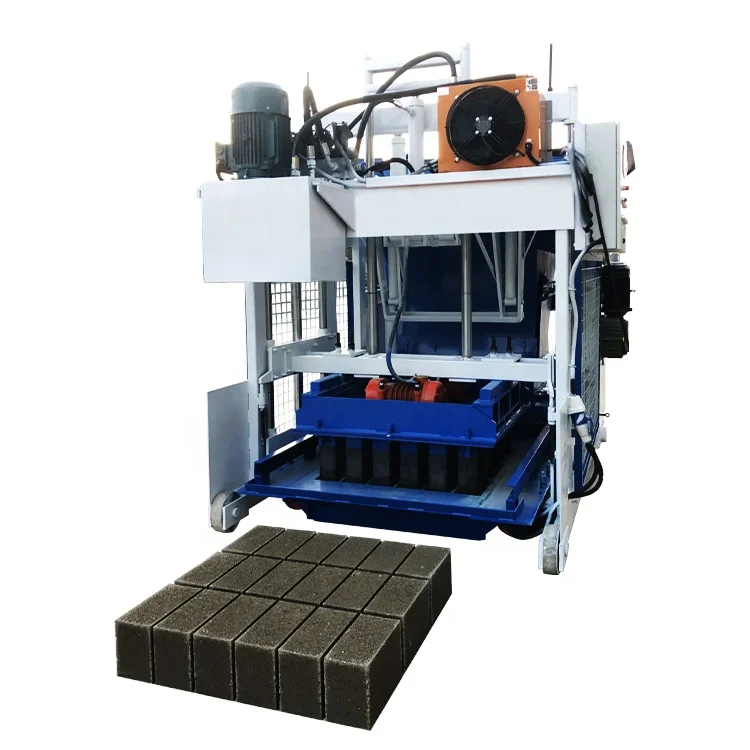
Integrated Line Layout — the QMY18-15 mobile block machine production line is planned around your site conditions, with mixer discharge height and mobile cycle matched before dispatch.
Technical Specifications
| Parameter | Value |
|---|---|
| Model | QMY18-15 |
| Product Type | Mobile Egg-Laying Concrete Block Making Machine |
| Working Method | Hydraulic pressure with mechanical vibration |
| Rated Power | 24 kW |
| Control System | PLC |
| Output Capacity | ~3,400 pcs per shift (based on 400×200×200 mm hollow block) |
| Pallet Requirement | No pallets required (egg-laying on ground) |
| Block Types | Customizable to buyer’s required formats |
| Automation Level | Semi-automatic mobile with PLC control |
| Voltage & Frequency | Configurable to local industrial supply |
| Mould Change System | Manual swap with bolt-secured mould frame |
Application Suitability
| Application | Material or Output |
|---|---|
| On-site hollow block production for housing projects | Crushed stone, sand, cement, water |
| Remote site solid block manufacturing | Local aggregate mixed with cement binder |
| First plant setup for entrepreneurs | Standard concrete mix with available regional sand |
| Paving block and interlocking brick for site use | Fine aggregate with pigment for coloured pavers |
What "3,400 Blocks per Shift" Assumes About Your Ground Surface
The output figure is valid only when the ground is flat, cured concrete, and the mixer discharge aligns with the hopper feed height.
Many contractors receive a mobile block machine production line quotation showing a single output number without stating the block format or the ground conditions required to sustain that pace. When the machine arrives on raw soil, the egg-laying carriage sinks slightly with each cycle, causing uneven block bases and frequent stops to re-level. The hopper then ends up higher than the loader bucket, forcing a site-welded steel platform that delays production [NEED_CITE: ground preparation standards for mobile concrete equipment].
How the Egg-Laying Design Reshapes the Supporting Line
Because the QMY18-15 deposits blocks directly on the ground, the mobile block machine production line eliminates pallet feeding, pallet return conveyors, and curing rack handling stations entirely. This simplification means the mixer output rate becomes the pacing constraint rather than the press cycle. If the mixer cannot deliver a fresh batch before the machine completes its travel loop, the press sits idle waiting for material, which erodes the shift output well below the stated capacity.
Aligning Mixer Height with Hopper Intake Before Dispatch
A recurring issue on African project sites involves a pan mixer whose discharge gate sits below the QMY18-15 hopper rim, making gravity feed impossible without manual shovelling or a fabricated platform. Line planning must confirm the mixer discharge elevation and the loader bucket reach before the equipment leaves the factory, so the mobile block machine production line functions as a continuous loop rather than a series of bottlenecks [NEED_CITE: material handling alignment in mobile concrete plants].
Reading the Specs That Actually Govern Block Strength
Hydraulic pressure and vibration force work together to compact the concrete mix inside the mould. Higher pressure alone will not achieve target density if the vibration frequency is mismatched to the aggregate size; coarse crushed stone demands lower frequency and higher amplitude to settle fully. The PLC manages cycle timing but cannot compensate for a mix that lacks sufficient fines to fill voids between larger particles. Voltage stability on site directly affects the hydraulic pump motor; fluctuating supply causes pressure drops mid-cycle, resulting in softer blocks at the top of the stack.
The Cost of Skipping Line Layout Before Shipment
When the supporting mixer, feeder, and water dosing system arrive without a coordinated layout, operators spend days repositioning equipment on site. Cables and hoses get stretched across traffic paths, creating trip hazards and forklift damage [NEED_CITE: site safety incidents from uncoordinated plant layout]. The machine may sit idle while the contractor sources a different mixer whose discharge height actually matches the hopper, turning a fast-start project into a multi-week delay.
Why Specifying the Whole Line Here Matters
Block machinery is our single focus, so the QMY18-15 is planned together with its mixer, feeder, and water system as one matched set rather than sourced from separate vendors. The line capacity calculation states the block format and ground conditions assumed, so daily output expectations stay realistic. Mould drawings cover the formats your local market sells, including custom shapes when standard options fall short. Automation level starts at semi-automatic with PLC, leaving room to add batching accuracy later. Voltage, frequency, and PLC display language are confirmed in writing before production begins.
Documentation & Verification
- Line layout drawing showing mixer discharge height matched to QMY18-15 hopper rim
- Capacity calculation sheet stating the 400×200×200 mm hollow block format and shift hours assumed
- Mould drawing and format list confirming exact block dimensions included in scope
- Voltage and PLC display language confirmation signed off before production
- Factory test record demonstrating cycle time and block density prior to shipment
Installation, Commissioning & Support
- Ground must be level cured concrete to sustain egg-laying travel without base unevenness
- Power supply must deliver stable 24 kW with dedicated circuit breaker for hydraulic pump motor
- Machine ships assembled with mould mounted; only hydraulic hoses and electrical connections require site fitting
- First-day commissioning verifies PLC language, cycle timing, and hydraulic pressure against local mix design
- Operator training covers mould swap procedure, daily hydraulic fluid check, and vibration plate inspection
- Wear parts list identifies mould liner and vibration springs with reorder part numbers
Starting the Conversation on Line Configuration
To size the supporting equipment around the QMY18-15, share the block format you sell most, your target daily output, and the aggregate type available near your site. Confirm your local voltage, frequency, and preferred PLC display language so the control panel matches your electrician’s standards. Let us know whether you already have a mixer or need the complete mobile block machine production line quoted from raw material feed through to finished block.
Frequently Asked Questions
Q: How is the daily output calculated, and which block format does the capacity figure assume?
A: The stated output is based on producing 400×200×200 mm hollow blocks over a standard shift, assuming flat concrete ground and a mixer that keeps pace with the machine travel cycle. A different block format will change the cycle time and the pieces per mould, so we recalculate capacity once your primary format is confirmed.
Q: What ground surface preparation is needed for the egg-laying machine to operate correctly on site?
A: The machine requires a level, cured concrete surface so the wheels and block base do not sink during laying. Compacted soil or fresh screed will cause uneven blocks and carriage drag. We provide ground tolerance limits in the line layout drawing so your site team can prepare the area before the machine arrives.
Q: How does voltage and frequency get confirmed to match my local power supply before shipment?
A: We request your site voltage, phase, and frequency in writing during the quotation stage, then specify the motor and PLC transformer accordingly. The control panel label and PLC display language are confirmed on the pre-production drawing you sign off, so no rewiring is needed on arrival.
Q: What supporting equipment is needed around this mobile machine to form a complete line?
A: A pan or twin-shaft mixer, raw material batching system, and water dosing unit complete the loop. The mixer discharge height must sit above the QMY18-15 hopper rim for gravity feed. We specify each station’s position and cable route in the line layout so the press is never left waiting for material.


