
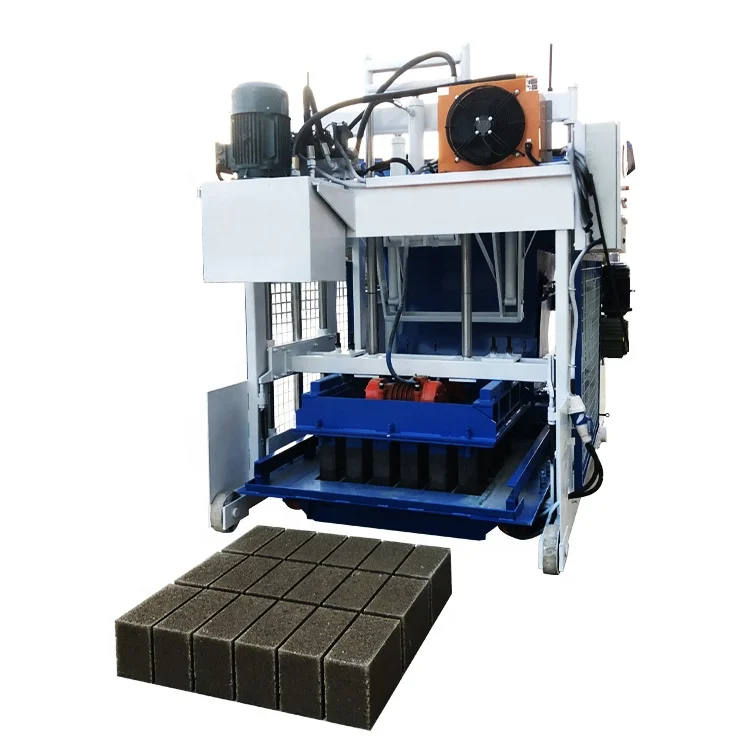
Matched System Configuration — the QMY18-15 egg laying block machine is specified as one coordinated line with mixer, feeder and ground-curing layout rather than sourced as isolated stations.
Technical Specifications
| Parameter | Value |
|---|---|
| Product Type | Egg Laying Mobile Concrete Block Making Machine |
| Model | QMY18-15 |
| Rated Power | 24 kW |
| Control System | PLC (display language to be confirmed with buyer) |
| Voltage & Frequency | Customized to local industrial standard (exact value to be confirmed) |
| Working Method | Hydraulic pressure station |
| Block Output Reference | Approx. 3,400 pcs/shift for 400×200×200 mm hollow block (shift length to be confirmed) |
| Pallet Requirement | None — blocks laid directly on ground |
| Block Type Capability | Customizable mould formats per buyer requirement |
| Automation Level | Semi-automatic with PLC |
| Assembly State | Mobile, egg-laying type |
Application Suitability
| Application | Material or Output |
|---|---|
| On-site hollow block production for building contractors | Crushed stone, sand, cement and water mix laid on compacted ground |
| First-stage block plant for entrepreneurs with limited infrastructure | Local aggregate and cement blended in a pan mixer and fed to the mobile press |
| Housing project block supply without a fixed factory | Solid and hollow formats produced directly on the construction site |
| Paving and kerb production in remote locations | Customized mould formats producing interlocking or solid units on prepared ground |
Why the Egg Laying Block Machine Production Line Is More Than Just the Press
A mobile press without a matched mixer and feed system is a machine that spends half its shift waiting.
Many buyers focus on the press itself and leave the rest of the egg laying block machine production line as an afterthought. The result is a mobile block making machine turnkey setup that starves for mix, forces workers to shovel material by hand, and leaves freshly laid blocks exposed to foot traffic before they gain initial set. The QMY18-15 eliminates pallets from the equation, but that only shifts the planning burden to material flow and ground curing logistics [NEED_CITE: material handling bottlenecks in mobile block plants].
Keeping the Mobile Press Fed Without Over-Mixing
The egg laying block machine production line built around the QMY18-15 starts with a mixer sized to the press cycle. Because the machine lays blocks directly on the ground and moves forward continuously, the mixer must deliver a steady batch volume that matches the press consumption rate — neither flooding the hopper nor letting it run dry. A mixer that is too large wastes cement through extended mixing times, while one that is too small forces the press operator to stop and wait, breaking the production rhythm that keeps block density consistent across the run.
Ground Curing Layout That Protects Early Strength
Once blocks leave the QMY18-15, they sit exposed on the ground until they gain enough early strength to survive handling. The mobile block making machine turnkey plan must therefore define a curing zone that is flat, protected from vehicle traffic and sized for a full shift of output. Without this, blocks laid in the morning are walked over or driven past before the afternoon, and the strength the press worked to build is destroyed by site logistics rather than by any fault in the mix or the machine [NEED_CITE: early-age concrete handling damage on construction sites].
Reading the Specs That Actually Matter on Site
The 24 kW rated power covers both the hydraulic pressure station and the vibration system that compacts the mix inside the mould. Hydraulic pressure and vibration force must work together — pressure alone leaves voids in the block wall, while vibration without sufficient pressure produces a block that crumbles at the edges before it is even laid on the ground. The PLC control simplifies the operator interface so that cycle start, mould lift and travel are managed from one panel, reducing the worker count immediately around the press. Voltage and frequency are customized to the buyer’s local industrial supply, and the PLC display language is confirmed before production so that commissioning is not delayed by an interface the operator cannot read. Because the QMY18-15 requires no pallets, the cost and logistics of pallet return, cleaning and storage are removed entirely from the line.
When the Line Around the Press Is Left to Chance
Buyers who quote the QMY18-15 as a standalone unit often discover that the mixer they already own cannot keep pace, or that their site has no level ground prepared for curing. Blocks are then laid on uneven soil, producing units with inconsistent height that fail the dimensional checks on the building site. In other cases, the raw material feed configuration was never matched to the local aggregate, so the mix design the machine was set up for cannot actually be sourced, forcing a costly material substitution mid-project [NEED_CITE: aggregate grading effects on concrete block compressive strength].
Why Buyers Plan the Full Line Here
The QMY18-15 is configured against the buyer’s actual mix design and local aggregate, not against a catalogue default, so the hydraulic pressure and vibration settings match the material that will actually arrive on site. Mould formats are selected or custom-designed for the block types the buyer’s market actually sells, preventing the situation where a machine arrives with moulds for products nobody wants to buy. The egg laying block machine production line is laid out as one drawing that shows mixer position, feed path, press travel direction and curing zone, so that stations connect logically and cycle times match. Automation level is selectable, meaning a buyer can start with semi-automatic PLC operation and add handling stations later as output grows. Installation support includes operator training on the specific mix and block format, not a generic start-up script.
Documentation & Verification
- Line layout drawing showing mixer, feed path, press travel and curing zone dimensions
- Capacity calculation sheet stating block format, cycle time and assumed shift length
- Voltage, frequency and PLC display language confirmation signed before production
- Factory test record run on a mix profile matching the buyer’s local aggregate
- Mould drawing and format list for every block type included in the quotation
Installation, Commissioning & Support
- Site ground preparation checklist specifying flatness tolerance for the QMY18-15 curing area
- Electrical supply verification for the 24 kW rated load, including dedicated circuit and breaker rating
- First-day commissioning with mix trial and cycle time adjustment on the buyer’s actual aggregate
- PLC display language loaded and verified before the control panel is powered up on site
- Operator training covering mould change procedure, daily greasing points and hydraulic fluid level checks
- Wear parts list with hydraulic seals and mould liner dimensions for local sourcing or re-order
What We Need to Configure Your Line
To build an egg laying block machine production line that matches your site, please share the block formats you plan to sell, your target daily output and the shift hours you intend to run. We also need a sample or description of your locally available aggregate and cement type, your site voltage and frequency, and the dimensions of the ground area you can dedicate to block laying and curing.
Frequently Asked Questions
Q: How is daily output verified when the egg laying machine produces multiple block formats?
A: The capacity calculation sheet lists each block format separately with its own cycle time and pieces-per-shift figure, all based on the same assumed shift length. This prevents the situation where a single headline number hides the fact that smaller formats produce more pieces while larger hollow blocks produce fewer.
Q: What mixer capacity and feed rate keep the QMY18-15 from waiting for material?
A: Mixer batch volume and discharge rate are matched to the press cycle time for the buyer’s chosen block format. The line layout drawing shows the feed path so that the hopper is replenished before it empties, keeping the mobile block making machine turnkey system in continuous operation.
Q: How is the curing area planned when blocks are laid on the ground?
A: The curing zone is sized for one full shift of output with travel lanes for the QMY18-15 and clearance for later block collection. Ground flatness tolerance is specified in the site preparation checklist so that block height remains consistent across the curing area.
Q: What electrical details must be confirmed before the line ships?
A: Voltage, frequency and PLC display language are confirmed in writing before production begins. This ensures the 24 kW power system matches the buyer’s local supply and the operator can read the control panel from day one without reprogramming on site.
Q: How does the raw material feed adapt to local aggregate?
A: The feed configuration — including screen size, hopper geometry and mixer blade profile — is set against the buyer’s actual aggregate grading and cement type, so the egg laying block machine production line runs on material that is genuinely available at the project site.


