
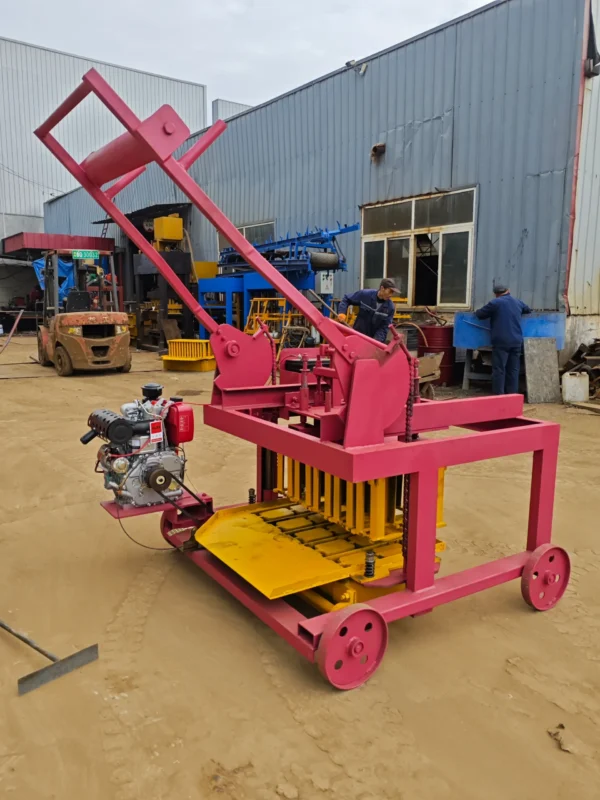
Matched System Integration — The QMR4-45 arrives with its diesel mixer and trolley specified as one continuous material flow, eliminating the idle press syndrome common on sites where equipment is sourced piecemeal.
Technical Specifications
| Parameter | Value |
|---|---|
| Model | QMR4-45 |
| Product Type | Mobile Diesel Engine Block Making Machine |
| Molding Cycle | 45s (basis not stated in source — confirm block format / material / thickness) |
| Power Source | Diesel |
| Rated Power | 8hp |
| Molding Form | Vibration and Pressure |
| Vibration Force | 60KN |
| Total Weight | 800kg |
| Overall Dimensions (L×W×H) | 2420×1320×1650mm |
| Pallet Size | No pallet required (egg-laying type) |
| Mould Format | Paver brick, hollow block, concrete block, solid brick, fly ash brick (basis not stated in source — confirm block format / material / thickness) |
| Automation Level | Manual / Easy Operation |
| Stacking Method | Manual (egg-laying, no pallet) |
| Basic Equipment Included | JZC350 or JQ350 Diesel Concrete Mixer; Trolley |
| Assembly State | Mobile, movable on site |
Application Suitability
| Application | Material or Output |
|---|---|
| On-site hollow block production for housing projects | Crushed stone, sand, cement, and water mixed at the project site |
| Paver brick manufacturing for landscaping contractors | Local aggregate blended with cement for interlocking or rectangular paver formats |
| Solid brick production in remote or off-grid areas | Desert sand, fly ash, or stone dust combined with cement where grid electricity is unavailable |
| Small-scale concrete block supply for infrastructure works | Standard concrete mix producing structural and non-structural block formats |
Why the Pallet Question Decides Your Real Daily Output
A pallet-free egg-laying system removes the single biggest bottleneck on mobile block production sites.
I once watched a contractor in Oman lose an entire shift because his curing racks were full but the press kept cycling. Blocks stacked on whatever flat surface the crew could find, cracked under their own weight before setting. The QMR4-45 lays blocks directly onto a prepared ground surface, which means the mobile block machine production line keeps moving as long as there is flat, level earth ahead of it. No pallet return loop, no pallet storage yard, no forklift ferrying boards back to the press [NEED_CITE: typical pallet handling logistics in mobile block operations]. The constraint shifts from pallet inventory to ground preparation and curing space — a far simpler problem to solve on a project site.
How the Line Stations Connect Around the Press
The diesel mixer feeds blended material into the trolley, which delivers it to the QMR4-45 hopper at a rate matched to the 45-second molding cycle. When any station runs slower than the press, the entire mobile block machine production line stalls. The included JZC350 or JQ350 mixer is sized so that batch mixing does not fall behind the press demand, and the trolley bridges the gap between a stationary mixer position and a press that relocates across the site as the curing area fills.
Ground Conditions That Make or Break Egg-Laying Output
The QMR4-45 deposits wet blocks directly onto the ground, so surface flatness and compaction become part of the production setup. A site with uneven or soft soil will produce blocks that settle unevenly before initial set, causing dimensional variation across a batch. Contractors who invest in a leveled and compacted curing strip before starting production find that block consistency improves noticeably compared to laying on rough terrain. This is where mobile block machine production line planning must account for site prep, not just machine specs [NEED_CITE: ground preparation standards for egg-laying block machines].
Vibration, Pressure, and What 60KN Actually Means on Site
The 60KN vibration force works together with mechanical pressure to compact the concrete mix inside the mould cavity. Vibration alone leaves voids; pressure alone cannot consolidate a stiff mix around aggregate particles. On the QMR4-45, the two forces act simultaneously during the 45-second cycle. The practical result is that blocks achieve sufficient green strength to hold their shape immediately after demoulding — a requirement for egg-laying operation where no pallet supports the block during the first critical minutes. The 8hp diesel engine must deliver enough torque to sustain both vibration and hydraulic pressure without stalling under load, particularly when processing stiff, low-slump mixes common in hot arid climates. Mould format changes also depend on this force balance: a hollow block mould with thin cores requires different vibration transmission than a solid paver mould, and the operator must understand how to adjust feed volume per format.
When the Mixer Cannot Keep the Press Fed
A common failure on mobile sites is treating the mixer as an afterthought — sourcing it locally, undersizing it, or running it on a separate schedule. When the mixer batch cycle is longer than the press consumption rate, the QMR4-45 sits idle with a full hopper that empties before the next batch arrives. The result is a mobile block machine production line that produces well below its stated capacity, not because the press is slow, but because the feeding station was never matched to it. This mismatch is the single most frequent cause of output disappointment on projects I have walked onto after commissioning [NEED_CITE: material flow bottlenecks in small-scale block plants].
Why Sourcing the Full Line Matters Here
Block machinery as a single focus means the QMR4-45 press, its diesel mixer, and the trolley are specified together rather than assembled from unrelated suppliers. The mixer capacity is calculated against the press cycle, not quoted in isolation. Configuration is set against the buyer’s actual mix design and local aggregate, which matters enormously when desert sand or high-clay materials behave differently from the standard test mix. Mould design covers the formats the buyer’s market actually sells, with custom drawings available for non-standard block dimensions. The automation level stays manual by design for this tier, keeping operator training straightforward and maintenance within the capability of a site mechanic. Documentation includes line layout and capacity calculation that states which block format the cycle time assumes — removing the guesswork from daily output planning.
Documentation & Verification
- Line layout showing mixer-to-press material flow with trolley path marked
- Capacity calculation stating the exact block format assumed for the 45s cycle
- Mould drawing and format list covering all included block types
- Hydraulic and electrical schematic for the diesel power circuit
- Factory test record run on buyer-specified mix before dispatch
- Operation and maintenance manual with wear parts list
Installation, Commissioning & Support
- Ground leveling and compaction across the curing strip before first egg-laying run
- Diesel engine break-in procedure and fuel filter schedule for the 8hp unit
- Mixer-to-trolley-to-press feed rate verification during commissioning
- Mould change walkthrough covering all included block formats
- Operator training on vibration duration adjustment per mix stiffness
- Wear parts identification for first-year reorder planning
What to Share Before Requesting a Quote
Provide the block formats your project or market requires, along with the daily volume target and the local aggregate you plan to use. Confirm whether the site has any electrical supply at all or if diesel-only operation is mandatory. Share ground conditions and available curing area dimensions so the line layout can be planned around your actual site rather than a generic template.
Frequently Asked Questions
Q: What block formats can the QMR4-45 produce, and how is daily output calculated per format?
A: The machine covers hollow block, solid brick, paver brick, concrete block, and fly ash brick formats through mould changes. Daily output depends on the specific block format, as each mould has a different cavity count and may require a slightly adjusted cycle. A capacity calculation should state the exact format assumed so buyers can plan realistically.
Q: How does the diesel mixer feeding rate match the 45s press cycle to avoid idle time?
A: The included JZC350 or JQ350 diesel mixer is sized to produce batches at a rate that keeps pace with the press consumption. The trolley bridges the distance between the mixer station and the mobile press position. Matching these three stations as one system prevents the press from waiting on material between cycles.
Q: What site conditions are needed for pallet-free egg-laying operation?
A: The ground surface must be flat, level, and compacted to support wet blocks immediately after demoulding. A prepared curing strip allows consistent block dimensions and reduces breakage. Adequate curing area ahead of the machine path ensures continuous production without stopping to wait for space.
Q: Is the trolley and mixer included in the standard scope, or quoted separately?
A: The QMR4-45 package includes either a JZC350 or JQ350 diesel concrete mixer and a trolley as basic equipment. These are specified as part of the mobile block machine production line rather than optional add-ons, ensuring the material flow from mixing to pressing functions as a matched system.
Q: What spare moulds and hydraulic wear parts are recommended for the first year?
A: A wear parts list is provided with the documentation package, identifying components most likely to need replacement based on operating hours. For moulds, buyers producing multiple formats should consider spare cavity liners for their highest-volume block type to avoid production stops during mould maintenance.


