
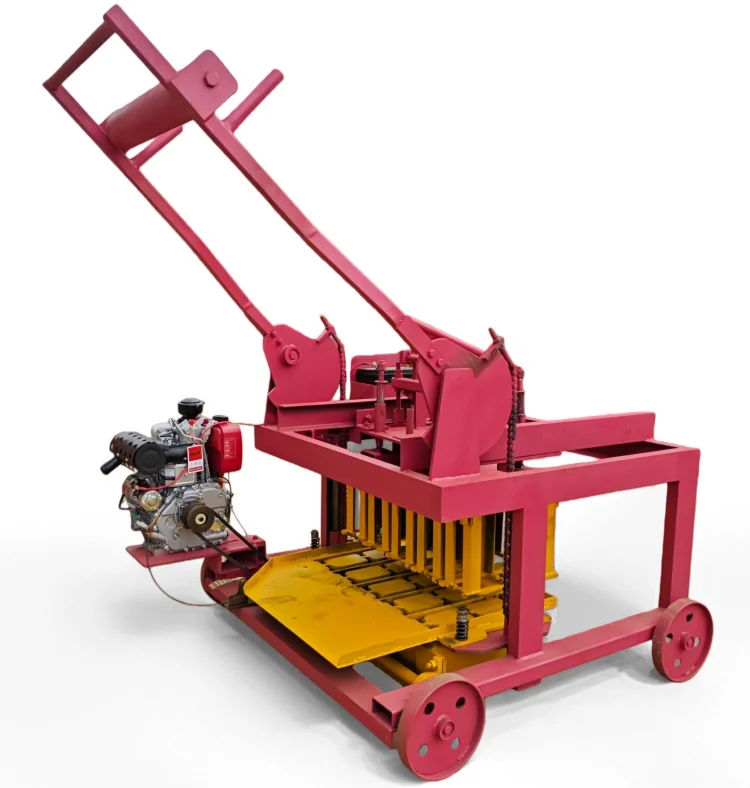
Diesel-Driven Line Matching — The QMR4-45 mobile block making machine is configured as a complete on-site production setup with diesel mixer and trolley, so the press is never left idle waiting for material feed or pallet handling in off-grid conditions.
Technical Specifications
| Parameter | Value |
|---|---|
| Model | QMR4-45 |
| Product Type | Mobile Block Making Machine |
| Molding Cycle | 45s (basis to be confirmed for specific block format) |
| Power Source | Diesel |
| Rated Power | 8hp |
| Molding Form | Vibration and Pressure |
| Vibration Force | 60KN |
| Total Weight | 800kg |
| Overall Dimensions | 2420×1320×1650mm |
| Pallet Requirement | No pallet required (egg-laying type) |
| Mobility | Mobile / Movable |
| Compatible Mixer | JZC350 or JQ350 Diesel Concrete Mixer |
| Supporting Equipment | Trolley for material transport |
| Automation Level | Manual / Egg-laying type |
| Block Formats | Paver brick, hollow block, concrete block, solid brick, fly ash brick (basis not stated in source) |
Application Suitability
| Application | Material or Output |
|---|---|
| On-site housing project block production | Hollow and solid concrete blocks from crushed stone, sand, and cement |
| Remote-area block plant without grid power | Diesel-driven production using locally available aggregate |
| Contractor-produced blocks at construction sites | Paver bricks and kerbstones laid directly on the ground |
| First-time block plant with minimal infrastructure | Small-scale solid and fly ash brick runs with portable setup |
Why "45 Seconds per Cycle" Does Not Tell the Whole Story
Cycle time means nothing without the block format it assumes and the line stations that feed it.
When a mobile block making machine production line is quoted with a single cycle figure, the number usually reflects an idealized hollow block under factory conditions. In reality, a paver brick with a face-mix layer or a tall kerbstone requires different vibration duration and pressure hold, stretching that 45-second window. Add in mixer turnaround, trolley refill, and the operator walking the machine to the next laying position, and the real throughput per shift can fall well short of what the math suggests. I have seen contractors order a mobile unit based on a cycle-time calculation, only to discover that their local aggregate — high in clay content — required a longer vibration cycle to achieve adequate block density. [NEED_CITE: effect of aggregate clay content on concrete block vibration time]
How the Line Stations Must Keep Pace
A mobile block making machine production line is only as fast as its slowest station. The QMR4-45 press completes a cycle, but if the JZC350 mixer has not finished its batch, the operator stands idle. The trolley must deliver fresh mix before the next molding stroke begins. Because this egg-laying design drops blocks directly onto the ground, there is no pallet return loop to manage — a simplification that keeps the line moving but demands disciplined curing-area layout so freshly laid blocks are not obstructed by the next pass of the machine.
Diesel Power as a System, Not Just a Motor
Running the entire mobile block making machine production line on diesel means the mixer, generating unit, and press must share a common fuel logistics chain. The JQ350 mixer option pairs with an electric generating unit when site conditions allow partial electrification, while the JZC350 runs purely mechanical. Matching fuel consumption across all three diesel consumers determines how often a fuel truck must visit a remote site, and mismatched tank capacities can strand a crew mid-shift. [NEED_CITE: fuel supply logistics for off-grid construction equipment]
Reading the Numbers That Actually Matter
The 60KN vibration force and pressure molding form work together to consolidate the concrete mix into a dense block. Higher vibration alone will not produce a strong block if the hydraulic pressure is too low to compact the aggregate skeleton. The 8hp diesel engine must deliver enough torque to drive the vibration eccentric while simultaneously powering the hydraulic pump — a load split that smaller engines struggle with when the mix is stiff. At 800kg total weight, the machine is heavy enough to resist walking during vibration but light enough to be repositioned by two operators across a laying field. The 2420×1320×1650mm footprint defines the minimum aisle width the machine needs to travel between rows of freshly cured blocks.
What Happens When the Mixer Is Undersized
Buyers sometimes treat the mixer as an afterthought, assuming any concrete mixer will keep up. An undersized mixer forces the press operator to pause between batches, turning a continuous egg-laying run into a stop-start operation. Over a ten-hour shift, those pauses accumulate into a significant gap between expected and actual output. Worse, a mixer that cannot fully blend the local aggregate in the available cycle time sends poorly homogenized mix to the press, producing blocks with weak spots that only show up after curing. [NEED_CITE: concrete mix homogeneity and block compressive strength correlation]
Why Line Configuration Starts with Your Raw Material
Every component in this mobile block making machine production line — from the mixer paddle speed to the vibration duration — is set against a specific mix design. We request raw material samples before finalizing the line, because aggregate grading, moisture absorption, and clay content all change how the 60KN vibration force behaves in practice. Configuration against your actual material means the line arrives already matched, rather than requiring weeks of on-site adjustment after commissioning.
Documentation & Verification
- Line layout showing mixer-to-press-to-curing flow with cycle timing per station
- Capacity calculation sheet stating which block format the 45s cycle assumes
- Mould drawing and format list for hollow, solid, paver, and fly ash brick
- Factory test record run on your specified block format before dispatch
- Voltage and generating unit specification confirmed to your site power conditions
Installation, Commissioning & Support
- Ground leveling and compaction requirements for the 2420×1320mm laying area
- Diesel fuel storage and supply routing for the 8hp press and JZC350 mixer
- Vibration force calibration against your local aggregate sample at first start-up
- Mould change procedure training for switching between hollow and paver formats
- Wear parts list covering eccentric blocks, hydraulic seals, and mixer blades
- Recommended maintenance intervals tied to operating hours rather than calendar dates
What We Need from You to Size This Line
Before we confirm the mobile block making machine production line layout, we need your target block format and the daily output you expect per format. Send us a sample of your local sand, crushed stone, or fly ash so we can test the mix against the 60KN vibration setting. Let us know whether your site has any grid power available or if the entire line must run diesel, and tell us the curing area dimensions you can allocate on the project site.
Frequently Asked Questions
Q: How do I verify the real daily output of this line for the block format I actually sell?
A: The 45-second cycle time must be matched to a specific block format and wall thickness before daily output can be calculated. We provide a capacity sheet that states the assumed format, mixer batch turnaround time, and trolley refill interval, giving you a realistic shift output rather than a theoretical maximum based on an unspecified block.
Q: Which supporting equipment is included in the line quotation beyond the press itself?
A: The quotation covers the QMR4-45 press, a matched JZC350 or JQ350 diesel mixer, and the material trolley. Curing area layout guidance and fuel logistics planning are part of the configuration service. Additional stations like a conveyor or water spraying system can be added if your site conditions require them.
Q: What site preparation does a mobile block production setup actually need?
A: The laying field must be compacted and level within a tolerance that prevents the 800kg machine from tilting during vibration. You need a clear aisle width matching the 2420×1320mm footprint plus turning space, and a designated curing zone that does not overlap with the machine travel path for at least the initial curing period.
Q: Can I switch between hollow blocks and paver bricks on the same machine without losing a full shift?
A: Mould change on an egg-laying machine involves lifting the old mould and bolting on the new one, which is faster than pallet-based systems since there are no pallet guides to realign. We provide the mould drawing and change procedure so your operator can complete the swap within a planned break rather than losing production time.
Q: How does diesel operation affect maintenance scheduling compared to electric lines?
A: Diesel engines on the press, mixer, and generating unit each have their own service intervals tied to running hours. Fuel filter and injection system maintenance must be coordinated across all three units to avoid staggered downtime. We include a unified maintenance schedule that groups service tasks to minimize the number of stops per week.


