
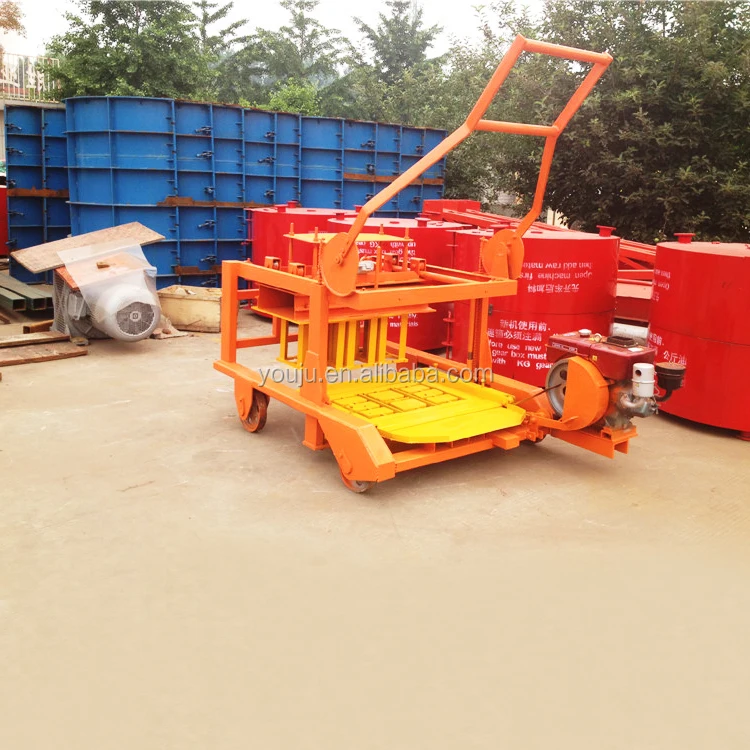
Matched System Approach — The QMR4-45 mobile block machine is specified alongside its mixer, feeder, and curing layout so the press never waits on upstream stations or outpaces downstream handling.
Technical Specifications
| Parameter | Value |
|---|---|
| Model | QMR4-45 |
| Product Type | Mobile Egg-Laying Block Making Machine |
| Overall Dimensions (L×W×H) | 2420×1320×1650 mm |
| Net Weight | 810 kg |
| Moulding Cycle | 40–45 s |
| Pallet Size | No pallet required (egg-laying type) |
| Rated Power | 6 kW |
| Power Source Option | Electric motor or diesel engine (6–8 HP) |
| Voltage | 220 V / 380 V / configurable to local supply |
| Output Capacity | 3000 pcs/day based on 400×200×200 mm hollow block, 4 pcs/mould, 8-hour shift |
| Output Capacity (alt.) | 3500 pcs/day based on 400×150×200 mm hollow block, 5 pcs/mould, 8-hour shift |
| Output Capacity (alt.) | 4500 pcs/day based on 400×120×200 mm hollow block, 6 pcs/mould, 8-hour shift |
| Mould Formats | Interchangeable hollow block moulds: 400×200×200 / 400×150×200 / 400×120×200 mm |
| Automation Level | Semi-automatic |
| Stacking Method | Manual (egg-laying on ground) |
| Warranty | One year for the whole machine |
Application Suitability
| Application | Material or Output |
|---|---|
| On-site hollow block production | Crushed stone, river sand, cement mix laid directly on compacted ground |
| Contractor-owned building sites | Masonry blocks produced adjacent to active construction without fixed plant |
| Temporary housing project supply | Multiple hollow block formats from a single mobile press on prepared earth |
| Off-grid or unreliable power sites | Diesel engine option for locations lacking stable three-phase electricity |
| Small-scale block yard startup | Low-infrastructure entry with manual stacking and open-air curing |
What "3000 Pieces per Day" Actually Means for Your Site
The daily output figure only holds if your supporting equipment keeps pace with the press cycle.
Many buyers receive a mobile block machine production line quotation stating a single capacity number without revealing which block format that number assumes. The QMR4-45 produces 3000 pieces per day only when running the 400×200×200 mm hollow block format with four cavities per mould across a full eight-hour shift. Switch to a wider wall block and the count changes. I have seen contractors in Southeast Asia plan their entire masonry schedule around a headline figure, then discover on site that the format they actually sell yields a different daily total [NEED_CITE: capacity calculation standards for block making equipment]. The egg laying block machine supporting equipment — mixer batch size, feeder rate, and curing area layout — must be sized to the format you will actually run, not the one that produces the highest brochure number.
How the Line Connects Around a Mobile Press
A mobile block machine production line is only as reliable as its weakest station. The QMR4-45 completes a moulding cycle every 40–45 seconds, which means your mixer must deliver a fresh batch to the feed hopper within that same window. If the mixer is undersized, the press idles and your real output drops. The egg-laying design eliminates pallets entirely, but it demands a flat, compacted ground surface stretching far enough to hold a full day’s production while earlier blocks cure. Planning that curing footprint is part of the line layout, not an afterthought.
Matching Mixer Capacity to Press Cycle Time
The rated power of 6 kW tells you what the press consumes, but the mixer motor must be calculated separately based on batch volume per cycle. Each moulding cycle draws a specific volume of wet concrete; multiply that by the number of cycles per hour and you know the hourly throughput your mixer must sustain. Undersizing the mixer is the most common bottleneck I encounter on mobile block machine production line installations across the region — the press is ready, but the hopper is empty [NEED_CITE: mixer sizing guidelines for mobile block plants].
Reading the Specifications That Matter on Site
The overall dimensions of 2420×1320×1650 mm mean the QMR4-45 can be maneuvered between existing structures on a building site, but you still need clearance for the operator to walk the machine backward as it lays each row. The 810 kg net weight is light enough for a small crane or forklift to reposition, yet heavy enough that the vibration force transfers into the mould cavity rather than shaking the frame itself apart. The dual power option — electric motor or 6–8 HP diesel engine — matters most when your site generator cannot sustain the starting surge of an electric motor under load. Voltage and frequency must be confirmed against your local supply before the machine leaves the factory; a 380 V machine arriving at a 220 V site means weeks of delay.
When Supporting Equipment Gets Left Out of the Quote
The most frequent complaint I hear from buyers in this region is that the quotation covered the press and nothing else. They receive the egg laying block machine supporting equipment list only after placing the order, then realize they need a pan mixer, a water metering system, and a ground preparation plan — none of which were budgeted. Without a documented line layout showing mixer placement, feed path, and curing zone dimensions, the mobile block machine production line operates at a fraction of its rated cycle time [NEED_CITE: common omissions in block machine quotations]. The result is a press that spends half the day waiting.
Why Sourcing the Whole Line from One Supplier Matters
Block machinery is the single focus here, which means the QMR4-45 is not paired with a generic mixer from a different factory. The machine, mould, and handling equipment are specified as one matched system. Configuration is set against your actual mix design and local aggregate, not a catalogue default — that Philippine client who lost half his output to high-clay river sand would have caught the problem before shipment if his supplier had asked for an aggregate sample first. Mould design covers the hollow block formats your market actually buys, and custom mould drawings are available when standard formats do not match. The automation level is selectable, so you can begin with semi-automatic operation and add feeding or stacking automation later as volume grows.
Documentation & Verification
- Line layout drawing showing mixer position, feed path, and curing area dimensions for your site
- Capacity calculation sheet stating which hollow block format and shift length each output figure assumes
- Mould drawing and format list confirming included and optional cavity designs
- Voltage and frequency confirmation document matched to your local supply before dispatch
- Factory test record on your specified block format and mix proportion
- Operation and maintenance manual with wear parts and mould replacement schedule
Installation, Commissioning & Support
- Ground must be compacted and level across the full curing zone; no concrete floor slab required for egg-laying operation
- Electrical connection requires confirmed voltage and frequency; dedicated circuit rated above 6 kW starting surge
- Diesel engine option eliminates grid dependency; fuel supply and engine service intervals planned before first run
- Mould change procedure trained on site using the three included hollow block formats as practice runs
- Wear parts list provided with recommended stock quantities for first-year operation in local aggregate conditions
- Operator training covers mix consistency judgment, cycle timing, and manual stacking alignment without pallets
What to Prepare Before Requesting a Proposal
Before we configure a mobile block machine production line around the QMR4-45, we need to know which hollow block format your market buys most, your target daily output for that specific format, and the source and gradation of your local sand and aggregate. Share your site dimensions so we can plan the curing area, and confirm your available voltage and whether grid power is reliable enough for the electric motor or if the diesel engine is the safer choice.
Frequently Asked Questions
Q: How is daily output calculated, and which block format is the figure based on?
A: Each output figure for the QMR4-45 is tied to a specific hollow block dimension and cavity count. The 3000 pieces per day figure assumes the 400×200×200 mm format with four cavities per mould over an eight-hour shift. Different formats yield different daily totals, so always confirm which block size the quoted capacity refers to before comparing machines.
Q: What supporting equipment is needed around the mobile press?
A: The egg laying block machine supporting equipment typically includes a pan mixer sized to match the press cycle, a water metering system for consistent mix moisture, and a prepared ground area long enough to hold a full day’s laid blocks. We document mixer capacity, feed path, and curing zone dimensions in the line layout before confirming the order.
Q: How do I confirm voltage and power source for my site?
A: The QMR4-45 is configurable to 220 V or 380 V and can be fitted with a 6–8 HP diesel engine instead of the electric motor. We require your site voltage, frequency, and power stability details before production begins so the machine arrives ready to run without rewiring or transformer delays.
Q: What mould formats are included with the machine?
A: The QMR4-45 ships with interchangeable moulds for 400×200×200 mm, 400×150×200 mm, and 400×120×200 mm hollow blocks. Additional formats including solid blocks and pavers may be available upon request. The mould drawing and format list are confirmed before dispatch so there are no surprises on arrival.


