
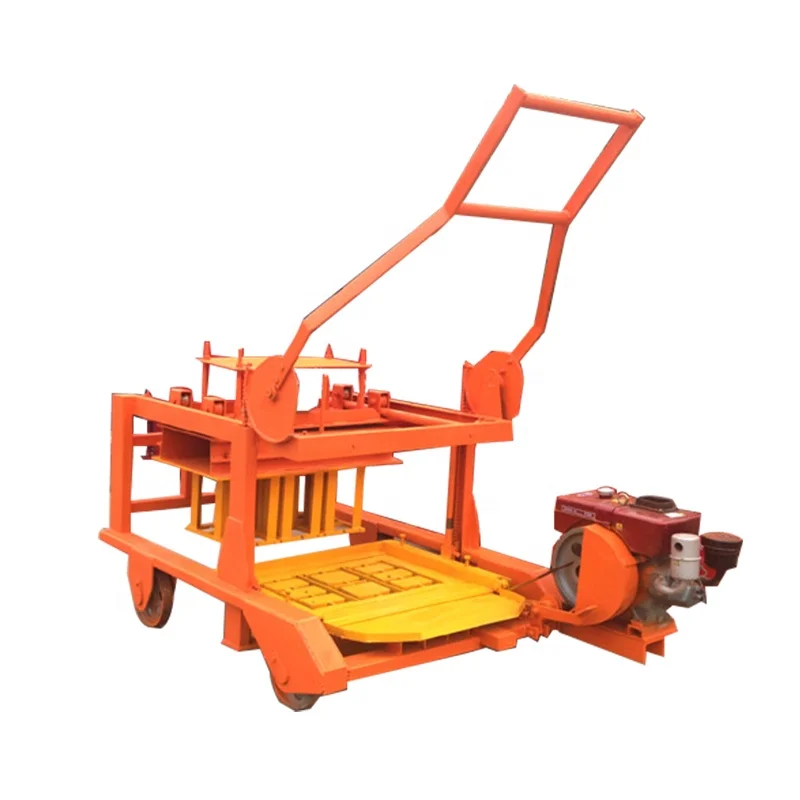
Matched System Design — mixer, mobile press, and curing area planned as one line so no station waits on another, verified against your daily format target.
Technical Specifications
| Parameter | Value |
|---|---|
| Model | QMR4-45 |
| Product Type | Mobile Block Machine |
| Power Source | Diesel / Electric (dual option) |
| Engine Power | 8hp |
| Molding Cycle | 45s per cycle (basis not stated in source — confirm block format and material) |
| Molding Form | Vibration and Pressure |
| Vibration Force | 60KN |
| Total Weight | 800kg |
| Overall Dimensions (L×W×H) | 2420×1320×1650mm |
| Pallet Requirement | No pallet required (egg-laying type) |
| Mobility | Mobile, movable on-site |
| Compatible Mixer | JZC350 Diesel Concrete Mixer or JQ350 Diesel Concrete Mixer (Electric Generating Unit) |
| Supporting Equipment | Trolley |
| Automation Level | Manual / Semi-manual operation |
| Block Formats Produced | Paver brick, hollow block, concrete block, solid brick, fly ash brick |
Application Suitability
| Application | Material or Output |
|---|---|
| On-site housing project construction | Hollow and solid blocks from crushed stone, sand, and cement |
| Remote infrastructure without grid power | Fly ash and concrete blocks using diesel-driven mixer and press |
| First-stage entrepreneur block operations | Paver and interlocking bricks from locally sourced aggregate |
| Small-scale contractor self-production | Solid concrete blocks for perimeter walls and foundations |
What a Mobile Block Machine Quotation Often Leaves Out
Daily output depends on how the mixer, trolley, and curing area are arranged around the press, not on the press cycle alone.
I once spent four days on a diesel-powered mobile hollow block line where the mixer discharge rhythm fell half a beat behind the press. Workers were shoveling mix by hand just to keep the hopper fed, and output collapsed well below expectation. The mobile block machine production line only reaches its stated capacity when every supporting station — from the JZC350 mixer through the trolley route to the curing ground — is timed against the 45-second molding cycle. Without that alignment, the press sits idle more often than it runs [NEED_CITE: on-site production line bottleneck analysis in small-scale block plants].
How the Line Stations Must Connect
The QMR4-45 egg-laying design removes pallets from the equation entirely, which simplifies the supporting equipment but shifts the planning burden onto the curing area. The mixer must discharge fast enough to refill the trolley before the press completes its current cycle, and the trolley operator must be able to move fresh blocks out of the machine’s travel path without interrupting the next mold drop. When these intervals are mapped on paper before the first day of production, the mobile block machine production line runs continuously rather than in bursts.
Sizing the Curing Ground to Your Daily Target
Every block the QMR4-45 lays on the ground stays there until it reaches handling strength, which means the curing footprint grows directly with daily volume. A site producing hollow blocks will need a larger flat area than one making smaller paver bricks, simply because each block occupies more ground space. Planning the curing zone layout — including walkways for the trolley and clearance for the press to advance — prevents the machine from running out of drop space mid-shift [NEED_CITE: curing area calculation methods for egg-laying block machines].
Reading the Specifications That Actually Matter
The 60KN vibration force works together with hydraulic pressure to compact the mix inside the mold, and the resulting block density depends heavily on whether the vibration frequency matches your local aggregate gradation. A coarse crushed-stone mix responds differently to vibration than a fine fly ash blend, so the force rating is a starting point rather than a guarantee of block strength. The 8hp engine must drive both vibration and mold movement, which is adequate for standard hollow and solid formats but means cycle consistency depends on keeping the engine at rated RPM. The no-pallet design eliminates pallet investment and pallet handling equipment, yet it requires a smooth, level ground surface — uneven terrain causes blocks to crack or deform before the cement sets. Diesel-electric dual power means the entire mobile block machine production line can run off-grid, provided the JQ350 electric generating unit is sized to handle both the mixer and press loads simultaneously.
The Cost of Undersizing Your Supporting Equipment
When the mixer is too small for the press appetite, the operator either slows the machine down or runs it partially empty — both of which waste the vibration cycle and produce blocks with inconsistent density. A trolley route that crosses the curing area at an angle forces the operator to detour around stacked blocks, adding seconds to every trip that accumulate into lost cycles across a full shift. I have seen sites where the curing ground was not leveled before production started, resulting in a row of hollow blocks that cracked along the base within the first hour [NEED_CITE: field failure patterns in mobile egg-laying block production].
Why Sourcing the Line Together Matters
Block machinery as a single focus means the QMR4-45, its compatible JZC350 or JQ350 mixer, and the trolley are specified as one matched set rather than assembled from separate suppliers with mismatched discharge rates. Configuration is set against your actual mix design, local aggregate, and target block format, so the vibration force and molding pressure are adjusted to what your site can actually source. Mould supply covers the formats your local market sells — hollow, solid, paver, interlocking, or fly ash — with custom drawings available when standard molds do not match. The automation level is selectable from manual upward, allowing a buyer to start with the basic QMR4-45 setup and add handling equipment as volume justifies it. Installation support includes operator training on the specific mix and format combination, not a generic machine walkthrough [NEED_CITE: mobile block machine installation and commissioning scope].
Documentation & Verification
- Line layout drawing showing mixer position, trolley path, and curing area sized to your target format
- Capacity calculation stating the exact block format and crew assumption behind the output figure
- Mould drawing and format list covering hollow, solid, paver, and fly ash brick options
- Hydraulic and electrical schematic for the dual-power diesel and electric configuration
- Factory test record on your specified mix design before dispatch
- Packing photographs and customs documentation for container loading
Installation, Commissioning & Support
- Level ground preparation across the curing area to match the QMR4-45 egg-laying drop path and prevent block cracking
- Diesel fuel supply planning for the 8hp engine and JZC350 mixer to cover full-shift operation without refueling stops
- Voltage and frequency confirmation for the JQ350 electric generating unit matched to your local grid standard
- First-day production run with operator training on mold change procedure across all ordered block formats
- Wear parts list covering vibration system components and diesel engine consumables with first-replacement stock confirmed
- Trolley route marking on site to minimize travel distance between press and curing area
Before You Request a Quotation
Share the block formats you intend to produce daily, the local aggregate type and gradation available at your project site, and whether your location has reliable grid electricity or requires full diesel operation. Include the total flat area available for the curing ground so the line layout can be drawn to scale. If you already own a mixer or material handling equipment, provide the model and capacity so we can confirm whether it matches the QMR4-45 cycle timing or needs to be replaced.
Frequently Asked Questions
Q: How is daily output calculated for the QMR4-45, and what does the figure depend on?
A: The 45-second molding cycle is the starting point, but daily output depends on which block format you produce, how many crew members handle the trolley and mixer, and whether the curing area is large enough to accept continuous drops. We provide a capacity calculation per format so you know the realistic daily range before ordering.
Q: What supporting equipment keeps the QMR4-45 running without idle time?
A: The JZC350 or JQ350 mixer must discharge fast enough to keep the trolley loaded, and the trolley operator must clear blocks from the machine path before the next cycle begins. A properly leveled curing ground prevents the press from stopping due to lack of drop space.
Q: How do I choose between diesel and electric power for my site?
A: If your project site lacks reliable grid electricity, the diesel option with a JZC350 mixer keeps the entire line self-sufficient. Where grid power is available and fuel costs are high, the electric generating unit option reduces operating cost per shift.
Q: Can the vibration force be adjusted to match my local aggregate?
A: The 60KN vibration force combined with pressure molding is configured against your specific mix design and aggregate gradation. A coarse crushed-stone blend requires different vibration tuning than a fine fly ash mix to achieve consistent block density.
Q: What is the total line footprint including the curing area?
A: The machine itself measures 2420×1320mm, but the curing area scales with your daily output target and block format. We provide a line layout drawing that shows the complete footprint, including trolley paths and space for adding a second machine later.


