
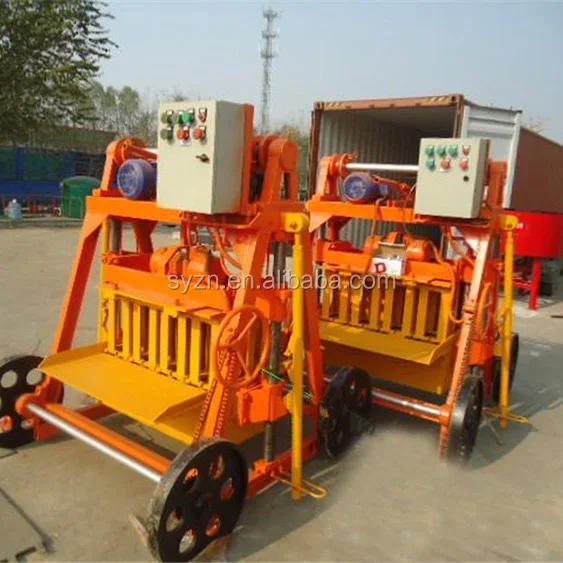
Integrated System Approach — machine, mixer, and curing workflow are specified together so the press is never left waiting for material or blocked by unhandled output.
Technical Specifications
| Parameter | Value |
|---|---|
| Model | QMJ4-45 |
| Product Type | Mobile Egg Laying Concrete Block Making Machine |
| Machine Power | 7.4 kW |
| Molding Cycle | 45 s |
| Output Capacity | 2,400 pieces / 8 hours (based on 400×200×200 mm hollow block) |
| Output Capacity (Alternative) | 3,200 pieces / 8 hours (based on 400×150×200 mm block) |
| Output Rate | 300 pcs/hour (based on 400×200×200 mm, 4 pcs/mould) |
| Output Rate (Alternative) | 400 pcs/hour (based on 400×150×200 mm, 5 pcs/mould) |
| Raw Materials | Concrete, sand, cement, fly ash, lime, gypsum |
| Machine Weight | 1 T |
| Overall Dimensions (L×W×H) | 1,550 × 1,335 × 1,580 mm |
| Pallet Requirement | None (egg-laying / mobile type) |
| Voltage | Configured to buyer’s local supply |
| Control Method | Manual force control with jog control |
| Guidance System | Four-pole orientation with ultralong orientation bearing |
| Mould Versatility | Hollow bricks, road blocks, curb stones, interlocking bricks via mould change |
| Automation Level | Semi-automatic |
Application Suitability
| Application | Material or Output |
|---|---|
| On-site housing project block production | Hollow blocks from crushed stone, sand, and cement |
| Remote rural block supply | Solid blocks and road pavers from local aggregate and fly ash |
| Small-scale first plant operation | Curb stones and interlocking bricks via mould change |
| Contractor self-supply on infrastructure sites | Hollow and solid blocks produced directly on compacted ground |
Why "Output per Hour" Tells Only Part of the Story
A mobile block machine production line is only as fast as its slowest supporting station.
Quoted cycle rates assume the mixer delivers fresh concrete every 45 seconds without interruption and that finished blocks are cleared from the laying path before the machine advances. In practice, I have seen operators lose entire mornings because a standalone mixer could not keep pace, or because the curing area was too far from the laying path and blocks were still blocking the machine’s travel route [NEED_CITE: common bottlenecks in small-scale egg-laying block operations]. The QMJ4-45 mobile block machine production line must be planned as a continuous workflow — from batching through mixing, laying, and curing — not as a standalone press with accessories added later.
Eliminating the Pallet Loop Entirely
The egg-laying design of this machine removes pallets, pallet return conveyors, and pallet storage racks from the line layout. Blocks are laid directly onto compacted ground, which means the mobile block machine production line footprint shrinks to the press itself, a mixer positioned within one shovel reach, and a clear forward path. For contractors working on active construction sites where space is contested and forklift access is limited, this simplification removes an entire material-handling subsystem that stationary lines require.
Keeping the Mixer Synchronized with the Press
A 45-second molding cycle means the mixer must deliver a usable batch within that same window. If the mixer batch size is too small, the press idles between cycles. If it is too large, concrete begins to set before it is pressed. Matching mixer drum capacity, discharge rate, and raw material feed timing to the QMJ4-45 cycle ensures the mobile block machine production line runs without the operator choosing between waiting for material and wasting it [NEED_CITE: mixer-to-press synchronization in egg-laying block lines].
Understanding the Core Specifications in Practice
The 7.4 kW total machine power reflects the vibration motor and hydraulic drive combined, which is typical for a single-mould egg-laying format. The four-pole orientation system with ultralong bearings controls the vertical travel of the pressure head and mould box, reducing lateral play that causes uneven block density and accelerated mould wear. Because the machine operates without pallets, ground preparation becomes a critical variable — the laying surface must be level and compacted to prevent block distortion during the initial set. Voltage configuration must be confirmed before production begins, since the electrical components and motor windings are built to the buyer’s specified supply standard.
The Cost of Treating Supporting Equipment as Optional
When the mixer, raw material feed, and curing layout are treated as afterthoughts rather than line components, the consequences compound. A mismatched mixer leaves the press idle for half of each shift. An unplanned curing area forces workers to hand-carry freshly laid blocks, risking edge damage before initial set. Voltage discrepancies discovered at arrival delay commissioning by weeks while replacement motors or transformers are sourced locally [NEED_CITE: voltage mismatch delays in exported construction machinery]. These are not equipment failures — they are line-design failures that a complete workflow plan prevents.
Why Source the Complete Line Here
Block machinery is our single focus, so the QMJ4-45 press, its moulds, and the supporting mixer and curing workflow are specified as one matched system. Machine configuration is set against the buyer’s actual mix design and local aggregate, not a catalogue default. Mould design covers the formats the buyer’s market sells, including custom drawings for non-standard profiles. Automation level is selectable, allowing a buyer to begin with manual batching and jog control and add semi-automatic feed later. Installation support includes operator training on the full workflow, not just the press controls.
Documentation & Verification
- Line layout with capacity calculation stated per block format
- Machine specification sheet including voltage and frequency confirmation
- Mould drawing and format list matched to buyer’s market
- Factory test record on buyer’s specified block format before dispatch
- Operation and maintenance manual covering full line workflow
- Wear parts and mould replacement list with lead times
Installation, Commissioning & Support
- Ground leveling and compaction guidance for egg-laying surface preparation
- Electrical connection verified against buyer’s confirmed voltage and frequency
- Machine assembled from shipping configuration with guidance system alignment check
- First production run supervised across full 45-second cycle with mixer synchronization
- Operator training on jog control interface and mould change procedure
- Wear parts inventory recommendation based on target block format and daily output
Moving Forward with a Line Inquiry
To scope a mobile block machine production line around the QMJ4-45, we need the block formats your market demands, the daily output target per format, and the raw materials available locally including aggregate type and gradation. Share your site voltage and frequency, the curing area dimensions you can allocate, and whether you already have a mixer or need one included in the line layout.
Frequently Asked Questions
Q: How do I verify the real daily output of the QMJ4-45 for my specific block format?
A: The stated capacity of 2,400 pieces per 8 hours is based on a 400×200×200 mm hollow block at 4 pieces per mould. If your primary product is a different format, the output per cycle and total daily figure will change. Request a capacity calculation that names your exact block dimensions and mould cavity count so you can plan labour and curing area accordingly.
Q: What supporting equipment does a mobile egg-laying line need around the press?
A: At minimum, a mixer matched to the 45-second cycle, a raw material batching setup, a level and compacted laying surface, and a defined curing zone with water access. Pallets, conveyors, and stacking systems are not required. The line layout should show where each station sits relative to the machine’s forward travel path.
Q: How do I match the mixer capacity to the press cycle time?
A: The mixer must discharge a complete batch within or slightly under the 45-second molding cycle to prevent press idling. Oversized batches risk concrete setting before pressing. Specify your mixer drum volume and discharge method so the line plan confirms batch-to-cycle alignment.
Q: What voltage and frequency options are available for my destination market?
A: The machine voltage is configured to the buyer’s local supply standard before production. Confirm your site voltage, frequency in Hz, and plug or terminal type during the inquiry stage so that electrical components and motor windings are built correctly and commissioning proceeds without delay.
Q: How long does a mould change take and what tools are needed?
A: Mould change on the QMJ4-45 involves releasing the mould box from the four-pole guidance system and swapping to the new format. Standard hand tools are sufficient. The exact changeover time depends on operator familiarity, so first-change training is included during commissioning to establish a baseline for your crew.


