
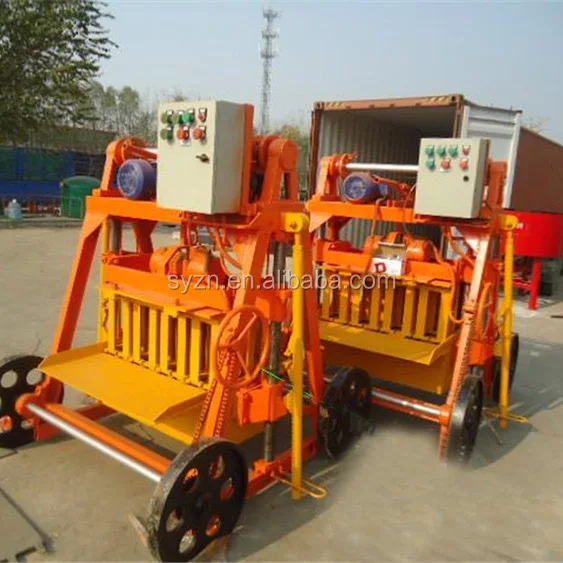
Integrated Line Matching — the QMJ4-45 mobile egg laying block machine production line is sized with mixer, feed path and curing layout calculated against its 45-second cycle, not sold as a standalone press.
Technical Specifications
| Parameter | Value |
|---|---|
| Model | QMJ4-45 |
| Product Type | Mobile Egg Laying Block Making Machine |
| Rated Power | 7.4 kW |
| Voltage & Frequency | Configured to buyer’s local supply (exact values to be confirmed before dispatch) |
| Control System | Manual force control and jog control (no PLC cabinet required) |
| Overall Dimensions (L×W×H) | 1550 × 1335 × 1580 mm |
| Net Weight | 1 T |
| Output Capacity | 2,400 pcs / 8 h based on 400×200×200 mm hollow block (4 pcs/mould); 3,200 pcs / 8 h based on 400×150×200 mm block (5 pcs/mould) |
| Cycle Time | 45 s |
| Pallet Requirement | None (egg-laying type) |
| Orientation Mechanism | Four-pole oriented with ultralong orientation bearing |
| Mould Change | Supported for multiple block formats |
| Assembly State | Fully assembled |
Application Suitability
| Application | Material or Output |
|---|---|
| On-site hollow block production for housing projects | Concrete, sand, cement, fly ash, lime, gypsum |
| Remote job-site curb stone and road block manufacturing | Crushed stone and cement mix |
| First block plant setup with low initial investment | Locally available aggregate with cement binder |
| Supplementary mobile capacity for existing fixed plants | Matching mix design from the buyer’s primary batching station |
Why the Supporting Line Matters More Than the Press Alone
A 45-second cycle rate means nothing when the mixer cannot feed the hopper fast enough.
In my years walking project sites across Southeast Asia, the most common failure with egg-laying machines is not the press itself but the stations around it. Contractors quote the QMJ4-45 cycle time, then pair it with a small pan mixer that takes two minutes per batch. The mobile egg laying block machine production line sits idle for half of every cycle, and daily tonnage falls well short of the buyer’s plan [NEED_CITE: typical mixer-press mismatch on small block sites]. The press, the mixer, the feed path and the curing area must be treated as one connected system.
Line Layout Around a Moving Press
Unlike a fixed station press where blocks travel to the operator on pallets, the QMJ4-45 travels across the curing floor. This changes how the entire mobile egg laying block machine production line must be arranged. The mixer sits at one end of the curing area, and the operator pushes or guides the machine along a defined travel route, laying blocks directly onto the prepared ground surface.
The travel route must be long enough that freshly laid blocks are not stepped on or driven over before initial set. For an output of 2,400 to 3,200 pieces per eight-hour shift depending on block format, the floor space required is substantial and must be calculated before the machine arrives.
Matching Mixer Batch Size to the 45-Second Cycle
The QMJ4-45 completes one moulding cycle every 45 seconds. At four pieces per mould for 400×200×200 mm hollow blocks, that means roughly 1.3 blocks per minute from the press. The mixer must deliver a fresh batch to the hopper at a rate that matches or slightly exceeds this draw, so the press never waits.
A pan mixer or drum mixer with a batch volume matched to three or four cycles is typically the right size. If the batch is too small, the operator spends more time feeding than pressing. If the batch is too large, the mix begins to set before it reaches the mould [NEED_CITE: concrete mix workability loss during delayed feeding]. Getting this ratio right is the difference between a line that runs and one that stalls.
Reading the Specs That Actually Matter on Site
The 7.4 kW rated power reflects a machine designed for sites where electrical supply is limited. This motor drives the vibration system that compacts the concrete mix inside the mould. On egg-laying machines, vibration force and the weight of the machine itself combine to produce block density, since there is no hydraulic pressure head pushing down from above as on a stationary press.
The four-pole orientation with ultralong orientation bearing keeps the pressure head aligned as different moulds are swapped in. When you change from a hollow block mould to a curb stone mould, the alignment must hold without re-shimming. The manual force control and jog control system means there is no PLC cabinet, no compressed-air line, and no batching station required. The line starts at the mixer and ends at the curing area.
Voltage and frequency must be confirmed against the buyer’s site supply before the machine leaves the factory. A 7.4 kW motor wound for one voltage standard will not run on another, and rewinding on site is costly and slow.
The Cost of Ignoring the Feed Path
When the raw material feed path is not planned before the machine arrives, the operator ends up wheeling barrows of mix across an uneven yard. Blocks laid on unprepared ground crack or settle unevenly. The curing area, which should be a flat and swept concrete or compacted surface, becomes a source of breakage. I have walked sites where the daily breakage rate climbed noticeably because nobody scoped the floor preparation as part of the line [NEED_CITE: floor preparation impact on egg-laying block breakage].
The QMJ4-45 eliminates pallet costs and the entire pallet return-loop conveyor system, but it replaces those with a demand for a large, flat, well-drained curing yard. That yard is part of the line, not an afterthought.
Why Buyers Source the Whole Line Here
Block machinery is the single focus of this supplier, so the QMJ4-45 is specified as part of a matched system rather than assembled from separate sources. The mixer, feed arrangement and curing layout are calculated together against the buyer’s actual target block format and local aggregate.
Configuration is set against the buyer’s mix design and site conditions, not pulled from a catalogue default. Mould design covers the formats the buyer’s market actually sells, and custom mould drawings are available for non-standard shapes. Automation level is selectable, so a buyer can start with the manual jog control on this machine and add a batching and conveyor line later.
Installation and commissioning support includes operator training on the specific mould formats and cycle sequence. Documentation is provided for every stage from factory test through to customs clearance.
Documentation & Verification
- Line layout drawing showing mixer placement, machine travel route and curing area sized to the stated output format
- Capacity calculation sheet stating the block format and cycle assumptions used for daily output figures
- Mould drawing and format list for every block type included in the buyer’s order
- Voltage and frequency confirmation document matched to buyer’s site supply before dispatch
- Factory test record run on the buyer’s specified block format before shipment
- Operation and maintenance manual covering mould change procedure and daily lubrication points
Installation, Commissioning & Support
- Level and compacted curing floor required across the full travel route, sized to the 1550 × 1335 mm machine footprint plus clearance
- Electrical supply must match confirmed voltage and frequency for the 7.4 kW motor, with a dedicated circuit breaker
- Machine ships fully assembled; site preparation limited to floor leveling and mixer placement
- First-run commissioning includes vibration timing adjustment and jog control calibration with the buyer’s actual mix
- Operator training covers mould change procedure using the four-pole orientation system and ultralong bearing alignment
- Wear parts list and mould maintenance schedule provided for the specific block formats in use
What to Include in Your Inquiry
To size the mobile egg laying block machine production line correctly, share the block formats your market sells and the daily volume you need per format. Provide your site dimensions, available curing area, and the voltage and frequency of your existing electrical supply. Let us know what mixer or batching equipment you already have on site so the feed path can be matched from the start.
Frequently Asked Questions
Q: How is the mixer batch size matched to the 45-second cycle so the press is never left waiting?
A: The mixer batch volume is calculated to deliver enough concrete for three to four pressing cycles at the stated 45-second rate. This ensures the hopper stays topped up without the mix losing workability. The exact batch size depends on the block format and mould cavity count you select.
Q: What curing area do I need for the stated output, and how does the machine travel route fit within it?
A: The curing area must be large enough to hold 2,400 to 3,200 blocks per shift depending on format, plus travel lanes for the QMJ4-45. A line layout drawing is provided showing the machine route, mixer position, and minimum floor dimensions based on your chosen block type.
Q: Which block formats can run on this machine, and how long does a mould change take?
A: The QMJ4-45 supports hollow block, solid block, road block and curb stone formats. The four-pole orientation with ultralong bearing allows mould swaps without re-shimming. Mould change time depends on the format and operator familiarity, and the procedure is covered in training.
Q: How do I confirm voltage, frequency and motor rating against my site supply before the machine ships?
A: A voltage and frequency confirmation document is issued before production, matched to your site electrical supply. The 7.4 kW motor is wound to your confirmed specification. Providing your local voltage standard and phase configuration during inquiry prevents commissioning delays on arrival.
Q: What supporting equipment completes the line, and what is left to the buyer?
A: The QMJ4-45 and its moulds are supplied as the core press. A compatible mixer, manual feed tools, water supply and curing covers complete the mobile egg laying block machine production line. The buyer prepares the curing floor and provides the electrical connection. A full supporting equipment list is included in the quotation.


