
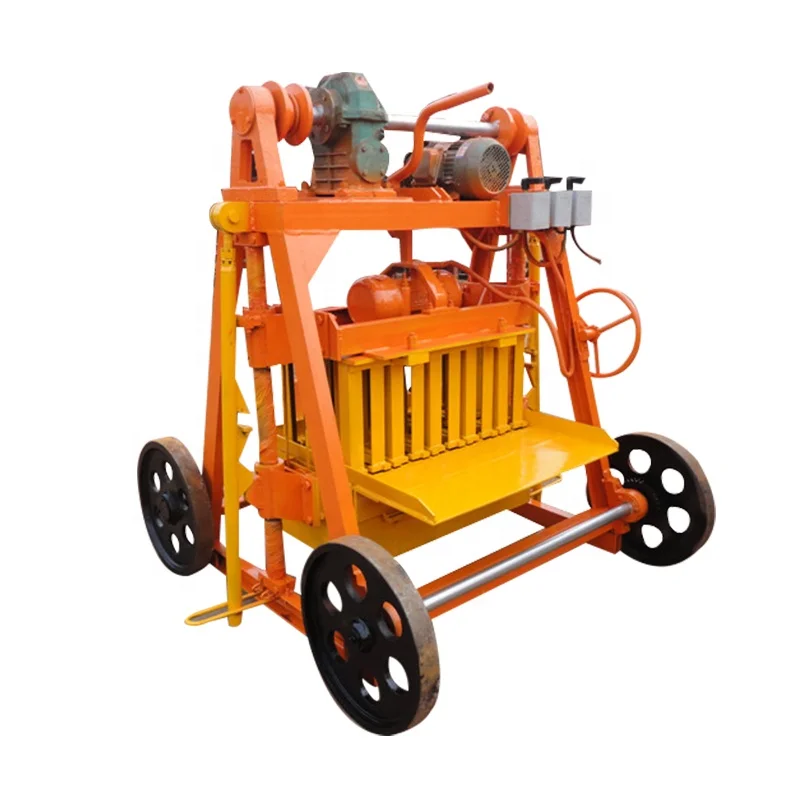
Integrated Line Matching — Every QMJ4-45 mobile block machine is configured alongside its upstream mixer and downstream curing layout so the press is never left waiting for material or blocked by output.
Technical Specifications
| Parameter | Value |
|---|---|
| Model | QMJ4-45 |
| Product Type | Manual Mobile Egg-Laying Block Making Machine |
| Molding Capacity | 4 pcs/mould (basis: 400×200×200mm hollow block) |
| Vibration Frequency | 2400 r/min |
| Vibration Method | Mould vibration (twice-vibration system) |
| Molding Cycle | 45 s |
| Demould Method | Manual |
| Turning Method | Manual |
| Total Power | 6 kW |
| Power Source | Diesel / Petrol engine |
| Automation Level | Manual (egg-laying / mobile) |
| Pallet Requirement | None (blocks laid directly on ground) |
| Hollow Block 400×200×200mm | 4 pcs/mould, 40–45 s cycle, approx. 3000 pcs/day (8 h) |
| Hollow Block 400×150×200mm | 5 pcs/mould, 40–45 s cycle, approx. 3500 pcs/day (8 h) |
| Hollow Block 400×120×200mm | 6 pcs/mould, 40–45 s cycle, approx. 4500 pcs/day (8 h) |
| Productivity | 2600–4000 pcs/day (basis not stated in source — confirm block format / material / thickness) |
| Warranty | One year |
| Certification | CE |
Application Suitability
| Application | Material or Output |
|---|---|
| On-site hollow block production for building contractors | Cement, crushed stone, sand and water mix laid directly on prepared ground |
| Small-scale cement block manufacturing startups | Local aggregate with cement binder, no fixed plant infrastructure required |
| Construction sites with existing concrete working areas | Standard hollow block formats from 120mm to 200mm wall thickness |
| Entrepreneurs establishing a first block plant on limited capital | Hollow blocks in three standard formats with minimal supporting equipment |
What a Mobile Block Machine Production Line Actually Needs Beyond the Press
A mobile press without a matched mixer and curing area is just an expensive paperweight sitting in the yard.
I have watched a QMJ4-45 sit idle for half the shift because the pan mixer upstream could not feed it fast enough. The 45-second cycle means the press is ready for a fresh batch before the previous one has finished mixing. On another site, blocks were laid straight onto uneven ground with no curing plan, and the first rain washed away half the day’s output. The machine itself worked fine — the line around it was the problem [NEED_CITE: common causes of mobile block plant underperformance].
The QMJ4-45 mobile block machine production line is only as productive as its slowest upstream or downstream station.
Sizing the Mixer to the Press Cycle
The QMJ4-45 completes a mould every 45 seconds, which translates to roughly 80 cycles in an eight-hour shift. Each cycle consumes a specific volume of wet mix depending on the block format being produced. A mixer that takes three minutes per batch will leave the press standing idle for two-thirds of its available time. Matching the mixer capacity and discharge speed to this cycle is the first calculation that determines whether the mobile block machine production line delivers what the nameplate suggests.
Ground Preparation and Curing Logistics
An egg-laying machine deposits blocks directly onto the ground, which means the production surface is also the curing surface. The area must be level, compacted and large enough to hold an entire shift’s output without forcing the operator to walk further and further from the material feed point. Planning the curing footprint before the machine arrives prevents the situation where production slows through the afternoon simply because the operator is running out of space [NEED_CITE: ground preparation standards for egg-laying block machines].
Reading the Specification Sheet Against Your Site Reality
The 2400 r/min vibration frequency and twice-vibration mould system work together to compact the mix into a denser block than a single-pass vibration unit of this class. Higher density means the block can be moved sooner without corner damage, which shortens the curing footprint requirement. The 6 kW total power rating is modest, and the diesel or petrol engine option means the machine does not depend on grid availability — a practical choice for remote construction sites where power supply is unreliable. The manual demould and manual turning keep the mechanical assembly simple, which reduces the spare parts list to wear items rather than electronic components.
When Supporting Stations Are Left Out of the Quote
A buyer who receives a quotation for the press alone often discovers that raw material storage, water metering, block transport and curing cover are additional costs that were never discussed. The result is a machine that technically works but produces well below its stated capacity because the operator spends more time shovelling material and moving blocks by hand than running the press. This gap between quoted output and actual daily production is the single most common complaint I hear from buyers who sourced a mobile unit without a line-level conversation [NEED_CITE: buyer complaints on incomplete block line quotations].
Why a Line-Level Approach Matters Here
Our configuration process starts with the block format the buyer actually sells and the daily volume the market absorbs, not a catalogue headline number. The mixer, material feed arrangement and curing layout are specified as one system around the QMJ4-45, so each station’s capacity matches the 45-second press cycle. Moulds are selected for the formats that move in the buyer’s local market, including custom drawings when standard formats do not match. Voltage and engine type are confirmed against the buyer’s actual site conditions before production begins. The factory test record covers the specific block format in the order, not a generic run.
Documentation & Verification
- Capacity calculation sheet stating daily output per block format ordered
- Machine specification sheet confirming engine type and total power
- Mould drawing and format list matching buyer’s market requirements
- Hydraulic and electrical schematic for the diesel or petrol configuration
- Factory test record on the buyer’s specified block format before dispatch
- Operation and maintenance manual covering daily start-up and mould care
Installation, Commissioning & Support
- Level compacted ground area sized to hold one full shift of egg-laid blocks
- Diesel or petrol fuel supply arranged on site matching the 6 kW engine specification
- Mixer positioned within direct discharge distance of the QMJ4-45 feed hopper
- First-run commissioning with mould alignment and vibration frequency verification
- Operator training on 45-second cycle rhythm, manual demould and manual turning
- Wear parts list covering mould liners and vibration components for initial spares stock
What We Need From You to Build a Working Line
Send us the block formats your market actually buys, the daily volume you need to sustain, and the raw materials you can source locally — including aggregate grading and cement type. Let us know whether your site has reliable grid power or whether the diesel engine option is necessary. If you already own a mixer or have an existing curing area, share those dimensions so the mobile block machine production line can be laid out around what you have.
Frequently Asked Questions
Q: How is the daily output of the QMJ4-45 calculated, and which block format does each figure assume?
A: Output depends on the block format in the mould. With a 400×200×200mm hollow block the machine produces 4 pieces per mould at a 40–45 second cycle, yielding approximately 3000 pieces in an eight-hour shift. Switching to a 400×120×200mm format increases pieces per mould to 6 and daily output to approximately 4500 pieces. Always confirm which format a quoted figure assumes.
Q: What mixer capacity and feeding arrangement keep the machine running without pauses?
A: The QMJ4-45 cycles every 45 seconds, so the mixer must discharge a full batch within that window or the press stands idle. A pan mixer sized to match one mould volume with a discharge time under 40 seconds keeps the rhythm intact. Positioning the mixer close enough for direct gravity feed or a short belt conveyor removes manual shovelling between stations.
Q: Can the QMJ4-45 run on a diesel engine, and what should the site plan for?
A: Yes, the machine is available with a diesel or petrol engine power source, which suits sites without stable grid electricity. The 6 kW total power requirement is modest. The buyer should plan for fuel storage on site and routine engine maintenance alongside the standard block machine servicing schedule covered in the operation manual.
Q: What ground preparation does an egg-laying machine require compared to a pallet-based line?
A: Because the QMJ4-45 lays blocks directly on the ground, the production area must be level, compacted and large enough to hold a full shift’s output. Unlike pallet-based lines, there is no pallet investment or pallet return system, but the curing surface is the production surface — so adequate space and ground quality are critical to maintaining output pace through the day.
Q: Which supporting stations complete the line around this mobile press?
A: A complete mobile block machine production line around the QMJ4-45 includes raw material storage with proportioned feeding, a mixer matched to the 45-second cycle, a water supply with metering, and a prepared curing area. Pallet feeding and stacking stations are not required since blocks are egg-laid, which keeps the supporting equipment list short and the capital requirement low.


