
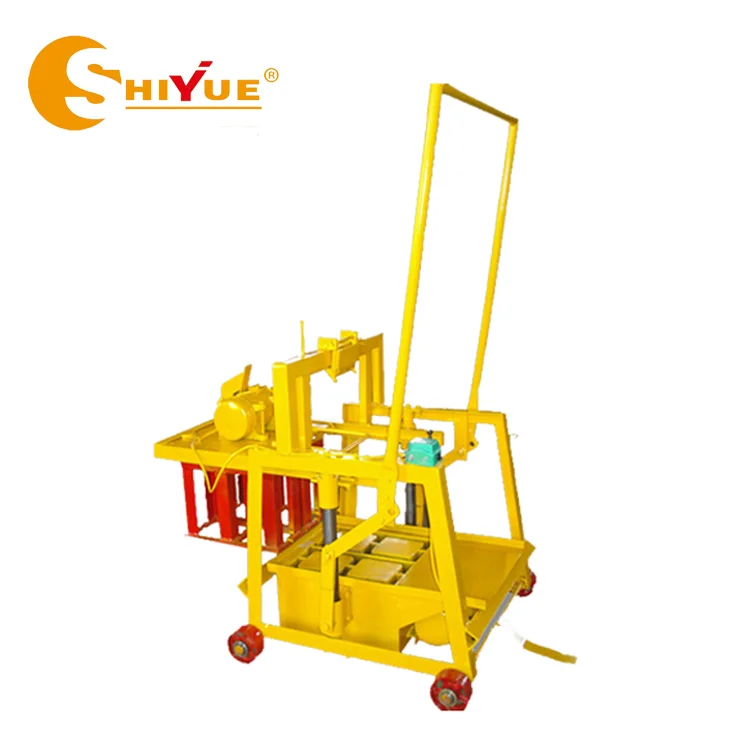
Palletless operation — The QMJ2-45 lays blocks directly on the ground, removing the need for a pallet return loop and freeing up curing space for the rest of the line.
Technical Specifications
| Parameter | Value |
|---|---|
| Model | QMJ2-45 |
| Product Type | Manual mobile egg-laying block machine |
| Machine Type | Palletless / egg-laying mobile block making machine |
| Mould Format | Hollow brick (interchangeable moulds) |
| Mould Change Method | Manual replacement of the mould box |
| Pallet Requirement | None (palletless) |
| Labor Requirement | 1 to 3 workers |
| Molding Cycle | 25–30 seconds |
| Capacity – 400×200×200mm | ~160 pcs/h, ~1,280 pcs/8hr (based on 2 pcs/mould and 25–30s cycle) |
| Capacity – 400×150×200mm | ~240 pcs/h (basis to be confirmed) |
| Capacity – 400×100×200mm | ~320 pcs/h, ~2,560 pcs/8hr (based on 4 pcs/mould and 25–30s cycle) |
| Automation Level | Manual |
| Power Source | Motor-driven (rated power to be confirmed) |
| Overall Dimensions | Compact footprint for small-space operation |
Application Suitability
| Application | Material or Output |
|---|---|
| On-site contractor production | Hollow bricks from crushed stone, sand, and cement |
| Remote housing projects | 400×200, 400×150, and 400×100mm hollow block formats |
| First-time block plant entry | Small-volume hollow brick runs with minimal infrastructure |
| Supplementary site production | Additional hollow brick output where a fixed plant is not viable |
What the Molding Cycle Actually Means for Your Line
A 25–30 second cycle only holds if the mixer and material feed keep pace.
Buyers often quote the press cycle as if it runs in isolation. In practice, a mobile block making machine production line stalls when the upstream mixer cannot deliver fresh batch to the hopper in time, or when workers are still clearing the previous block from the laying path. The press sits idle, and the headline capacity number becomes irrelevant. The real output depends on whether every station in the portable egg-laying block machine supporting equipment chain is timed to the same cycle [NEED_CITE: production line cycle synchronization for block plants].
How the Press Fits Into the Material Flow
The QMJ2-45 sits at the center of a line that starts with raw material feeding and mixing. The mixer must discharge a consistent batch within the 25–30 second window so the press operator never waits. When the upstream station falls behind, the mobile block making machine production line loses its rhythm and daily output drops accordingly. Sizing the mixer to match the press demand is the first layout decision.
Where Curing Area and Handling Connect Downstream
Because this machine lays blocks directly on the ground, the curing zone extends from wherever the press is currently working. Workers need clear access to mark off cured sections and move fresh blocks into protected areas. The downstream handling requirement is lighter than a pallet-based line — no pallet return conveyor, no rack loading — but the curing footprint still needs to be planned so that the press path does not cross wet blocks [NEED_CITE: curing area layout for egg-laying block production].
What the Molding Cycle Tells You About Block Density
The 25–30 second cycle across all three hollow brick formats reflects the vibration and compaction time built into each stroke. Longer cycles generally allow more complete consolidation of the mix, which matters when local aggregate is angular or poorly graded. The manual operation means the operator controls when each cycle starts, so consistency depends on maintaining a steady rhythm rather than relying on a PLC timer. Mould interchangeability across 400×200, 400×150, and 400×100mm formats gives flexibility, but each change requires manual alignment and a test run to confirm block dimensions before full production resumes.
The Cost of Skipping Line Layout Before Ordering
When a buyer orders the press without mapping the material flow, the mixer output rarely matches the press appetite. I have seen mobile block machines of this class spend half a shift waiting for material because the batching station was sized for a smaller unit. The result is not a machine fault — it is a line design gap that surfaces only after the equipment arrives on site [NEED_CITE: common causes of idle time in small block plants].
Why This Is Where the Line Gets Specified
Block machinery is the single focus here, which means the QMJ2-45 is not sold as a standalone press but positioned within a line where mixing, laying, and curing are calculated together. The configuration is set against the buyer’s actual mix design and local aggregate rather than a catalogue default. Mould design covers the formats the buyer’s market sells, with custom drawings available. The automation level is selectable, so a buyer can start with manual mobile operation and add semi-automatic pallet-based stations later as the plant grows.
Documentation & Verification
- Line layout showing mixer-to-press material flow and curing area allocation
- Capacity calculation per hollow brick format with molding cycle stated
- Mould drawing and format list for 400×200, 400×150, and 400×100mm blocks
- Voltage and power source confirmation sheet before dispatch
- Operation manual covering mould change procedure and cycle rhythm
Installation, Commissioning & Support
- Ground surface must be level and firm for palletless egg-laying operation
- Power connection requires confirmed voltage and frequency matching the motor rating
- Machine arrives assembled; operator positions it on the production ground
- First production run verifies molding cycle and block dimensions per mould
- Manual mould change training covers alignment and test block procedure
- Wear parts list supplied with initial mould and recommended replacement intervals
What to Include in Your Inquiry
Provide the hollow brick format your market requires and the daily output target so the line can be sized from mixer through curing area. Confirm the local voltage and frequency available on site, along with the raw materials and aggregate you plan to use. If you already have a mixer or plan to add one later, include its batch capacity so the material flow matches the press cycle.
Frequently Asked Questions
Q: How do I verify the daily output for each hollow brick format?
A: Daily output depends on the molding cycle and the number of blocks per mould. For the 400×200×200mm format, the QMJ2-45 produces 2 blocks per cycle at 25–30 seconds, yielding approximately 160 pieces per hour. Request the capacity calculation that states the assumed cycle time and block format so you can compare against your production target.
Q: What mixer capacity do I need to keep the press running without idle time?
A: The mixer must discharge a full batch within the 25–30 second molding cycle. If the mixer takes longer, the press waits and output drops. Share your target daily volume so the upstream mixing station can be matched to the press demand in the line layout.
Q: Can I run this machine on a site with limited or no grid electricity?
A: The QMJ2-45 is motor-driven, and the power source must be confirmed before dispatch. Voltage and frequency options depend on the motor configuration available. Specify your site power conditions — grid supply, generator capacity, or solar — so the correct electrical setup is selected.
Q: How does the line grow from a single mobile press to a larger setup?
A: The QMJ2-45 serves as a compact entry point. As volume grows, buyers can add pallet-based semi-automatic stations with automatic stacking and curing rack handling alongside the mobile press. The line layout can be expanded in stages without replacing the original machine.
Q: Are moulds available for hollow brick formats beyond the three listed?
A: Custom mould design is available to buyer drawings. If your market requires a format outside the standard 400×200, 400×150, and 400×100mm range, provide the block dimensions and wall thickness so a mould drawing can be prepared and lead time confirmed.


