
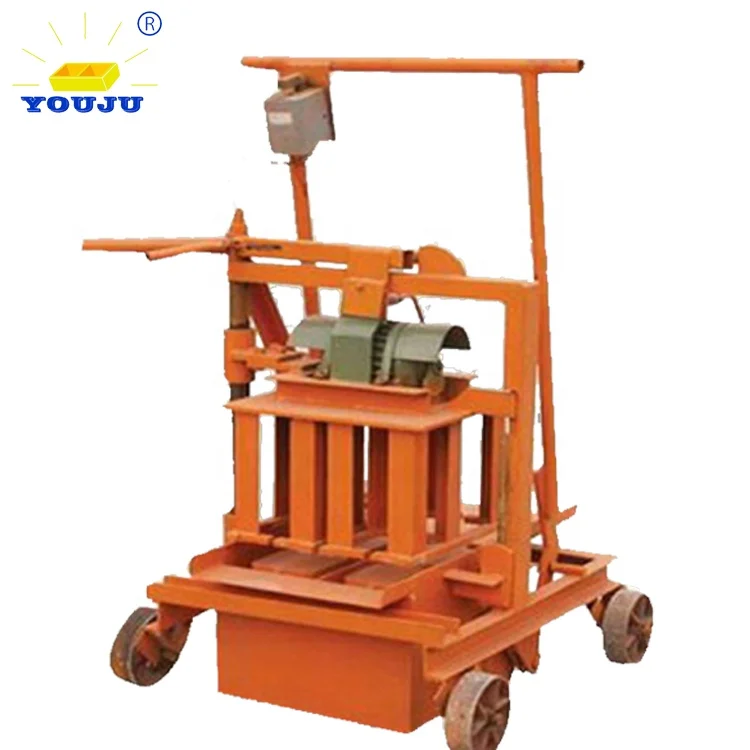
Integrated Line Design — the QMJ2-45 mobile egg-laying machine is specified together with upstream feeding, mixing and downstream curing handling as one matched system rather than a standalone press.
Technical Specifications
| Parameter | Value |
|---|---|
| Product Type | Mobile Egg-Laying Block Making Machine |
| Model | QMJ2-45 |
| Machine Operation | Manual mobile egg-laying (palletless) |
| Mould Change | Interchangeable moulds for different hollow brick formats |
| Pallet Requirement | None — egg-laying operation directly on ground |
| Power Source | Electric motor |
| Labor Requirement | 1 to 3 workers |
| Cycle Time | 25–30 seconds per mould (basis not stated in source — confirm block format, material and wall thickness) |
| Output Capacity | 2 pcs per mould for 400×200×200 mm hollow brick (basis to be confirmed); 3 pcs per mould for 400×150×200 mm hollow brick (basis to be confirmed); 4 pcs per mould for 400×100×200 mm hollow brick (basis to be confirmed) |
| Mobility | Hand-pushed, free movement on prepared ground |
| Space Requirement | Small footprint, usable in confined site areas |
| Voltage & Frequency | To be confirmed against buyer site supply before ordering |
| Control System | To be confirmed |
| Certification | ISO 9001:2000, CE (verify against manufacturer catalog) |
Application Suitability
| Application | Material or Output |
|---|---|
| On-site hollow brick production for construction contractors | Crushed stone, sand, cement and water mixed locally |
| Small-scale block plant for entrepreneurs and first-time producers | Hollow bricks in 400×200×200 mm, 400×150×200 mm and 400×100×200 mm formats |
| Remote or temporary project locations without fixed infrastructure | Palletless egg-laying production directly on levelled ground |
| Housing project contractors producing blocks locally | Variable hollow brick formats via interchangeable moulds |
What the Line Around the Press Actually Looks Like
A mobile block machine is only as productive as the stations feeding it and the curing area receiving its output.
Buyers often receive a quotation for the press alone and assume the rest of the mobile block machine production line supporting equipment will sort itself out on site. In practice, I have watched machines sit idle for half a cycle because the mixer batch was not ready, or see freshly laid blocks damaged by workers carrying them before initial set. The gap between quoted capacity and actual daily output almost always lives in these upstream and downstream gaps, not in the press itself. [NEED_CITE: typical output shortfall causes in small-scale block production]
Matching the Mixer Batch Window to a 25–30 Second Mould Cycle
Every mould drop on the QMJ2-45 demands a fresh batch of concrete within roughly half a minute. The upstream mixer must therefore discharge a usable volume in well under that window, and the material feed station — whether a manual wheelbarrow route or a small belt conveyor — must replenish the mixer before the next batch call. When the mobile block machine production line supporting equipment is laid out with this rhythm in mind, the press never waits. When it is not, cycle time stretches from seconds into minutes and daily output collapses.
Designing the Curing Area Around a Palletless Machine
Because the QMJ2-45 lays blocks directly on the ground, there is no pallet return loop to plan — but there is also no pallet to carry the block to a rack. The curing area must therefore begin exactly where the machine travels. I mark out a levelled, swept production path and a curing zone that branches off it, with enough linear metres for the day’s output to reach initial set before anyone walks on it. [NEED_CITE: minimum curing time before block handling for cement-based hollow bricks] Getting this layout wrong means broken edges, wasted material and a site that looks productive but ships very little.
Reading the Specs That Actually Matter on Site
The electric motor specification and the voltage and frequency confirmation are the two items I check before anything else, because a motor wired for the wrong supply will burn out on the first shift and delay the entire project. The interchangeable mould system defines which hollow brick formats the line can produce, but the changeover procedure must be rehearsed with the crew so that a format switch does not consume most of a morning. The hand-pushed mobility means the production path must be firm and level — soft ground causes the machine to settle unevenly, producing blocks with inconsistent wall thickness. Labour allocation of 1 to 3 workers covers the press itself; the total line headcount depends on how the material feed and curing handling are organised around it.
When Stations Are Specified Separately
I have arrived on sites where the mixer was oversized, the curing area was an afterthought and the mobile block machine production line supporting equipment was never discussed before shipment. The result is a press that produces perfectly formed blocks at a fraction of its possible rate because concrete arrives too slowly and cured blocks are stacked by hand in a space that was never planned. The cost of these mismatches shows up not in the equipment invoice but in missed project deadlines and rework. [NEED_CITE: hidden cost of unmatched line stations in block production]
Why Specify the Whole Line from One Source
The QMJ2-45 and its surrounding stations are configured against the buyer’s actual mix design and local aggregate, not a catalogue default. Line layout drawings show how feeding, mixing and curing handling connect, with capacity calculated per block format. Voltage, frequency and motor specification are confirmed for every station before production starts. Mould options are selected for the formats the buyer’s market actually sells. Installation support includes the complete line, not the press alone, with operator training covering material flow and curing area management.
Documentation & Verification
- Line layout drawing showing feeding, mixing and curing stations connected to the QMJ2-45
- Capacity calculation stating the hollow brick format assumed for each output figure
- Voltage and frequency confirmation sheet covering every motor in the line
- Mould drawing and format list matching the buyer’s market requirements
- Factory test record on the buyer’s specified block format before dispatch
- Operation and maintenance manual covering the press and all supporting stations
Installation, Commissioning & Support
- Ground preparation guidance specifying the level and compaction needed for hand-pushed travel
- Electrical supply requirements confirmed for the QMJ2-45 motor and mixer before shipment
- Arrival condition and on-site assembly steps for the press and supporting stations
- First-run commissioning covering cycle timing between mixer discharge and mould drop
- Operator training on mould change procedure and curing area block spacing
- Wear parts list identifying items most likely to need replacement in the first operating months
What We Need to Configure Your Line
Tell us which hollow brick formats your market requires, the daily output you need to hit and the local aggregate and cement you plan to use. Share your site voltage, frequency and the space available for the production path and curing area. If you already have a mixer or material handling setup on site, let us know the model and capacity so we can confirm whether it fits the rhythm of the mobile block machine production line supporting equipment or needs to be adjusted.
Frequently Asked Questions
Q: How do upstream mixing and material feeding stations need to be timed to match the QMJ2-45’s cycle?
A: Each mould cycle requires a fresh concrete batch within the 25–30 second window. The mixer must discharge and the feed station must replenish within that interval. We specify mixer batch size and feed method — whether manual or conveyor — so the press never waits between cycles.
Q: Since the QMJ2-45 uses no pallets, what does the curing and handling area need to look like?
A: Blocks are laid directly on levelled ground, so the curing zone starts where the machine travels. We provide a layout drawing showing the production path, branching curing rows and the minimum spacing required for initial set before handling.
Q: What is the total line footprint when mixer, material storage and curing area are included?
A: The QMJ2-45 itself has a small footprint, but the complete line includes material storage, mixing, the production travel path and a curing zone sized for daily output. We calculate the total area based on your target format and volume.
Q: How do I confirm voltage and frequency for all stations in the line before shipment?
A: We supply a confirmation sheet listing the motor specification for the QMJ2-45, the mixer and any feed equipment. You verify these against your site supply and we lock the specifications before production begins.


