
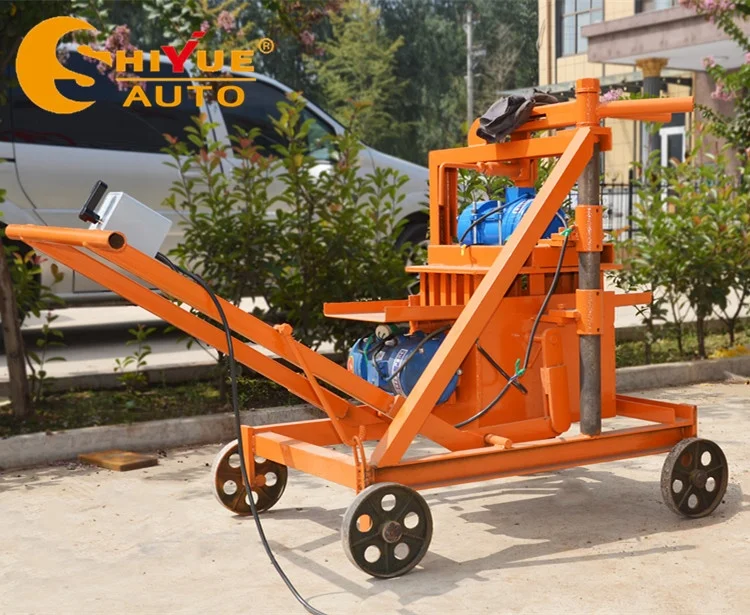
Single-focus block line engineering — every QMJ2-45 deployment is planned around your actual site conditions, including mixing workflow, curing footprint, and manual handling paths rather than shipped as a standalone press.
Technical Specifications
| Parameter | Value |
|---|---|
| Model | QMJ2-45 |
| Product Type | Manual Mobile Concrete Block Making Machine |
| Automation Level | Manual operation, no PLC |
| Machine Type | Mobile / Egg-laying |
| Pallet Requirement | No pallets required |
| Power Source | Diesel engine |
| Labor Requirement | 1 to 3 workers |
| Mould Options | Interchangeable moulds for hollow brick formats |
| Cycle Time | 25–30 seconds per mould |
| Output Capacity (400×200×200 mm hollow brick) | 2 pcs/mould, approx. 160 pcs/h, approx. 1280 pcs/8 hr |
| Output Capacity (400×150×200 mm hollow brick) | 3 pcs/mould, approx. 240 pcs/h (basis not stated in source) |
| Output Capacity (400×100×200 mm hollow brick) | 4 pcs/mould, approx. 320 pcs/h (basis not stated in source) |
| Voltage & Frequency | Not stated — confirm before commissioning |
| Overall Dimensions | Not stated — verify against manufacturer catalog |
| Net Weight | Not stated — verify against manufacturer catalog |
| Hydraulic Pressure | Not applicable (manual machine) |
| Certification | Not stated — verify before shipment |
Application Suitability
| Application | Material or Output |
|---|---|
| On-site hollow block production at housing projects | Crushed stone, sand, cement, water mixed on-site |
| Small-scale block manufacturing without fixed plant | Local aggregate blended with Portland cement |
| Project-based production at remote construction sites | Engine-powered operation independent of grid electricity |
| First-time block plant startups with minimal capital | Basic cement-aggregate mix designs for hollow bricks |
| Contractor self-supply at infrastructure developments | Multiple hollow brick formats from interchangeable moulds |
What "Pieces per Hour" Ignores on a Mobile Site
Realistic daily output depends more on your curing area layout and material feeding rhythm than on the cycle time stamped on the nameplate.
I have watched buyers receive a mobile block machine, start production, then realize their curing ground was half the size needed for a full shift’s output. Blocks stacked on top of each other before initial set, strength compromised, entire batches scrapped. The cycle time tells you what the press can do. It says nothing about how fast your mixer can feed material, how far the machine must travel between laying positions, or whether your ground is level enough to prevent fresh blocks from slumping. [NEED_CITE: on-site curing area sizing for mobile block production]
When we plan a mobile block machine production line, we start from the curing area and work backwards to the mixer.
Designing the Line Around the Press, Not the Other Way Around
A mobile block machine production line has no conveyor belts and no automatic stackers, which means every supporting station must be planned around human pace and site geometry. The mixer must sit close enough that workers can wheel barrows or use a small hopper to feed the QMJ2-45 without the press standing idle. If the mixer is too far, your 25–30 second cycle time means nothing because the operator is waiting for the next batch. We map the travel path, the turning radius, and the feed point before we confirm the line layout.
Curing Area Planning That Matches Daily Output
Each hollow brick laid on the ground occupies space until it gains enough initial strength to be moved or stacked. For the QMJ2-45 producing 400×200×200 mm blocks, a single shift lays down over a thousand units in a spread pattern. The curing area must be compacted, level, and large enough to hold at least one full shift’s production plus a buffer for the next morning before yesterday’s blocks are cleared to the stacking yard. Ground preparation is part of the line, not an afterthought. [NEED_CITE: minimum curing ground preparation standards for egg-laying block machines]
Reading the Specifications That Actually Matter
The diesel engine specification determines whether the machine can run continuously without overheating in your climate — ambient temperature and altitude both affect engine performance, and a unit rated for temperate conditions may derate noticeably in tropical or high-elevation sites. The interchangeable mould system defines which hollow brick formats you can produce, and the physical mould change process determines how much of your shift is lost when switching from 200 mm to 100 mm width. The manual operation means no PLC, no sensors, and no automated fault detection — every process adjustment is made by the operator based on visual and tactile feedback from the fresh mix. This makes mix consistency critical: if your aggregate moisture content shifts between morning and afternoon, the operator must recognize the change and adjust water addition by hand.
What Happens When the Line Stations Are Mismatched
I have seen contractors buy a mobile machine, run it for two weeks, and then discover that their hand-mixed material could not keep the press fed continuously. The machine sat idle for half of every hour while workers mixed the next batch by shovel. The daily output dropped to a fraction of the quoted capacity, not because the machine was slow, but because the feeding station was never planned. Other buyers skip ground compaction, and the egg-laying blocks settle unevenly, creating dimension variation that fails inspection. [NEED_CITE: common causes of output shortfall in mobile block production] These are not machine defects. They are line planning failures.
Why Buyers Plan the Full Line With Us
Block machinery is our single focus, so the QMJ2-45 is never quoted as a standalone press — we configure the mixer type, feeding method, curing area dimensions, and handling workflow as one matched system. We calculate capacity against the exact hollow brick format you intend to produce, not a catalogue default, and state the assumptions clearly. Mould design covers the formats your local market actually buys, with custom drawings available if your specification falls outside the standard range. We confirm voltage-free operation through the engine specification sheet so there are no commissioning surprises. Installation support includes line layout guidance covering mixer placement, machine travel paths, and curing zone preparation.
Documentation & Verification
- Line layout drawing showing mixer placement, machine travel path, and curing area dimensions for your chosen hollow brick format
- Capacity calculation stating the exact block format and daily output assumptions including mould change frequency
- Mould drawing and format list confirming included and optional hollow brick sizes
- Engine specification sheet with power rating, fuel consumption, and maintenance intervals
- Operation manual covering mix consistency checks and manual mould change procedures
- Packing photographs and customs documentation support for shipment
Installation, Commissioning & Support
- Curing ground must be compacted and level across an area sized for one full shift of QMJ2-45 output before first production run
- Diesel engine fuel supply and spare filter stock confirmed at site prior to commissioning
- Mixer positioned within barrow or hopper reach of the QMJ2-45 feed point to prevent press idle time
- Mould change practiced with operator until format switch completes within a reasonable portion of the shift
- Engine maintenance schedule posted at site covering oil change intervals and air filter cleaning frequency
- Wear parts list provided covering mould liners and vibration components specific to the QMJ2-45
Before You Request a Quote
Send us your target hollow brick format and daily volume requirement so we can calculate curing area dimensions and line staffing. Confirm your local aggregate type and whether you have access to a mechanical mixer or plan to hand-mix. Let us know your project site conditions including ground type, ambient temperature range, and whether grid electricity is available for any supporting equipment.
Frequently Asked Questions
Q: How is realistic daily output calculated when the machine moves across the site?
A: We base the calculation on your chosen hollow brick format, the cycle time per mould, and subtract time for mould changes, material feeding gaps, and machine repositioning. Curing area availability acts as the ceiling — if the ground is full, the machine stops regardless of its mechanical capacity. We provide a written capacity statement showing these assumptions.
Q: What mixing setup keeps the QMJ2-45 continuously supplied?
A: A small pan mixer or drum mixer positioned within wheelbarrow distance of the machine feed point works for most sites. Hand mixing is possible but will reduce daily output since the press waits between batches. We recommend sizing the mixer batch volume to match one or two mould cycles so material flows without interruption.
Q: How large must the curing area be, and what ground preparation is needed?
A: The curing ground must hold at least one full shift of laid blocks before they can be moved to stacking. The surface needs compaction and leveling so freshly laid blocks do not settle unevenly. We calculate the required square meterage based on your chosen block format and daily target, then include this in the line layout drawing.
Q: Can this machine be upgraded to a fixed-plant line later?
A: The QMJ2-45 is designed as a standalone mobile unit. When your volume grows, the transition path typically involves moving to a pallet-based semi-automatic or automatic line with fixed stations. We plan automation levels that allow buyers to start mobile and scale up, with mould formats carrying over where compatible.
Q: What engine maintenance should we plan for at the project site?
A: Diesel engine maintenance follows standard intervals for oil changes, air filter cleaning, and fuel filter replacement. We supply the engine specification sheet with recommended schedules and advise stocking critical consumables at site since remote locations may lack immediate parts availability. Spare mould liners and vibration wear parts should also be ordered with the initial shipment.


