
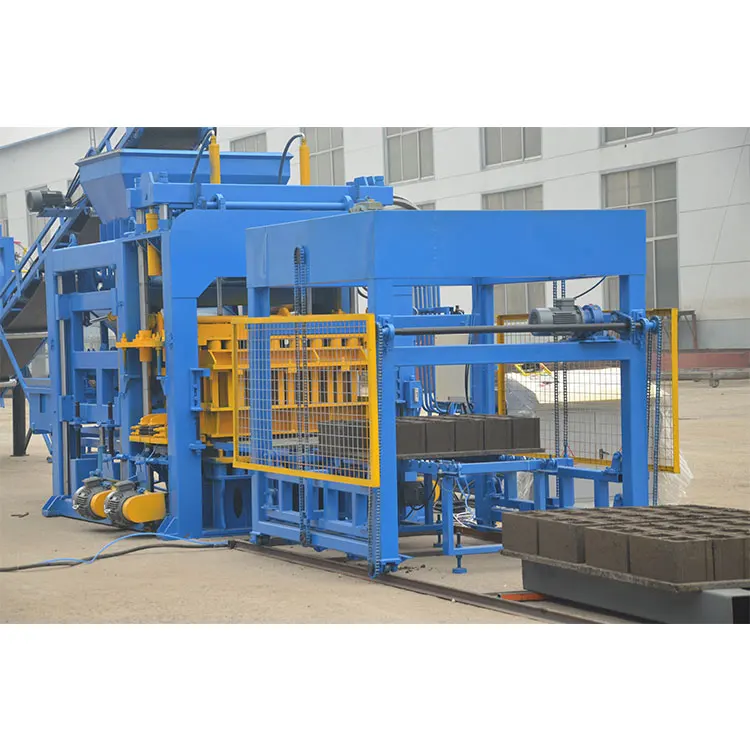
Integrated Line Engineering — The QT12-15 block making machine production line treats the press, mixer, pallet feeder, and stacker as one synchronized system, matching every station’s cycle to the 15–25 second press window so throughput stays continuous from batching to curing.
Technical Specifications
| Parameter | Value |
|---|---|
| Model | QT12-15 |
| Product Type | Automatic Concrete Block Making Machine |
| Overall Size | 9350 × 2520 × 2950 mm |
| Rated Pressure | 21 MPa |
| Main Vibration Form | Platform Vibration |
| Vibration Frequency | 2800–4500 r/min |
| Vibration Acceleration | 15–20 g |
| Exciting Force | 120 kN |
| Fixed Brick Height | 50–200 mm |
| Pallet Size | 1350 × 850 mm |
| Molding Cycle | 15–25 s |
| Storage Hopper Volume | 0.4 m³ |
| Feeding Device Volume | 0.31 m³ |
| Total Power | 50.7 kW |
| Total Weight | 12000 kg |
| Control System | PLC controlled (mechanical hydraulic synthesis) |
| Structure | Gantry frame type, super steel |
| Mould Material | Manganese steel, carburizing and quenching (cartridge type welding) |
| Output Capacity (Hollow block 390×190×190mm) | 13700–17200 pcs/day (8h) |
| Output Capacity (Porous block 240×115×90mm) | 40300–50400 pcs/day (8h) |
| Output Capacity (Standard block 240×115×53mm) | 105000–119000 pcs/day (8h) |
| Voltage & Frequency | basis not stated in source — confirm with buyer site conditions |
| PLC Language Options | basis not stated in source — confirm with buyer preference |
Application Suitability
| Application | Material or Output |
|---|---|
| Hollow block production | Crushed stone, cement, and sand aggregate blends |
| Porous block production | Lightweight aggregate mixes with cement binder |
| Standard solid block production | Dense concrete from local gravel and Portland cement |
| Interlock brick production | Interlocking profile moulds with standard concrete mix |
| Paving block production | High-density mix with fine aggregate for surface finish |
| Fly ash block production | Fly ash, lime, and cement composite blends |
What the Press Cycle Time Does Not Tell You About Your Daily Output
The QT12-15 press completes a mold in 15–25 seconds, but real daily throughput depends entirely on whether pallet feeding, stacking, and curing stations keep pace.
Buyers often evaluate a block machine by its molding cycle alone. I once planned a line where the press could cycle faster than the upstream mixer could deliver a batch, and the stacker could not clear finished pallets quickly enough. The press sat idle while workers hand-stacked blocks at the end of the conveyor. A QT12-15 block making machine production line avoids this by sizing every upstream and downstream station against the press cycle, not the other way around. [NEED_CITE: impact of line synchronization on block plant throughput]
Synchronizing the Mixer and Batching Station with the Press Cycle
The QT12-15 holds 0.4 m³ in its storage hopper and draws 0.31 m³ per feed cycle. If the batching and mixing station cannot replenish the hopper within each 15–25 second molding window, the press pauses. A properly configured QT12-15 block making machine production line pairs the press with a mixer whose batch volume and discharge rate match the hopper draw-down, keeping the material column full throughout the shift without overstocking above the press.
Pallet Flow and Stacking as the Downstream Constraint
Each press cycle produces one pallet of blocks. At 15–25 seconds per cycle, the line generates a substantial volume of finished pallets over an eight-hour shift. The pallet feeder must deliver empty pallets at a rate equal to or greater than the press output, while the stacker must clear cured pallets from the conveyor before they queue back to the press station. In the lines I have configured, specifying the pallet size at 1350 × 850 mm early ensures that the curing rack dimensions and forklift capacity align with the handling equipment from day one. [NEED_CITE: pallet handling bottlenecks in concrete block plants]
Reading the Key Specs for Line Planning
The 21 MPa rated pressure combined with 120 kN exciting force defines the compaction density the QT12-15 can achieve. Higher vibration acceleration (15–20 g) drives tighter particle packing, which is critical when producing hollow blocks at 390×190×190 mm where wall thickness demands consistent density. The platform vibration form distributes force across the full 1350 × 850 mm pallet area, meaning blocks at the pallet edges receive the same compaction as those in the center. For buyers producing paving blocks where surface uniformity matters, this full-pallet vibration pattern reduces scrap from edge weakness. The gantry frame in super steel provides the mass and rigidity needed to absorb repeated vibration cycles without resonance drift over long production runs.
The Hidden Cost of Ignoring Line Coordination
When supporting equipment is quoted separately or left to the buyer to source, the line typically develops a single slow station that governs overall output. I have seen plants where a high-speed press was paired with an undersized mixer, and the daily production fell far short of the quoted capacity because the press waited for material. Mould changeovers on an uncoordinated line take longer when handling equipment was never designed for the pallet dimensions in use. Voltage mismatches between the press PLC and the batching controller can prevent communication, delaying commissioning for weeks after arrival. [NEED_CITE: equipment mismatch consequences in block production lines]
Why This Line Is Configured as One System
Block machinery is our single focus, so the QT12-15 press, moulds, pallets, and handling equipment are specified together rather than assembled from separate suppliers. Configuration is set against the buyer’s actual mix design, local aggregate, and target block format, not a catalogue default. Mould design covers the formats the buyer’s market actually sells, including custom drawings. The automation level is selectable, so a plant can start with semi-automatic pallet handling and add automatic stacking later. Installation support includes line layout with capacity calculation stated per block format, operator training, and ongoing mould and wear parts supply.
Documentation & Verification
- Line layout drawing showing station spacing matched to the 15–25 s QT12-15 cycle time
- Capacity calculation per block format with pallet feeding and stacking rates included
- Voltage and PLC display language confirmation sheet before production begins
- Hydraulic and electrical schematic showing press interface with batching and handling stations
- Factory test record on the buyer’s specified block format before dispatch
Installation, Commissioning & Support
- Foundation plan reflecting 12000 kg total weight and gantry frame footprint for the QT12-15
- Power supply specification for 50.7 kW total draw with dedicated circuit requirements
- Pallet size 1350 × 850 mm confirmed against existing curing racks and forklift capacity
- PLC language and voltage set per site conditions before the QT12-15 ships from factory
- Operator training covering mould change procedure and daily maintenance schedule
- Wear parts and mould inventory list provided with recommended reorder intervals
What to Include with Your Inquiry
To configure a QT12-15 block making machine production line that matches your actual production conditions, we need your target block format and daily volume, the aggregate materials available at your site, and your workshop dimensions including ceiling height. Include your local voltage and frequency, preferred PLC display language, and whether existing upstream or downstream equipment will be retained.
Frequently Asked Questions
Q: How is daily output verified when the whole line is considered?
A: The capacity calculation covers each station — batching, mixing, pallet feeding, pressing, stacking, and curing — not just the press cycle. Each station is sized so its throughput matches or exceeds the QT12-15 molding rate for the specific block format you produce, giving a realistic daily figure based on an eight-hour shift.
Q: Do pallet feeding and stacking stations match the QT12-15 cycle time?
A: Yes. The pallet feeder and stacker are selected so their cycle times equal or beat the 15–25 second press window. If the stacker clears pallets slower than the press produces them, finished blocks queue on the conveyor and the press eventually idles, so station timing is verified during line layout planning.
Q: What supporting equipment is included in the line quotation?
A: The quotation covers raw material feeding, mixing, pallet feeding, the QT12-15 press, automatic stacking, and curing rack handling as applicable. Each item is listed with its cycle time and capacity so the buyer can see how every station connects to the next without gaps or bottlenecks.
Q: How are voltage, frequency, and PLC language coordinated across stations?
A: All line stations — the press, batching controller, and handling equipment — are specified to the same voltage and frequency before production. The PLC display language is confirmed with the buyer so operators at every station read instructions in their working language from the first day of commissioning.
Q: Can the line be expanded with automatic cubing later?
A: The QT12-15 line layout reserves physical space and electrical capacity for future additions like automatic cubing or upgraded curing rack handling. Buyers starting with semi-automatic pallet handling can add these stations as production volume grows without replacing the press or redesigning the line.


